

Beyond the Surface Unveiling South Florida’s Driveway Duality
Why Your Driveway Choice Defines Your Home in the South Florida Climate
A driveway functions as far more than a simple parking pad beneath the relentless Florida sun. It establishes the first visual conversation your property has with every visitor and passerby. In a region defined by intense humidity, seasonal downpours, and the constant threat of tropical storms, the material you select shapes your daily life. The wrong surface can crack, fade, or turn into an unbearable heat island under bare feet. Meanwhile, the right selection elevates curb appeal while quietly managing stormwater runoff and resisting structural fatigue. Homeowners undertaking a South Florida driveway materials comparison quickly learn that the climate itself becomes the strictest quality inspector.
This decision also influences long-term maintenance demands and resale positioning in competitive coastal markets. A surface that looks stunning for two years but demands constant sealing will drain your time and budget. Conversely, a material that flexes with the soil’s thermal expansion preserves both its beauty and your sanity. Many residents initially underestimate how deeply subgrade preparation, aggregate base depth, and drainage engineering affect the final outcome. Working with a knowledgeable contractor in South Florida ensures these hidden layers receive the attention they deserve. The driveway truly becomes the foundation of your home’s exterior experience, blending art with environmental resilience.
The Aesthetic and Functional Crossroads for Delray Beach and Boca Raton Homes
Neighborhoods from Delray Beach to Boca Raton showcase an architectural tapestry that demands thoughtful material integration. Mediterranean estates, mid-century modern gems, and sleek coastal contemporaries all require driveway solutions that respect their design language. Pavers offer a spectrum of color blends, shapes, and laying patterns that can mirror Old World cobblestone or achieve razor-sharp contemporary lines. Concrete, especially when stamped or stained, can convincingly emulate natural stone, brick, or even wood plank textures. Yet the visual promise must also reconcile with the functional reality of South Florida’s sudden afternoon thunderstorms. That picturesque slope must channel water away from the foundation without pooling or eroding the landscape.
The crossroads deepens when you weigh immediate budget against decades of performance cycles. An entry-level concrete slab might seem perfectly adequate until the first hairline fissure appears after an especially hot summer. A premium travertine paver installation can feel extravagant at the outset yet pay dividends in future repair avoidance. Local design review boards and homeowners’ associations often impose material and color restrictions that narrow your choices before you even begin. Engaging general contractors in South Florida who understand municipal codes and aesthetic standards prevents costly compliance missteps. Ultimately, the driveway must feel like an intentional extension of the home rather than an afterthought poured by the lowest bidder.
Setting the Stage for a Tropical Material Match Up
Before we pit poured concrete against interlocking pavers, we must acknowledge the unique environmental stress factors at play. South Florida’s geology features sandy soils, a high water table, and the occasional salt spray carried inland by ocean breezes. All South Florida outdoor construction materials must contend with ultraviolet radiation that degrades polymers, bleaches pigments, and accelerates surface wear. The daily thermal cycle causes materials to expand during the blistering afternoon and contract at night, a subtle dance that slowly tears apart rigid structures. Moreover, hurricane season introduces wind-driven debris and the potential for standing water that tests any drainage system to its limits. These forces make a compelling case for choosing the best driveway for Florida climate conditions, not just the most popular option from a catalog.
This matchup also serves as a lesson in lifecycle thinking. The lowest upfront cost rarely aligns with the lowest total cost of ownership when measured over fifteen or twenty years. Smart homeowners now ask their home builders in Florida and paving specialists to model the long-term financial picture before breaking ground. The conversation expands beyond aesthetics to include eco-friendly permeability, heat reflectance values, and even the sustainability of raw material sourcing. Every home improvement driveway ideas for Florida homes should begin with an honest assessment of how much maintenance you are truly willing to perform. Armed with that clarity, you can evaluate the two contenders with a sharper, more strategic eye.
Poured Concrete Under the Florida Sun Brilliance and Betrayal
Concrete Driveway Durability in Florida’s Heat and Humidity
Poured concrete possesses undeniable structural integrity when engineered and placed correctly. Its monolithic nature distributes vehicle loads evenly across a prepared subbase, resisting the rutting and settling that plague weaker materials. However, concrete driveway durability Florida experts know that the material’s greatest enemy is not weight but moisture intrusion and thermal cycling. High humidity continuously feeds water vapor into the concrete’s microscopic pore network, while afternoon heat bakes the slab into a rigid state. This constant expansion and contraction creates internal tensile stresses that the unreinforced matrix cannot absorb forever. Without meticulous control joint placement and adequate steel reinforcement, the slab eventually fractures along predictable lines of weakness.
Moreover, the alkaline chemistry of concrete makes it vulnerable to efflorescence and surface spalling in coastal environments. Salt-laden air accelerates the corrosion of any embedded rebar or wire mesh, leading to rust jacking that pops off chunks of the surface. A construction of concrete driveways in Florida manual will emphasize the need for a vapor barrier beneath the slab and a dense, low-permeability mix design. Even with these precautions, the relentless sun oxidizes the paste layer, turning a once-smooth finish into a chalky, dusting surface. The very qualities that make concrete seem permanent and trouble-free can betray the homeowner who neglects the region’s environmental realities.
Stamped Concrete vs Pavers Cost and the Illusion of Affordability
The allure of stamped concrete lies in its promise to deliver the look of natural stone or brick at a significantly lower material price. A typical stamped concrete vs pavers cost analysis shows concrete coming in substantially cheaper per square foot for the initial pour. Contractors position it as a budget-friendly luxury that can be tinted, textured, and sealed to mimic high-end finishes. Yet this initial economy often conceals the long-term expenses that accumulate like interest on a deferred payment plan. Stamped surfaces are still monolithic slabs, meaning any subsurface settlement telegraphs directly through the decorative layer as an irreparable crack. Repairing a cracked, colored, and patterned slab without leaving visible scars is notoriously difficult and expensive.
Homeowners who focus solely on the installation bid frequently underestimate the lifecycle costs. Stamped concrete mandates periodic resealing every two to three years to prevent color fading and surface degradation. If the sealant fails in one area, water penetrates the impression grooves, leading to spalling that destroys the imprinted pattern. By contrast, a paver driveway can have individual units lifted and replaced without any visual mismatch. When you need driveway concrete and paving contractors in South Florida to rescue a failing stamped slab, the restoration bill often erases the initial savings advantage. True affordability must account for replacement frequency, not just the number on the first invoice.
When Heat Meets Hardscape Concrete Sealing Against Humidity and Cracking
Effective concrete sealing against humidity is not a one-time event but a recurring ritual for any South Florida homeowner with a concrete driveway. Penetrating silane or siloxane sealers chemically bond within the capillary pores to repel liquid water while allowing vapor transmission. Surface film-forming sealers add gloss and color enhancement but can trap moisture if applied over a damp substrate, causing blistering and delamination. The intense ultraviolet exposure breaks down acrylic sealers rapidly, requiring reapplication almost annually for high-traffic areas. Neglecting this chore allows the concrete to absorb rainwater and irrigation overspray, creating the perfect environment for internal sulfate attack and alkali-silica reaction.
Heat itself directly contributes to concrete driveway cracking in heat through a phenomenon called thermal shock. A sudden afternoon thunderstorm dumps cold water onto a slab that has been baking at 140 degrees Fahrenheit, creating an instantaneous temperature gradient that can fracture the surface. Control joints help manage this movement, but only if they are cut to the proper depth and spacing ratio. When a South Florida general contractor driveway expertise professional evaluates an existing driveway, they often find that cracking originates from improperly located joints or insufficient subbase compaction. Sealing buys you time, but it cannot correct fundamental construction defects that were baked into the slab from day one.
Decorative Concrete Driveways in Boca Raton Style and Limitations
Decorative concrete driveways Boca Raton homes desire must reconcile sophisticated aesthetics with the harsh physical realities of the subtropics. Acid staining can produce rich, variegated tones that mimic weathered leather or natural geological formations. Integral color and exposed aggregate finishes add depth and slip resistance that complement luxury landscaping. Stencil work can create the illusion of individually laid tiles while preserving the seamless surface that makes snow removal easy-though that benefit is obviously irrelevant here. The style ceiling is impressively high when a skilled artisan controls the entire pour from truck to trowel, treating the concrete as a fluid canvas rather than a commodity.
Nevertheless, these decorative ambitions carry distinct limitations that become glaring under Florida’s scrutiny. The same expansion joints that prevent uncontrolled cracking also interrupt the visual continuity of a carefully orchestrated pattern. Tire wear patterns gradually polish the surface, creating unsightly shiny tracks that disrupt the consistent matte or satin finish. Stamped textures that look stunning on installation day accumulate dirt and mildew in their impression recesses, demanding pressure washing that accelerates sealer erosion. Homeowners considering this route should consult a South Florida general contractor for driveways and pavers who can honestly assess whether their specific site geometry and sun exposure will support the design dream. Often, the answer requires blending concrete with paver accents to mitigate aesthetic risk.
Interlocking Pavers Nature’s Partner in the Tropical Battle
Permeable Pavers South Florida The Eco Friendly Drainage Solution
Interlocking concrete pavers offer an inherently superior approach to stormwater management that aligns with South Florida’s flat terrain and sudden deluges. Permeable pavers South Florida installations utilize spacer lugs between units to create infiltration gaps filled with washed aggregate, allowing rainwater to percolate directly into a layered subbase reservoir. This design dramatically reduces runoff volume, filters out suspended solids, and recharges the shallow groundwater table that sustains local landscaping. Municipalities increasingly incentivize or even mandate permeable surfaces to relieve overburdened storm sewer systems during tropical downpours. Choosing pavers transforms your driveway from a water liability into an active ecological asset.
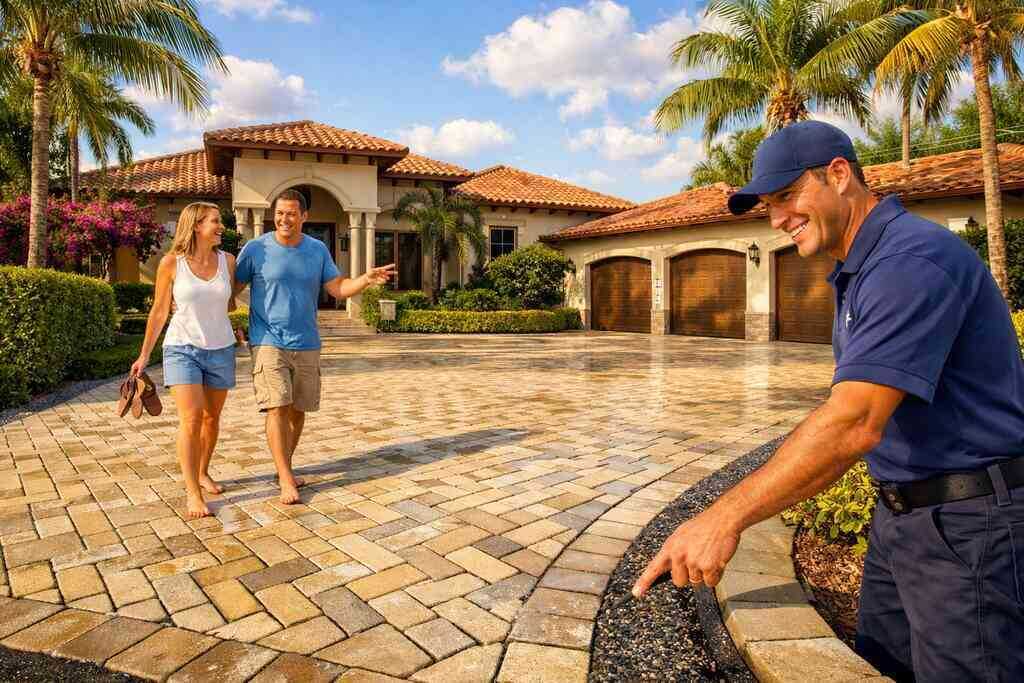
The environmental benefit extends beyond mere drainage volume. The subbase acts as a bio-retention zone where beneficial microbes break down trace hydrocarbons and lawn chemicals before they reach waterways. On a hot afternoon, the evaporative cooling effect of moisture retained in the paver joints slightly lowers the surrounding ambient temperature. This stands in stark contrast to an impermeable concrete slab that superheats runoff, sending a thermal plume into storm drains and contributing to urban heat island effects. Homeowners interested in eco-friendly driveway options Florida will find that permeable pavers meet the most rigorous green building standards without sacrificing structural capacity for everyday vehicle loads. The technology has matured to the point where it combines environmental stewardship with excellent long-term performance.
Paver Driveway Maintenance in Tropical Weather Longevity and Love
The maintenance narrative around pavers often triggers concerns about weed growth, ant colonies, and shifting units. In reality, modern paver driveway maintenance in tropical weather practices are far more manageable than fighting losing battles with concrete cracks and spalls. A properly installed paver driveway features edge restraints anchored into a concrete haunch, preventing lateral migration of the entire field. The bedding course of coarse sand and the interlocking geometry locks units together through frictional force, distributing loads across multiple adjacent pavers. When a heavy vehicle turns its wheels at a standstill, the slight articulation of individual units relieves stress that would fracture a rigid slab.
Occasional sweeping and a gentle rinsing with a fan-tip nozzle keep joints free of organic debris that might harbor weed seeds. Adding a small amount of polymeric sand every few years after deep cleaning restores the joint stability and inhibits ant excavation. If a stain from a leaky car becomes unsightly, you simply lift and replace the affected pavers rather than attempting to grind or overlay the blemish. That modular repairability is the secret to paver longevity, allowing the driveway to evolve gracefully rather than deteriorate irreversibly. Many paver driveway pros and cons discussions overlook the profound psychological value of owning a surface that can be healed one piece at a time instead of replaced wholesale.
Driveway Pavers Heat Resistance Walking Barefoot in Summer
One of the most visceral daily experiences in South Florida is the dash across a scorching hardscape to retrieve a delivery or grab the mail. The driveway pavers heat resistance advantage emerges from material composition and color selection. Light-colored concrete pavers reflect more solar radiation than dark asphalt or deeply tinted poured concrete, keeping surface temperatures measurably lower throughout the afternoon. Clay brick pavers, though often darker in hue, possess a lower thermal conductivity that prevents them from storing and re-radiating as much heat as dense, homogeneous slabs. The joint spaces between pavers also allow a degree of convective airflow that slightly disrupts the buildup of a stagnant thermal boundary layer.
While no surface remains cool under the direct August sun, pavers offer a more forgiving tactile experience for bare feet and pet paws. Families who prioritize outdoor play often specify a blend of ivory, sand, and shell tones to minimize heat absorption while still achieving design depth. Planning ahead with a paver driveway installation in Boca Raton specialist who understands solar orientation can yield a surface that remains tolerable even during the peak hours. This comfort factor directly impacts how much you enjoy your own property, turning a utilitarian pathway into an extension of the living space. Heat resistance is not merely a technical specification; it is a daily quality-of-life metric that homeowners feel with every step.
Paver Driveway Lifespan and the Art of Hurricane Resilient Driveway Paving
The true test of any South Florida hardscape arrives when tropical storm winds howl and water surges across the landscape. Paver driveway lifespan projections often exceed thirty years because the system’s flexibility inherently resists the forces that destroy monolithic slabs. Hurricane-resilient driveway paving relies on the pavers’ ability to move almost imperceptibly with the saturated soil, preventing the catastrophic upheavals and sinkhole-like depressions that appear in rigid concrete. After floodwaters recede, a paver driveway can often be re-leveled by lifting the affected area, adding or redistributing bedding sand, and relaying the same units. This resilience makes pavers the material of choice for coastal properties that face mandatory evacuation and the inevitable post-storm cleanup.
A paver driveway lifespan also benefits from the ease of subsurface utility access. Unlike a concrete slab that requires saw cutting and patching whenever plumbing or electrical lines need repair, pavers can be removed and reinstated invisibly. That feature eliminates the long-term aesthetic penalty of permanent patchwork scarring across the driveway. Standard Florida building code for driveway paving dictates structural loading and slope requirements that professional paver installers meet through certified engineering guidelines. Adhering to these codes and using high-density base materials ensures that even after decades of tropical abuse, the surface remains safe, functional, and visually cohesive. The driveway becomes a permanent asset rather than a countdown to a costly full replacement.
The Driveway Alchemist’s Final Formula for South Florida Homes
Merging Cost Curb Appeal and Resale Value in West Palm Beach and Beyond
Financial logic must reconcile with emotional satisfaction when you make the final paving decision. The initial cost to install paver driveway options generally exceeds a basic concrete pour, yet the long-term value equation tilts decisively in the other direction. Appraisers and real estate agents across Palm Beach County recognize that a well-designed paver driveway signals a higher level of property stewardship to prospective buyers. That perception translates into faster sales cycles and stronger offers, particularly in luxury markets where first impressions seal deals. Homeowners who view the driveway strictly as a line item often miss the broader concrete vs pavers resale value dynamic that plays out in every listing photograph.
A stamped concrete driveway that has begun to micro-crack and fade communicates deferred maintenance, which psychologically primes a buyer to scrutinize the entire home more critically. Pavers, with their enduring color-fastness and joint flexibility, project an image of meticulous care that extends to the house itself. Investing in premium materials now shields you from the need to discount your asking price later to compensate for a tired hardscape. When you collaborate with a South Florida general contractor driveway expertise professional, you receive realistic cost modeling that compares twenty-year scenarios rather than just the next billing cycle. That strategic perspective often reveals that the “more expensive” option actually preserves more wealth over time.
How a South Florida General Contractor Transforms Driveway Design Ideas into Reality
The gap between a magazine-worthy driveway concept and a flawless execution is bridged by seasoned professional coordination. A comprehensive driveway renovation in Delray Beach project entails soil compaction testing, drainage swale design, and utility location verification before a single paver or yard of concrete is ordered. Expert contractors understand how local Palm Beach County driveway regulations and design requirements govern setback distances, impervious surface ratios, and environmental buffer zones. They also navigate the permit process so that your vision complies with code from the first shovel strike. Attempting to manage these overlapping disciplines without a qualified general contractor invites scheduling chaos and substandard results.
Beyond compliance, an experienced team unlocks creative possibilities that a narrow material focus might overlook. They might propose a border of contrasting pavers to define the parking area while using a lighter field color to brighten a shaded entry. Integrated inlays, drainage channel grates that double as design features, and subtle grade transitions all emerge from the collaborative dialogue between homeowner and builder. When you are ready to translate inspiration into hardscape, connecting with a South Florida general contractor driveway expertise firm ensures that your design ideas are filtered through the lens of structural reality. The result is a driveway that feels at once artistic and indestructible.
Your Next Step Find Driveway Concrete and Paving Contractors Near You
The research phase culminates in the single most consequential action: selecting the right specialist to bring your chosen material to life. The South Florida Contractors directory streamlines this search by connecting you with vetted professionals who understand the local climate and soil conditions intimately. Instead of sorting through unverified online listings, you gain direct access to specialists who offer driveway concrete and paving contractors in South Florida services ranging from new installations to complete resurfacing. Entering your zip code instantly filters results by proximity, letting you evaluate portfolios and credentials before making a single phone call.
Every expert listed understands that concrete driveway durability Florida demands and tropical paver performance requirements are not abstract concepts but daily construction realities. They can accurately estimate your specific cost to install paver driveway in Boynton Beach or advise whether concrete driveway resurfacing in West Palm Beach can extend the life of your existing slab. By choosing a contractor through a curated directory, you avoid the risk of hiring a generalist who lacks the nuanced expertise that these projects demand. Take the first step today by visiting South Florida Contractors, entering your location, and scheduling a consultation that will transform your driveway from a source of stress into a source of pride and performance.
Frequently Asked Questions
Question: Which driveway option holds up better long-term in South Florida’s heat, humidity, and storms – concrete or pavers?
Answer: When you evaluate the best driveway for Florida climate extremes, interlocking pavers consistently outperform poured concrete because they flex with the sandy soil instead of fighting it. Concrete driveway durability Florida experts note that thermal cycling, moisture intrusion, and hurricane stress cause rigid slabs to crack and spall, while a properly installed paver system absorbs movement through its joints. Pavers also offer superior heat resistance; light-colored driveway pavers heat resistance keeps surfaces cooler under bare feet, and the permeable gaps allow water to drain away quickly. At South Florida Contractors, we connect you with local paving professionals who understand South Florida driveway materials comparison and will engineer a base that prevents settling, making pavers the resilient, low-maintenance choice for Boca Raton, Delray Beach, and beyond.
Question: How does the cost of stamped concrete versus pavers really compare when you factor in repairs and upkeep?
Answer: A simple stamped concrete vs pavers cost analysis based only on the initial pour can be deceptive; concrete often appears cheaper per square foot until you account for the recurring expense of concrete sealing against humidity every few years and the high price of patching cracks. Stamped concrete’s decorative layer cannot be invisibly repaired once a hairline fracture appears, whereas individual pavers can be lifted and replaced without any visual mismatch. The cost to install paver driveway may be higher upfront, but the paver driveway lifespan easily reaches thirty years or more with minimal maintenance, making it the more economical solution over time. When you find driveway concrete and paving contractors through our directory, they provide transparent lifecycle cost projections so you can see the true value, especially regarding concrete vs pavers resale value in West Palm Beach and surrounding neighborhoods.
Question: What kind of maintenance does a paver driveway need in tropical weather, and how does that compare to a concrete slab?
Answer: Paver driveway maintenance in tropical weather is refreshingly straightforward: occasional sweeping, a gentle rinse with a fan nozzle, and replenishing polymeric sand in the joints every few years keep the surface stable and weed-free. Unlike a monolithic slab that suffers from concrete driveway cracking in heat and requires constant resealing, pavers flex as the ground shifts and never need an overlay. Concrete driveway durability Florida challenges like spalling, efflorescence, and rutting simply don’t apply to an interlocking system. With a South Florida general contractor driveway expertise provider found through South Florida Contractors, your installation will include edge restraints and proper base compaction so that the only ongoing care is light cleaning – not expensive restorative patching.
Question: I read your blog “Comparing Concrete vs Pavers for South Florida Driveways” – how can permeable pavers help me manage drainage and comply with local codes?
Answer: Permeable pavers South Florida installations are a game-changer for handling our afternoon deluges and high water table: the spacer lugs create infiltration gaps filled with washed aggregate, letting rainwater percolate into a layered subbase reservoir instead of running off into overwhelmed storm drains. This eco-friendly driveway options Florida approach recharges groundwater, filters pollutants, and meets Palm Beach County driveway regulations that increasingly incentivize porous surfaces. The blog “Comparing Concrete vs Pavers for South Florida Driveways” explains how this drainage capability doubles as hurricane-resilient driveway paving because the system can reabsorb water and endure saturated soil without upheaval. Our directory of driveway installation contractors near me includes specialists who design these systems to code, blending functionality with curb appeal in Boynton Beach and Delray Beach.
Question: Where can I find trusted driveway concrete and paving contractors near me who understand South Florida’s unique challenges?
Answer: The easiest way to locate qualified professionals is to use South Florida Contractors, the premier directory for finding a contractor in South Florida. Simply enter your zip code on our site and you’ll see a list of verified general contractors in South Florida who specialize in both decorative concrete driveways Boca Raton styles and interlocking paver installation in Boca Raton and across the region. Each listed company is vetted for expertise in South Florida driveway resurfacing, drainage design, and understanding the nuances of concrete driveway vs pavers South Florida decisions. Whether you need a driveway renovation in West Palm Beach or want to explore home improvement driveway ideas for Florida homes, our platform connects you with the right local pros to turn your vision into a durable reality while keeping your project on budget.