Green Concrete Innovations with South Florida Contractors
January 23, 2026
Rising Tides of Opportunity: A South Florida Awakening to Green Concrete
Why climate resilient infrastructure matters for coastal communities
South Florida’s shoreline neighborhoods feel every gust of salty wind and each inch of sea-level rise. Consequently, climate resilient infrastructure is not an abstract ambition; it is a daily necessity for homeowners, developers, and every South Florida contractor for green builds. Green concrete technology now provides high durability marine concrete that resists chloride attack and wave erosion better than legacy mixes. When structures last longer, insurance risks drop and community safety improves. Therefore, embracing sustainable construction materials becomes both a civic duty and a strategic shield against escalating storm intensity.
Equally important, municipalities have tightened codes to demand Florida hurricane resistant green concrete in retaining walls, seawalls, and elevated foundations. Contractors who master low carbon cement solutions meet these codes without sacrificing project timelines. Moreover, innovative water reducing admixtures cut fresh-water demand, a benefit in regions subject to periodic drought. By marrying strength with stewardship, green mixes anchor coastal resilience while protecting sensitive wetlands from unnecessary extraction.
The economic and ecological upside of eco-friendly concrete mix adoption
Developers initially worry about the price tag of eco-friendly concrete mix alternatives. However, lifecycle studies reveal that recycled aggregate concrete and carbon capture cement innovation lower the total cost of ownership. Reduced maintenance, slower corrosion, and fewer slab replacements translate into measurable savings. Simultaneously, embodied-carbon footprints decline, helping project teams qualify for regional tax incentives and utility rebates linked to energy saving construction practices.
Furthermore, geopolymer binder applications often cure at ambient temperatures, eliminating the fuel-hungry kiln stage of traditional Portland cement. These smarter chemistries cut greenhouse gas emissions while maintaining compressive strengths suited for coastal loading. Additionally, solar reflective pavements and permeable concrete driveways mitigate urban heat and storm-water flash floods, creating cooler, safer neighborhoods. In short, what was once perceived as a specialty upgrade now functions as an economical mainstream choice across South Florida construction services.
South Florida contractor network as the catalyst for sustainable construction materials
No single innovation succeeds without the hands that place, finish, and protect it. General contractors in South Florida have become early adopters of bio based reinforcing fibers, self healing concrete research, and green concrete curing methods. Their field feedback allows material scientists to adjust formulas for humidity swings and high-salinity air. Consequently, the region has become a living laboratory, accelerating market readiness for global distribution.
These contractors also champion waste glass aggregate solutions that divert bottles from overflowing landfills. By specifying locally sourced recycled fines, they shorten supply chains and support the circular economy. Partnerships with academic labs further refine carbon capture cement innovation for mass-market deployment. Ultimately, the tight feedback loop among material engineers and boots-on-the-ground crews positions South Florida as a lighthouse for other coastal metros seeking climate resilient infrastructure solutions.
Navigating the South Florida Contractors directory to find near me green home builders in Florida
Homeowners often ask, “Where can I find a trusted team familiar with permeable concrete driveways or low carbon pool decks?” The answer hides in plain sight inside the eco-conscious contractor directory in South Florida. This comprehensive digital tool filters firms by specialty, license, and proximity, allowing users to compare credentials and schedule on-site evaluations in minutes.
After entering a zip code, users discover specialists in Boynton Beach low VOC flooring, Boca Raton sustainable remodelers, and Delray Beach eco construction services. One click reveals references, insurance certificates, and sample projects that spotlight carbon-neutral foundations and energy saving construction practices. When the platform highlights a provider’s expertise in bio based reinforcing fibers or water reducing admixtures, decision-making becomes data-driven and stress-free. By simplifying access to qualified experts, the directory empowers residents to transform visionary concepts into tangible, climate-smart homes.
Beyond Portland: Advancing Eco-Friendly Mix Designs for Coastal Strength
Low carbon cement solutions and carbon capture cement innovation
South Florida engineers are shifting from energy-intense kilns to mineral-activated binders that harden without massive fuel demands. These low carbon cement solutions slash embodied emissions while maintaining structural integrity against relentless coastal winds. Regional pilot plants now inject captured CO₂ into fresh mixes, turning a pollutant into strength-building limestone microcrystals. That circular chemistry, showcased by leadership in low carbon cement across South Florida, positions builders at the forefront of decarbonization. Every cubic yard poured with this technology helps homeowners meet stricter insurance guidelines and avoid future carbon penalties.
Contractors in Miami-Dade are already field-testing alkali-activated slag cement for critical seawall upgrades. Early results reveal compressive strengths matching conventional mixes within seven days, expediting project schedules. Moreover, the cooler hydration temperatures decrease cracking risk, essential for high durability marine concrete near tide lines. Architects appreciate the creamy workability, which allows slender profiles and reduces material use. Because permitting authorities reward innovations that decrease cement clinker, builders gain both regulatory credits and marketing advantage.
Recycled aggregate concrete incorporating waste glass aggregate solutions
Traditional quarries lie far from coastal job sites, driving up trucking emissions and project costs. Recycled aggregate concrete replaces virgin stone with crushed roofing tiles, reclaimed roadway, and polished bottle cullet. By integrating translucent particles, architects unlock terrazzo-like finishes without extra pigments. Municipal guidance titled understanding green concrete basics for coastal builds clarifies performance rules for reused aggregates. With strict gradation control, these mixes surpass thermal conductivity targets, keeping interiors cooler under subtropical sunlight.
Crushed mirror glass further enhances reflectivity, bouncing daylight deeper into open-plan interiors and reducing artificial lighting loads. Contractors report that angular recycled particles improve interlock, which can raise flexural strength by five percent. However, quality assurance remains critical; moisture-laden demolition debris can trigger unexpected slump loss during pumping. Therefore, experienced South Florida general contractors screen every truckload, ensuring chloride content stays below marine exposure thresholds. This vigilance protects rebar longevity and reinforces public trust in sustainable construction materials.
Geopolymer binder applications and bio based reinforcing fibers
Geopolymer binders form when aluminosilicate powders meet alkaline activators, producing a three-dimensional network similar to volcanic stone. The resulting matrix resists acid, sulfate, and heat, ideal for wastewater plants near mangrove fringes. Contractors complement these binders with hemp, basalt, or bamboo fibers, trimming steel demand and embedded carbon. Homeowners consult the eco-conscious contractor directory in South Florida to locate teams versed in this advanced chemistry. Because the fibers arrive dehydrated, onsite hydration protocols ensure uniform dispersion and prevent air pockets.
Pilot slabs at municipal garages showcase how bio fibers arrest microcracking and dampen vibration transfer from heavy vehicles. Tour groups often tap the surface and note the surprising acoustic hush compared to traditional decks. Engineers attribute the phenomenon to the natural cell structure, which absorbs high-frequency waves. Moreover, the fibers degrade harmlessly should demolition occur, supporting future material recovery goals. As codes evolve, the combination of geopolymer chemistry and plant-based reinforcement appears poised for mainstream adoption.
Water reducing admixtures and green concrete curing methods for high durability marine concrete
High humidity often tempts crews to splash extra water into the drum, yet excess moisture weakens the hardened structure. Water reducing admixtures solve this dilemma by dispersing cement particles so the flow increases without additional liquid. Contractors tracking saltwater splash zones also employ internal curing beads that slowly release moisture, mitigating plastic shrinkage. Those searching for specialists in these techniques can find sustainable builders near South Florida through the regional directory. Early adoption brings predictable strength gains and shorter rework cycles.
Once placed, slabs receive breathable curing blankets made from recycled jute that trap humidity yet allow carbon dioxide exchange. This controlled respiration accelerates hydration while promoting the formation of denser calcium silicate hydrate. Field sensors confirm that chloride diffusion coefficients drop by nearly thirty percent when these blankets stay on for four days. As a result, rebar enjoys a longer passive state even under relentless tidal spray. Such incremental changes collectively extend service life far beyond traditional maintenance intervals.
Self healing concrete research powering Florida hurricane resistant green concrete
Researchers at local universities cultivate limestone-producing bacteria that lie dormant inside microscopic clay capsules until cracks appear. When storm-driven tension opens a fissure, seawater activates the microbes, which quickly precipitate calcite and seal the wound. This self healing concrete research promises to reduce manual patching after each hurricane season. Consequently, crews describe the material as Florida hurricane resistant green concrete ready for real storm tests. Trusted hurricane resistant contractors in Boynton Beach FL embed capsules in pilot homes and gather sensor data for code approval. Early results indicate recovery of ninety percent compressive strength within two weeks of initial cracking.
Finance firms follow these trials closely because automatic crack repair lowers risk premiums tied to water intrusion claims. Additionally, autonomous sealing limits chloride ingress, which often accelerates rebar corrosion after impact damage. By lowering maintenance budgets, municipalities can allocate funds toward improved evacuation routes and renewable power microgrids. The technology also dovetails with carbon capture cement innovation, because bacterial reactions consume a small amount of dissolved CO₂. Consequently, every healed crack doubles as a microscopic carbon sink.
Solar reflective pavements and permeable concrete driveways for energy saving construction practices
Black asphalt absorbs heat and funnels storm runoff toward overtaxed drains, creating flash-flood risk and urban heat islands. Solar reflective pavements coated with titanium dioxide pigments instead deflect sunlight, keeping surface temperatures significantly cooler. When paired with permeable concrete driveways, homeowners simultaneously reduce puddles and ambient air conditioning loads. For design ideas, builders review permeable driveway concrete services on South Florida Contractors to compare regional case studies. Together, these strategies align with energy saving construction practices promoted by county resilience offices.
Cooling benefits extend beyond comfort; infrared imaging proves that nearby rooftop solar panels operate more efficiently over lighter pavements. Furthermore, permeable sub-bases recharge aquifers, preserving freshwater lenses threatened by seawater intrusion. Maintenance crews also appreciate the self-cleaning photocatalytic layer, which breaks down oil drips and algae. Although upfront costs can rise, reduced treatment expenses for storm-water and higher property values offset the premium. As neighborhood associations witness measurable temperature drops, reflective and porous surfaces become the new default specification.
 From Lab to Jobsite: How South Florida Contractors Deliver Sustainable Concrete Solutions
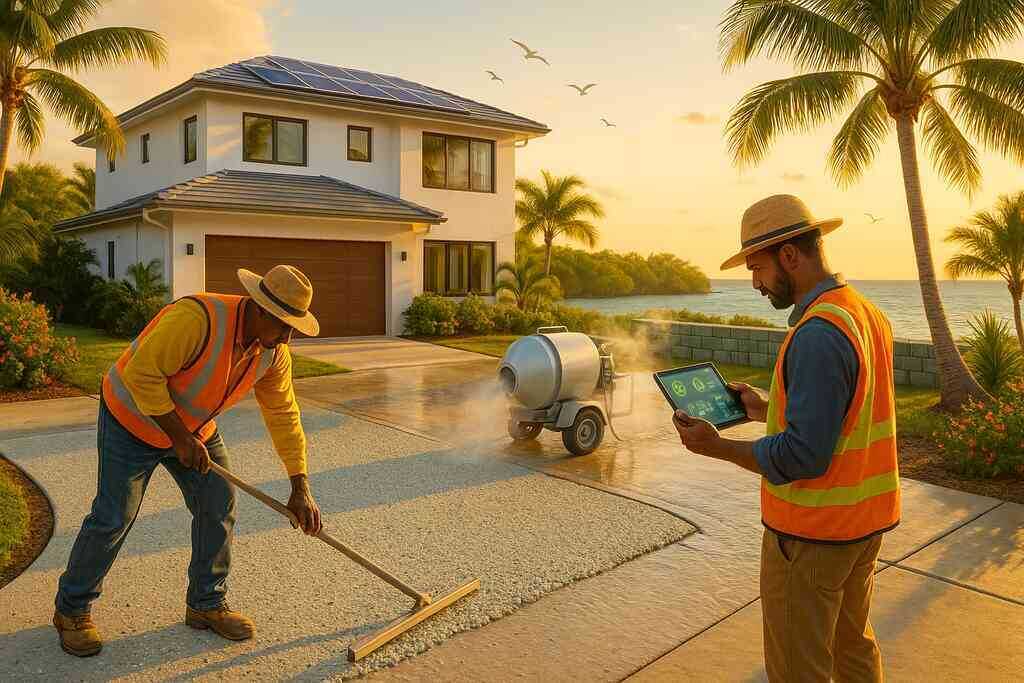 From Lab to Jobsite: How South Florida Contractors Deliver Sustainable Concrete Solutions
LEED certified South Florida general contractor selection process
South Florida homeowners want proof that their builder can translate lab discoveries into durable walls and slabs. Selecting a LEED certified South Florida general contractor shortens that learning curve because accreditation verifies experience with eco friendly concrete mix documentation. During interviews, ask which green concrete technology the firm has poured in flood zones and how many lifecycle credits were awarded. Top candidates showcase past projects that combined water reducing admixtures with recycled aggregate concrete to meet strict municipal scorecards. Their portfolios demonstrate that sustainability, schedule, and cost can align.
Savvy property investors also request safety records and third-party test reports before signing. A transparent contractor will share cylinder break data, chloride permeability numbers, and embodied-carbon calculators. Those metrics confirm that the promised high durability marine concrete performs as advertised. Finally, verify supply-chain alignment. Reliable builders maintain partnerships with regional ready-mix plants that stock low carbon cement solutions, ensuring every batch meets specification without shipment delays.
Integrating green concrete technology in Boca Raton sustainable remodelers and Boynton Beach low VOC flooring projects
Boca Raton sustainable remodelers have become early adopters of alkali-activated slag mixes that cure cooler and faster than traditional Portland cement. Their crews pour thin but strong floor plates, allowing architects to expand daylight wells without adding beam depth. Simultaneously, Boynton Beach low VOC flooring specialists seal polished slabs with bio based polymers, eliminating solvent odors and speeding re-occupancy. These paired tactics create healthier interiors, an essential selling point for coastal retirees with sensitive lungs.
Coordination between the concrete supplier and finish installer remains vital. Moisture meters track internal humidity because premature coating can trap vapor. Shared dashboards let the South Florida contractor team decide when to advance tasks, keeping tight renovation timelines on track. Clients appreciate how proactive communication protects budgets while delivering energy saving construction practices.
Eco-conscious pool decking options and sea level rise adaptive foundations
Residents upgrading outdoor living spaces now demand decking that resists salt spray and reflects solar heat. Contractors present low carbon pool decking options in South Florida that blend crushed shell aggregate with titanium dioxide pigment for glare control. The mix pairs well with pervious sub-base layers, which channel storm surge away from footers and recharge groundwater. These choices extend deck lifespan and keep bare feet cooler, a double win.
When designers tackle new waterfront homes, they specify sea level rise adaptive foundations. Elevated geopolymer piers anchor above predicted flood lines while permeable concrete driveways route runoff into bioswales. Structural engineers model lateral loads from projected wave impact and select bio based reinforcing fibers to add ductility. Together, these decisions yield Florida hurricane resistant green concrete platforms ready for tomorrow’s tides.
Concrete 3D printing sustainability for Delray Beach eco construction services
Concrete 3D printers no longer belong only in futuristic factories; Delray Beach eco construction services deploy mobile gantries that extrude geopolymer layers directly on site. The technology minimizes formwork waste and slashes transportation emissions because mixes are locally sourced. Crews program void patterns that reduce material volume yet maintain strength, achieving up to thirty percent embodied-carbon savings.
Speed also impresses clients. Small accessory buildings reach structural completion within days, reducing neighborhood disruption. Devices pause automatically when humidity spikes, preventing weak joints, and resume after conditions stabilize. Sensors embedded during printing transmit curing data to a cloud dashboard, letting project managers adjust admixture flow in real time. This feedback loop embodies the lab-to-jobsite philosophy championed by every forward-thinking South Florida contractor for green builds.
Lifecycle assessment of concrete structures and waste minimization on site
True sustainability extends beyond ribbon-cutting ceremonies. Teams perform a lifecycle assessment of concrete structures, forecasting maintenance, end-of-life recycling, and potential carbon offsets. Software models compare traditional slabs with geopolymer alternatives, revealing forty percent lower global warming potential over fifty years. Contractors then refine the mix design, aiming to balance upfront cost against long-term resilience.
Waste minimization begins at the batch plant. Excess returned concrete is repurposed into interlocking blocks for temporary seawalls, not dumped. Onsite, crews collect washout water in closed loops, capturing cement fines for reuse. Surplus rebar trimmings become spacers instead of scrap. These incremental practices transform job sites into teaching labs where apprentices witness the circular economy in action.
Partnering with Find Driveway Concrete and Paving Contractors to deploy permeable surfaces near you
Homeowners searching for storm-ready driveways often start with the South Florida Contractors directory. By filtering results, they quickly locate specialists under the Find Driveway Concrete and Paving Contractors category. These crews install permeable pavements that interlock recycled glass aggregate with high strength binders, allowing thousands of gallons of rain to infiltrate. Less runoff means fewer puddles and reduced local flooding.
Partnerships extend beyond installation. Design teams collaborate with professional construction management for sustainable projects to schedule inspections after major storms. Data loggers buried beneath the driveway capture infiltration rates, confirming performance goals. Homeowners receive annual maintenance tips, such as light vacuum sweeping to clear sediment. This holistic approach cements trust while proving that climate resilient infrastructure in South Florida can be attractive, affordable, and easy to source near you.
Building Tomorrow Foundations Visionary Pathways for Climate Resilient Construction
Scaling green concrete innovations across West Palm Beach green renovation experts
West Palm Beach homeowners increasingly value climate resilient infrastructure South Florida projects that stand firm against salt-laden winds. Local firms adapt recycled aggregate concrete and self healing technology to the city’s porous limestone sub-grade, ensuring slabs resist uplift during king tides. Because suppliers keep low carbon cement solutions in regular stock, scheduling hiccups fade and crews finish pours before afternoon storms roll in. Residents applaud shorter cure times and the cooler surfaces delivered by solar reflective pavements, noting lower summer energy bills. Word-of-mouth praise attracts newcomers who once doubted that sustainable construction materials could match conventional durability.
Regional engineers partner with climate-smart renovators in West Palm Beach FL to test geopolymer binder applications on mid-rise façades. Sensors buried in the cladding track chloride ingress, providing real-time data to structural researchers. Early readings reveal diffusion rates thirty percent lower than comparable Portland mixes, a nod to the denser aluminosilicate lattice. Municipal inspectors cite the findings when recommending code updates that favor eco-friendly concrete mix designs. As more projects share results, municipal confidence grows and permitting timelines shrink, further accelerating adoption.
Public private collaboration to mainstream biodegradable concrete formwork
Traditional plywood forms warp after one pour, creating piles of waste that bake in the tropical sun. To counter that cycle, South Florida general contractor consortiums are trialing biodegradable concrete formwork made from hemp-based composites. Public works departments waive disposal fees when contractors use these forms, because they compost directly into landscaping mulch. Universities map the decomposition curve, confirming that no harmful leachates enter groundwater during breakdown. Policymakers then model landfill capacity gains, strengthening the argument for widespread use.
Developers also see value in smoother internal surfaces achieved with bio-forms. Reduced honeycombing slashes remedial grout costs, an overlooked line item on tight budgets. When combined with water reducing admixtures, crews require less vibration, cutting onsite noise levels that often trigger community complaints. This synergy illustrates how multi-stakeholder collaboration speeds innovation from lab bench to jobsite. By showcasing clear financial and social returns, biodegradable options shift from experimental to expected.
Training the next generation of South Florida contractors for green builds
Apprentices once learned rebar tying and slump testing by rote; now curricula weave in lifecycle assessment of concrete structures and embodied-carbon math. Trade schools invite material scientists to demonstrate carbon capture cement innovation in portable mixers, letting students witness limestone crystal growth under the microscope. Field trips to coastal seawalls highlight how high durability marine concrete survives wave scouring. These tactile lessons cement conceptual knowledge and fuel career pride in sustainable construction services.
Mentorship extends beyond classroom walls. Veteran superintendents guide rookies through mixed submittal reviews, stressing how to match geopolymer binder applications with specific chloride thresholds. Online dashboards archive test cylinders, so trainees track strength development across multiple projects. This data-rich environment nurtures analytical thinking, a skill critical for custom green home building in Delray Beach and other forward-looking markets. As competencies rise, clients gain confidence that any South Florida contractor for green builds can execute complex specifications flawlessly.
Unlocking incentives and certifications that reward sustainable construction services
Financial incentives often determine whether an owner selects conventional or eco-friendly concrete mix designs. State utilities now rebate projects that demonstrate permeable concrete driveways reduce stormwater runoff below set quotas. Property appraisers add valuation points for buildings using solar reflective pavements, recognizing lower thermal loads. Insurance underwriters issue premium discounts when structural reports prove that Florida hurricane resistant green concrete exceeds wind uplift requirements.
Navigating overlapping programs can overwhelm busy developers, so consultants compile grant matrices and pre-fill documentation templates. Their research points frequently to resources that focus on boosting energy efficient construction in South Florida, streamlining paperwork for busy site managers. Once approvals arrive, crews display certification plaques near building lobbies, turning compliance into marketing leverage. Prospective tenants appreciate transparent sustainability metrics and often sign longer leases, stabilizing cash flow. Thus, smart use of incentives transforms green concrete from an ethical choice into a strategic asset.
Inviting homeowners and developers to connect through South Florida Contractors for their next project
Every visionary idea still needs skilled hands to mix, place, and finish the material. The South Florida Contractors directory simplifies that search by ranking firms according to specialty, license, and customer reviews. Users filter for general contractors in South Florida experienced with bio based reinforcing fibers or low VOC flooring, saving precious planning time. Built-in chat tools enable instant consultations, turning curiosity into actionable scope drafts within hours. Because credentials update automatically, clients never worry about expired insurance or lapsed certifications.
Homeowners renovating waterfront decks discover a curated list of green building experts in Boca Raton Florida alongside peer comments and photo galleries. Commercial developers, meanwhile, bookmark teams adept at sea level rise adaptive foundations and concrete 3D printing sustainability. Both groups schedule site walks straight from the platform, ensuring alignment before the first yard of concrete ships. By closing the gap between concept and execution, South Florida Contractors propels the region’s transition toward resilient, low-carbon communities.
Frequently Asked Questions
 Frequently Asked Questions
Question: How does South Florida Contractors help me find a LEED certified South Florida general contractor experienced with green concrete technology?
Answer: The South Florida Contractors directory lets you enter a zip code, filter for LEED credentials, and instantly view profiles of general contractors in South Florida who routinely pour low carbon cement solutions, recycled aggregate concrete, and other sustainable construction materials. Each listing shows license numbers, project photos, and third-party test results-so you can verify that the builder understands water reducing admixtures, green concrete curing methods, and documentation needed for LEED points. A Make a Call Now button connects you directly to schedule site visits, making it easy to secure a proven South Florida contractor for green builds without endless phone tagging.
Question: What makes the eco-friendly concrete mix options like low carbon cement solutions and recycled aggregate concrete ideal for coastal projects in South Florida?
Answer: Conventional Portland mixes struggle against salt spray, heat, and sea-level rise. By contrast, carbon capture cement innovation forms limestone micro-crystals that lock out chlorides, while recycled aggregate concrete diverts local demolition debris into high durability marine concrete that resists wave erosion. Because these mixes cure cooler and crack less, insurance premiums drop and maintenance cycles lengthen-exactly what homeowners and construction companies need when building near mangroves and seawalls. South Florida Contractors lists suppliers and installers who have field-tested these eco-friendly concrete mix designs so you gain coastal strength plus a lighter embodied-carbon footprint.
Question: In the blog Green Concrete Innovations with South Florida Contractors, permeable concrete driveways and solar reflective pavements are highlighted. Can your directory connect me with near me green home builders in Florida who install these energy saving construction practices?
Answer: Absolutely. After choosing Find Driveway Concrete and Paving Contractors on our platform, you can filter for companies that specialize in permeable surfaces, waste glass aggregate solutions, and solar reflective coatings. Whether you live in Boynton Beach, Boca Raton, or Delray Beach, the directory shows ratings, insurance certificates, and scheduling availability for crews that design permeable concrete driveways to reduce runoff and solar reflective pavements to cool the surrounding air. Many listed home builders in Florida also integrate bio based reinforcing fibers and sea level rise adaptive foundations, giving you a one-stop shop for comprehensive energy saving construction practices.
Question: Are South Florida Contractors’ listed builders prepared to use Florida hurricane resistant green concrete with self healing technology and high durability marine concrete for seawalls and elevated foundations?
Answer: Yes. Our network includes Miami-Dade and West Palm Beach green renovation experts who currently pilot self healing concrete research using limestone-producing bacteria. These contractors combine geopolymer binder applications with bio based reinforcing fibers to create Florida hurricane resistant green concrete that automatically seals small cracks after storm events. Many also deploy high durability marine concrete enriched with internal curing beads for seawalls, pier caps, and elevated slabs. By selecting a contractor in South Florida through our directory, you can be confident your project will meet or exceed stringent coastal wind-uplift and chloride-resistance standards.
Question: How do the lifecycle assessment of concrete structures and waste minimization strategies adopted by Boca Raton sustainable remodelers and West Palm Beach green renovation experts translate to cost savings for homeowners?
Answer: Lifecycle assessment tools used by builders listed on South Florida Contractors compare traditional slabs with geopolymer or carbon capture alternatives over 30-50 years. Results typically show up to 40 percent lower global-warming potential and fewer repairs, which reduces long-term ownership costs. Waste minimization-such as turning returned concrete into interlocking blocks and recycling wash-out water-lowers dumping fees and material purchases, savings that remodelers often pass on to clients. Boca Raton sustainable remodelers and West Palm Beach teams leverage these efficiencies to deliver competitive bids while still providing premium, eco-friendly concrete mix solutions.