
How South Florida Contractors Decode Winter Wind Codes 2026
January 26, 2026
Wind Warnings Unpacked: A South Florida Prelude
Why winter wind demands fresh coastal construction strategies
South Florida’s breezy winter skies may appear calm, yet pressure spikes ride every cold front. Those pressure shifts slam into roofs, soffits, and open-plan lanais with surprising force. A seasoned South Florida contractor therefore treats each seasonal northerly like a miniature hurricane rehearsal. Incorporating coastal construction wind engineering early prevents costly retrofits later. Many project owners now begin design charrettes with the South Florida wind code experts directory open, ensuring every trade partner shares the same wind-load vocabulary.
Milder temperatures also accelerate outdoor schedules, letting framing crews race ahead of finish trades. That tempo can hide envelope vulnerabilities until the first blustery squall whistles through. Experienced general contractors in South Florida institute wind-checkpoints at each milestone, verifying fastening patterns, sheathing spans, and gable bracing. This proactive cadence keeps winter punch-lists lean while elevating South Florida wind load compliance. Ultimately, smart scheduling saves budgets, reputations, and homeowners’ peace of mind.
Snapshot of Florida Building Code high velocity requirements
The Florida Building Code’s high-velocity hurricane zone provisions extend beyond cyclone season. Design wind speeds remain constant year-round, so load-path math never takes a holiday. Coastal custom home builders in Florida now run design pressure calculation tips during every permit cycle, not just summer rushes. This disciplined approach preserves structural redundancy when seasonal fronts stack gusts with tidal shifts. By treating winter breezes like test drives, contractors uncover framing tweaks before peak storm months.
HVHZ tables also demand precise mappings of exposure B, C, and D around brackish inlets. A Delray Beach remodeling crew working near dunes faces different edge-distance rules than a Boynton Beach renovation underway inland. Knowing these microclimates lets engineers specify narrower uplift clips or thicker roof sheathing only where needed, containing material costs. Continual code literacy thus empowers South Florida general contractor teams to offer competitive bids without compromising coastal resilience.
The influence of Miami Dade hurricane code expertise on regional projects
Miami-Dade County’s robust product approvals often serve as the bellwether for the tri-county region. Suppliers touting Miami-Dade hurricane code expertise routinely secure placements on Palm Beach winter wind inspection checklists. Builders translate that reputational capital into homeowner confidence, especially for impact windows and roofing membranes. Emulating these higher standards also simplifies cross-county logistics because one approval satisfies most municipal reviewers.
Broward County wind alley retrofits increasingly leverage Miami-Dade test data for soffit and fascia reinforcement. When an older Fort Lauderdale bungalow receives a retrofit hurricane strap installation, inspectors appreciate familiar labeling on connectors. This reduced friction speeds certificate issuance, freeing crews to chase the next project. The workflow underscores how shared expertise fuels regional collaboration across the South Florida Contractors network.
Winter storm surge mitigation across the Broward County wind alley and Palm Beach
Cold-front lows often coincide with king tides, pushing swells against seawalls from Pompano to Palm Beach. While surge heights may be modest, sustained wave action degrades pile-supported decks and pool coping joints. Renovation contractor teams near Boca Raton preempt damage by specifying epoxy-coated rebar and fiber-reinforced concrete during pool decking upgrades. Integrating storm-hardened details into leisure features elevates both lifestyle and safety.
Palm Beach winter wind inspection checklist items now include verifying breakaway wall perforations under elevated homes. These sacrificial panels reduce hydrostatic stress when back-bay waters rise, allowing superstructures to remain intact. Simultaneously, landscape architects collaborate with contractors on bioswale placement to disperse sheet flow. Such holistic winter storm surge mitigation echoes through every discipline, ensuring coastal communities face the season prepared rather than exposed.
Engineering the Invisible Enemy
Envelope pressure mapping services and design pressure calculation tips
Most coastal failures begin with invisible air knives slicing through unbalanced envelopes. Envelope pressure mapping services therefore set the baseline for South Florida wind load compliance. They deploy networked sensors along ridges, soffits, and joist lagoons. Readings expose pressure hot spots before framing nails even squeal. Contractors translate that data into pragmatic design pressure calculation tips every superintendent can understand. These insights trim overengineering and keep material budgets balanced.
Advanced modeling software overlays those field readings on digital twins of proposed structures. Engineers cross-check the output against Florida Building Code high velocity requirements for each exposure category. When discrepancies appear, the team consults the authoritative coastal code guide for HVHZ projects to refine fastener spacing. This single reference harmonizes structural calculations across Delray, Broward, and Palm Beach. With unified numbers, subcontractors fabricate trusses and panels that snap into predictable load paths.
Shear wall anchoring solutions for general contractors in South Florida
Shear walls act like spinal columns for coastal homes. General contractors in South Florida now specify redundant anchoring hardware at every floor diaphragm. High-strength hold-downs transfer overturning forces straight into reinforced slabs, detouring destructive racking. Installers torque bolts to manufacturer values, then photograph tags for digital inspection logs. That documentation shields project teams from liability when wind events test the system.
Broward County wind alley retrofits reveal another anchoring insight. Many older block homes lack continuous strapping between sill plates and tie-beam pockets. Qualified crews now inject epoxy dowels and add strap extensions without disturbing finished interiors. The result converts fragmented load paths into a unified shear network. Homeowners appreciate that structural upgrade because walls remain pristine while strength skyrockets.
Roofing uplift resistance strategies favored by Boca Raton renovation contractors
Boca Raton renovation contractors face gnawing gusts funneling off the Atlantic. They rely on roofing uplift specialists in South Florida to verify every shingle, seam, and clip. Field technicians conduct pull-tests across ridges and hips before the underlayment dries. Results feed adjustment tables that dictate longer ring-shank nails or upgraded self-drilling screws. By aligning fastening schemes with roofing uplift resistance strategies, crews reduce call-backs and insurance friction.
Tapered insulation profiles also influence uplift performance in flat roof assemblies. Designers stagger board joints, preventing flutter pockets beneath membranes. Edge metal upgraded to 24-gauge steel guards perimeter zones where suction peaks. Finally, ridge vent baffles receive stainless screws and butyl gaskets to lock moisture out. These incremental details add pennies per square foot yet save entire roof systems during winter squalls.
Impact window code interpretations and wind borne debris protection plans
Impact glazing stands as the frontline against wind-borne debris. Code interpretations evolve as test laboratories publish fresh missile protocols. South Florida general contractor teams therefore attend quarterly seminars with manufacturers and municipal reviewers. Those sessions clarify differences between essential facility ratings and standard residential requirements. Armed with precise data, estimators match glass thickness and interlayer composition to neighborhood exposure maps.
Wind-borne debris protection plans extend beyond the glass itself. Installers verify that anchoring flanges bite into continuous headers, not patchy stucco skins. They then silicone seal perimeters with joint widths meeting manufacturer tolerances. Finally, field inspectors shoot infrared images confirming frame contact without voids. Documenting that sequence satisfies insurance carriers and bolsters wind load certification portfolios.
High wind zone material selection with soffit and fascia reinforcement
Material selection becomes critical when gusts exceed typical suburban thresholds. Builders choose dense fiber-cement cladding over vinyl to resist flying gravel abrasion. Soffit panels shift from perforated aluminum to vented composite boards that accept hidden fasteners. Hidden systems prevent wind infiltration at panel laps while maintaining attic breathability. Fascia reinforcement arrives through continuous steel flashing and hurricane clips spaced per the designer tables.
Crew competency is as important as material chemistry. Owners should find certified contractors near South Florida who understand load paths from ridge to footer. These professionals pre-drill composite boards, eliminating fractures that invite moisture wicking. They also stage fasteners in corrosion-resistant trays, reducing onsite contamination. Unified craftsmanship and high wind zone material selection give coastal homes their lasting elegance and safety.
 Navigating the Paper Tempest
 Navigating the Paper Tempest
HVHZ permit navigation guide and Palm Beach winter wind inspection checklist
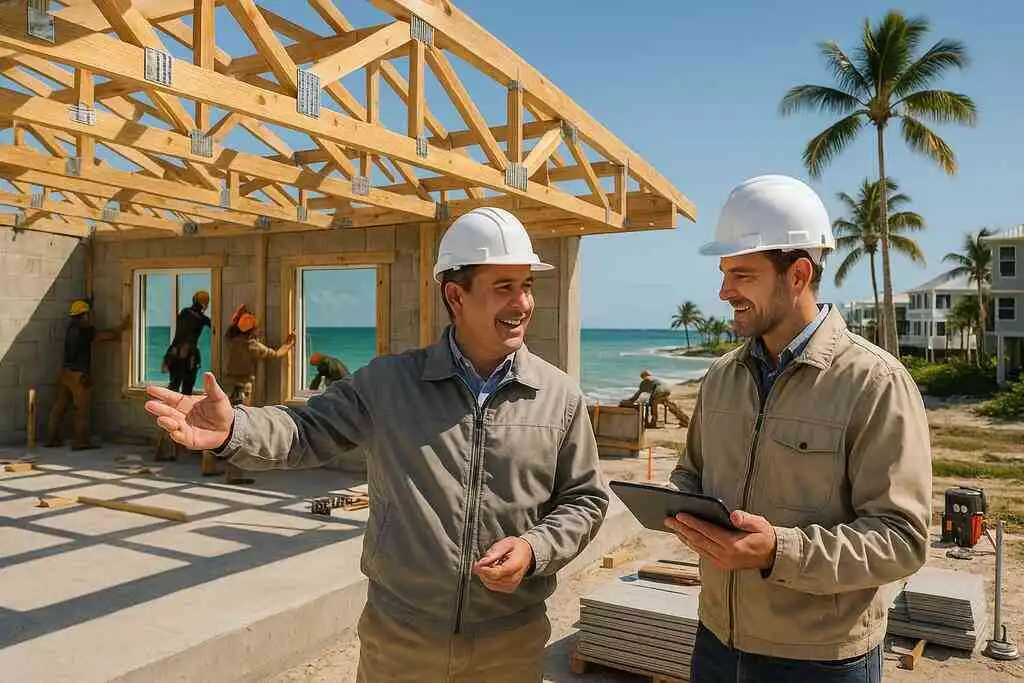
Securing a permit in the High-Velocity Hurricane Zone feels like threading a needle during a gale. Building officials now require digital submittals that match every uplift clip to precise Florida Building Code high velocity requirements. South Florida general contractor teams therefore assemble annotated load-path diagrams before uploading any plan set. Those diagrams speed reviewer approval because each sheet already references the Palm Beach winter wind inspection checklist line by line. As a result, paper chases shrink, and construction schedules stay intact even when seasonal fronts bring sudden gust alerts.
Experienced permit expeditors also consult county GIS overlays to prove exposure categories. They attach site photographs showing dune topography, mangrove buffers, and nearby high-rise interference zones. Inspectors appreciate that visual context, which confirms the accuracy of design pressure calculation tips embedded in structural notes. When unexpected comments arise, project managers open the construction compliance insights on the South Florida Contractors blog for recent clarifications. The shared resource often contains pre-approved language that resolves objections in one email, keeping South Florida wind load compliance both transparent and verifiable.
Structural engineer wind audits with Delray Beach construction companies
Third-party wind audits today resemble medical checkups for new builds. Structural engineers walk slabs with Delray Beach construction companies, matching bolt tags to shear wall schedules while the concrete still cures. Their tablets display real-time tolerance thresholds, alerting crews when washer diameters or embed depths appear borderline. By correcting those findings immediately, general contractors in South Florida avoid costly coring later. The audit culminates with drone imagery of truss anchor patterns, giving insurers a confidence boost.
Collaboration continues in the office, where engineers upload findings into cloud portals shared by all subcontractors. Framers receive color-coded maps that highlight areas needing extra nailing, while electricians learn which soffit penetrations demand fire-rated caulks. This integrated workflow turns structural engineer wind audits into living documents that guide every trade. Consequently, Delray Beach custom home clients receive projects fortified beyond minimum code without unplanned budget hikes.
Retrofit hurricane strap installation and coastal bracing techniques for home builders
Renovation booms across the Broward County wind alley push many owners toward retrofits rather than tear-downs. Retrofit hurricane strap installation therefore starts with infrared scans revealing hollow cells in existing block walls. Crews drill access ports, inject epoxy, then insert stainless dowels that link roof trusses directly to footers. These upgrades convert fragmented load paths into robust vertical force chains able to withstand winter storm surge mitigation demands. Home builders in Florida now bundle such straps with attic diaphragm sheathing so that uplift, shear, and racking forces share redundancy.
Coastal bracing techniques extend outdoors as well. Pergolas and patio coverings gain concealed steel knee braces that lock posts to beams without marring aesthetics. Pool screen enclosures swap flimsy corner brackets for gusseted aluminum plates rated for South Florida wind load compliance. By integrating both interior and exterior bracing, general contractors craft leisure spaces that resist seasonal gusts just as effectively as conditioned rooms.
Winter construction schedule adjustments and contractor liability in wind events
Cold fronts can topple partially framed walls before crews return from long weekends. To counter that threat, leading construction companies build weather margins into every Gantt chart. They sequence deliveries so heavy trusses arrive the same morning they will be set and braced, minimizing exposure. When forecasts predict elevated gusts, superintendents mandate temporary diagonal bracing and inspect tie-downs before clock-out. These proactive measures slash the probability of material blow-offs that trigger neighbor property claims.
Liability conversations now begin at pre-construction meetings. Contract clauses spell out responsibilities for securing job sites and outline deductible thresholds shared with subcontractors. Firms that follow coastal construction wind engineering best practices experience lower insurance rates and faster claim resolutions. The discipline also protects reputations, positioning each South Florida contractor as a reliable steward of client assets even when Mother Nature tests every fastener.
Leveraging the South Florida Contractors directory search to find certified experts near me
Homeowners often feel overwhelmed when storm-proofing checklists mention diaphragm ratios or soffit wind ratings. The South Florida Contractors directory simplifies that learning curve by filtering specialists according to zip code, license, and wind load certification. A single search can reveal engineers, framers, and hurricane contractors in Boca Raton FL who already speak the language of exposure categories. Transparent profiles display previous wind audit reports, allowing clients to vet expertise before making the first call.
Project owners also leverage the directory to assemble multidisciplinary teams. A Boca Raton renovation contractor collaborates with Boynton Beach remodelers and West Palm Beach roofers, all sourced from one platform. Because every listed firm follows standardized documentation templates, their reports integrate seamlessly into municipal portals. That unified approach accelerates permit issuance while building a regional culture of resilience, ensuring the next cold front becomes merely another performance test rather than a fiscal emergency.
Fortified Futures on the Gold Coast
Storm hardened custom homes through whole home remodeling collaborations
Storm-hardened custom homes start with an integrated vision between architects, engineers, and specialty trades. Whole home remodeling provides the clean slate needed to weave continuous load paths from ridge to footer. When owners select whole home fortification services in South Florida, every wall, opening, and eave receives deliberate attention. Uplift clips align with shear wall anchoring solutions, while impact window code interpretations drive opening dimensions. Consequently, South Florida wind load compliance becomes a design principle, not a retrofit afterthought.
Collaboration extends beyond drawings. General contractors engage mechanical, electrical, and plumbing teams so penetrations avoid critical structural zones. Envelope pressure mapping services then verify that planned assemblies withstand coastal construction wind engineering pressures. The iterative process yields custom homes capable of resisting winter storm surge mitigation challenges. Homeowners gain elevated safety without sacrificing architectural flair.
Integrating driveway paving decks and pool resurfacing into envelope protection
Ground-level features may seem cosmetic, yet they can shield foundations from driven water and debris. A seasoned renovation contractor near Boca Raton specifies interlocking pavers that drain laterally, easing hydrostatic loads around slabs. Deck joists gain stainless connectors synchronized with high-wind zone material selection tables. Pool resurfacing compounds include flexible admixtures that tolerate pressure fluctuations beneath wave action. Together, these elements create an exterior envelope as disciplined as any roof diaphragm.
Integrated hardscape planning also benefits maintenance budgets. When driveway paving, decks, and pool coping share compatible sealants, annual inspections are streamlined. Contractors capture data in construction documents for wind compliance, satisfying insurers. The strategy knits outdoor leisure into coastal bracing techniques, extending resilience from curb to cabana. Residents enjoy seamless transitions between safety and style.
Anticipating code updates and maintaining wind load certification
Codes evolve as laboratories release fresh gust and missile data. Forward-looking wind load builders in Delray Beach FL track proposed amendments through professional societies. They model projects against draft Florida Building Code high velocity requirements, adjusting fastening schedules early. This vigilance keeps projects ahead of reviewers and preserves schedules. Clients avoid surprise change orders midway through framing.
Maintaining wind load certification demands continuous education. Crews attend workshops on soffit and fascia reinforcement and record hours for licensing renewals. Structural engineer wind audits confirm that classroom knowledge translates to field precision. Digital badges then update profiles in the South Florida Contractors directory search. Transparency builds trust across the regional marketplace.
Call to action for the South Florida contractor community to build stronger together
Every stakeholder plays a role in fortifying the Gold Coast. Designers push creative boundaries, while tradespeople execute with meticulous craftsmanship. Industry leaders share insights through the best coastal building practices post, inspiring peer improvement. Continuous dialogue raises the baseline for contractor liability in wind events. Communities ultimately reap the benefits of stronger, longer-lasting structures.
Now is the moment to act. Review your current specifications, cross-check them against the HVHZ permit navigation guide, and engage a verified South Florida general contractor. Together we can transform winter wind from a looming threat into a routine performance test. Visit South Florida Contractors, connect with certified experts near you, and begin building resilience today. The future of coastal living depends on the decisions we make before the next front arrives.
Frequently Asked Questions
 Frequently Asked Questions
Question: How does South Florida Contractors guide owners and builders through the Florida Building Code high velocity requirements when winter fronts roll in?
Answer: The South Florida Contractors directory pairs you with structural engineers and South Florida general contractor teams who live and breathe South Florida wind load compliance. From the first design pressure calculation tips to the final Palm Beach winter wind inspection checklist, these experts translate dense coastal construction wind engineering tables into actionable fastening schedules, shear wall anchoring solutions, and soffit and fascia reinforcement details. Because every listed firm carries current wind-load certification, you get one-stop support for permitting, field inspections, and material submittals-keeping projects on time even when January gusts hit 150 mph design values.
Question: In the blog How South Florida Contractors Decode Winter Wind Codes 2026 you reference envelope pressure mapping services-what are they and why are they critical for my next project?
Answer: Envelope pressure mapping services plant wireless sensors across ridges, lanais, and soffits to capture real-time gust loads during seasonal fronts. The data reveals pressure hot spots long before drywall, allowing engineers to tweak hold-downs, upgrade uplift clips, or add coastal bracing techniques where they matter most. By booking a certified provider through South Florida Contractors, you receive a digital report that dovetails with Miami-Dade hurricane code expertise and satisfies insurers that your build exceeds HVHZ permit navigation guide thresholds.
Question: Can South Florida Contractors connect me with general contractors in South Florida who specialize in retrofit hurricane strap installation and other coastal bracing techniques for an older home?
Answer: Absolutely. Just type your ZIP code into the directory search and filter for retrofit hurricane strap installation. You’ll see vetted Delray Beach construction companies, Broward County wind alley retrofit specialists, and Boynton Beach remodelers who inject epoxy dowels, install continuous load paths, and document every strap for structural engineer wind audits. These pros blend winter storm surge mitigation best practices with affordable staging so your bungalow withstands both January northerlies and late-season hurricanes without costly interior tear-outs.
Question: What roofing uplift resistance strategies and impact window code interpretations do your Boca Raton renovation contractors employ to protect my coastal property?
Answer: Boca Raton renovation contractors inside the directory follow roofing uplift resistance strategies that begin with on-site pull tests, longer ring-shank nails, and 24-gauge edge metal in the roof perimeter zone. They pair these upgrades with impact window code interpretations rooted in the latest wind-borne debris protection plans-ensuring glass thickness, interlayer chemistry, and anchoring flanges that meet both Miami-Dade product approvals and local exposure maps. The result is a seamless barrier that handles sudden gusts, gravel abrasion, and flying palm fronds without compromise.
Question: How does using the South Florida Contractors directory search lower contractor liability in wind events and streamline HVHZ permitting?
Answer: Every contractor profile lists active licenses, wind load certification status, and documented winter construction schedule adjustments, so you can verify competence before signing a contract. Because their construction documents for wind compliance already reference the HVHZ permit navigation guide, reviewers spend less time issuing approvals and more time safeguarding the community. Fewer permitting delays mean walls are braced and roofs dried-in faster, slashing exposure and contractor liability in wind events while preserving your budget.