How South Florida Contractors Vet Coastal Concrete Designs
February 25, 2026
Tides of Innovation: The Coastal Concrete Imperative
Why every South Florida contractor champions hurricane-ready concrete mixes
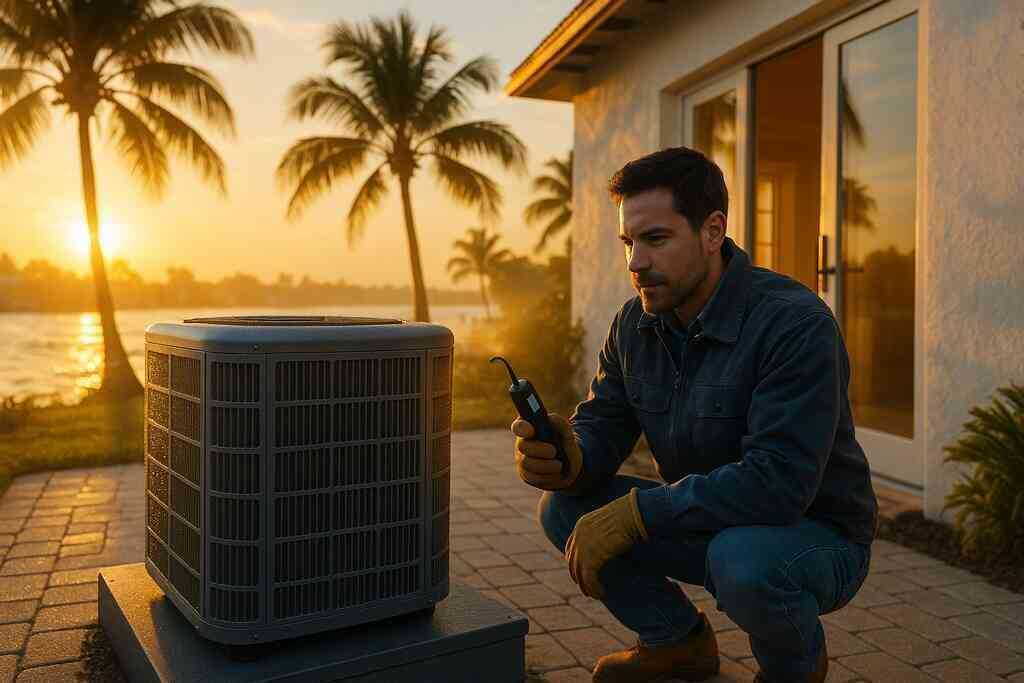
South Florida‘s construction pace quickens every time the tropics stir, so every South Florida contractor pushes hurricane-ready concrete mixes to the front of the materials line. These specialty blends rely on low water-cement ratios, supplementary cementitious materials, and corrosion-inhibiting admixtures that outperform standard mixes when wind-driven rain attacks. Because coastal concrete durability testing now sits at the top of every bid package, general contractors in South Florida systematically demand proof of saltwater corrosion resistance before a single yard is poured. Mixes are benchmarked against concrete permeability standards that target fewer than 1,500 coulombs on the ASTM C1202 rapid chloride test. Through this strict focus on performance, builders keep projects compliant with South Florida coastal building codes while protecting future owners from spalling failures.
The vetting process starts long before a ready-mix truck rolls through the gate, and it typically begins inside the South Florida contractor directory. Here, project owners connect with vetted concrete specialists who understand the region’s unique marine environment structural assessments. Each listed firm must show project histories where beachside foundation reinforcements met storm-surge load calculations without cracking. By filtering prospects this way, homeowners and developers gain confidence that their selected contractor already follows chloride penetration testing protocols. The result is a shorter learning curve, lower lifecycle cost figures, and faster approvals at city permitting desks.
Connecting Boca Raton remodelers and Boynton Beach renovation crews to beachside foundation demands
Boca Raton remodelers tackling a pool deck renovation just blocks from the Atlantic immediately confront chloride ions leaching through porous soils. To overcome that threat, they partner with concrete suppliers experienced in hurricane-ready concrete mixes containing fly ash and silica fume. Sulfate attack mitigation strategies also become critical because many reclaimed coastal parcels contain elevated sulfates that can degrade ordinary Portland cement. A well-documented concrete mix design submittal review preserves the project schedule while satisfying local inspectors who scrutinize marine environment exposure classes.
Just a few miles north, Boynton Beach renovation crews face similar challenges yet slightly different soils, so pre-construction mock-up evaluations help verify finishing techniques. Contractors prefer marine-grade rebar paired with epoxy coatings that lengthen service life by resisting corrosion. These decisions reflect lessons captured on previous beachside foundation reinforcements where thermal expansion considerations and concrete cracking control joints proved decisive for durability. By coordinating early through BIM and virtual inspections, remodelers ensure driveway concrete and paving surfaces transition smoothly to heavier structural elements without cold joints that invite saltwater intrusion. Homeowners gain resilient patios and living spaces that meet modern South Florida coastal building codes compliance.
Seasonal storm surge insights shaping West Palm Beach renovations
West Palm Beach sits on a barrier island network, so seasonal storm surge forecasts routinely influence slab elevations and waterproofing membrane selections. Building crews in marine zones design foundations that resist hydrostatic uplift by integrating heavier footing systems with extra reinforcing steel. They reference historic surge heights to perform storm surge load calculations that determine minimum anchorage requirements for columns and shear walls. From there, chloride penetration testing results guide membrane choices, ensuring waterproofing maintains bond integrity even when hydrostatic pressure fluctuates.
Because storm events now arrive with greater frequency, project teams build redundancy into their curing schedules. Concrete curing methods in tropical climates favor wet-cure blankets and evaporation retarders because rapid moisture loss diminishes compressive strength. Teams further adopt curing compounds rated for high humidity to prevent surface crazing under intense South Florida sunlight. Continuous quality assurance loops track compressive breaks at seven, fourteen, and twenty-eight days, confirming that each West Palm Beach renovation stays on trajectory for code-required strength. The payoff appears years later when façades resist chloride-induced spalling long after lesser structures show rust stains.
Saltwater Science: Decoding Coastal Concrete Performance
Chloride penetration testing and ASTM C1202 rapid assessments
Before a single footer forms, chloride penetration testing frames the performance conversation. The ASTM C1202 rapid chloride permeability test gives South Florida general contractors a numeric snapshot of ionic intrusion resistance in less than twenty-four hours. Results below 1,000 coulombs signal an exceptional mix; numbers above 2,000 raise red flags that trigger mix redesigns. Testing continues during production pours, with cylinders cast on-site and shipped to third-party labs for verification. This looped verification satisfies owners, lenders, and code officials who all demand data-driven confirmation of saltwater corrosion resistance.
Contractors store these test results in digital dashboards shared with engineers so specification adjustments happen quickly. For instance, if permeability creeps upward, the team may substitute a higher-grade pozzolan or adjust aggregate gradation. Such proactive collaboration reflects the region’s mature contractor vetting process, where transparent data keeps projects on schedule and within budget. ASTM C1202 serves as both a quality gate and a learning tool that raises collective industry expertise.
Marine-grade rebar selection and sulfate attack mitigation strategies
Selecting the right reinforcing steel is equally mission-critical. Marine-grade rebar-often ASTM A1035 or epoxy-coated ASTM A775-extends service life by slowing oxidation even when hairline cracks appear. Coastal site soil analysis frequently reveals elevated chloride and sulfate levels, so engineers specify concrete cover depths exceeding inland norms. Sulfate attack mitigation strategies include blending Type II MH cement with slag, which improves sulfate resistance while reducing heat of hydration. Teams also analyze pH and electrical resistivity of local groundwater to identify potential galvanic corrosion scenarios.
Simultaneously, chemical admixtures such as calcium nitrite inhibitors strengthen the passive oxide film on steel. These inhibitors, combined with reduced permeability, give South Florida construction companies an effective two-front defense: they block ionic ingress and armor the rebar itself. Contractors document each batch certification to earn final inspection clearance and coastal building codes compliance. Such traceability builds trust and cements reputations among clients seeking long-term resilience.
Concrete admixtures for high humidity and thermal expansion considerations
Humidity rarely dips below sixty percent along Florida’s lower peninsula, influencing both placement and long-term performance. High-range water reducers enable contractors to pour low-slump mixes that still flow around congested rebar, limiting excess water that could raise permeability. Shrinkage-reducing admixtures then address thermal expansion considerations that cause cracking when afternoon temperatures spike. These products lower internal tensile stresses during drying, reducing the likelihood of surface crazing.
Contractors further introduce integral crystalline waterproofers that react with free lime to form insoluble crystalline lattices. These lattices self-seal microcracks, enhancing concrete permeability standards without relying on external membranes. When combined with proper curing, admixtures maintain design intent even as rising ambient temperatures challenge performance. Home builders in Florida appreciate that this chemistry also preserves interior comfort, as slabs transmit less moisture vapor and protect flooring installation warranties.
Eco-friendly coastal concrete options and lifecycle cost analysis
Sustainability now merges with resilience, driving interest in green cement alternatives such as portland-limestone cement and geopolymer blends. These eco-friendly coastal concrete options cut embodied carbon while meeting strict sulfate and chloride thresholds. Lifecycle cost analysis often shows slightly higher upfront material prices but sizeable savings on maintenance and repair over decades. Early adopters frequently see lower insurance premiums because insurers reward reduced risk of structural failure.
Local case studies, highlighted by industry groups championing green concrete leadership on South Florida projects, reveal that owners recoup investments through energy efficiency and durability gains. Contractors calculate payback by modeling surface treatments, recoating intervals, and potential structural retrofits that are avoided entirely. In many waterfront communities, municipal incentives for lower-carbon builds further tilt the economics in favor of sustainable mixes. This combination of green practice and coastal performance positions South Florida firms as national thought leaders.
The Vetting Gauntlet: South Florida Contractor Protocol
Concrete mix design submittal review and third-party lab inspections
Before the first footing is excavated, concrete mix design submittals land on engineers’ desks for detailed scrutiny. Contractors include granular details: cement type, SCM percentages, admixture dosage, and target permeability benchmarks. Municipal reviewers cross-reference these numbers against South Florida coastal building codes compliance matrices. Upon provisional approval, third-party lab inspections verify material certifications, aggregate cleanliness, and moisture content directly at the batch plant. The independent status of these labs strengthens public trust and ensures contractor safety checkpoints remain objective.
If test cylinders fail to reach expected strength, rapid feedback loops allow immediate corrective action. This protocol protects project timelines because non-compliant pours are identified within hours, not weeks. South Florida general contractors have turned this iterative vetting into a competitive advantage, securing reputations for delivering coastal structures on time, on budget, and above code.
Pre-construction mock-up evaluations and BIM coordination for concrete pours
Full-scale mock-ups serve as living laboratories where finish schedules, formwork strategies, and concrete curing methods in tropical climates converge. Teams examine color uniformity, surface texture, and joint alignment under real sunlight conditions to pre-empt on-site surprises. Mock-ups also expose waterproofing membrane integrations, allowing installers to adjust detailing before large-scale deployment. Data captured here feeds into BIM models, enhancing clash detection and logistics planning.
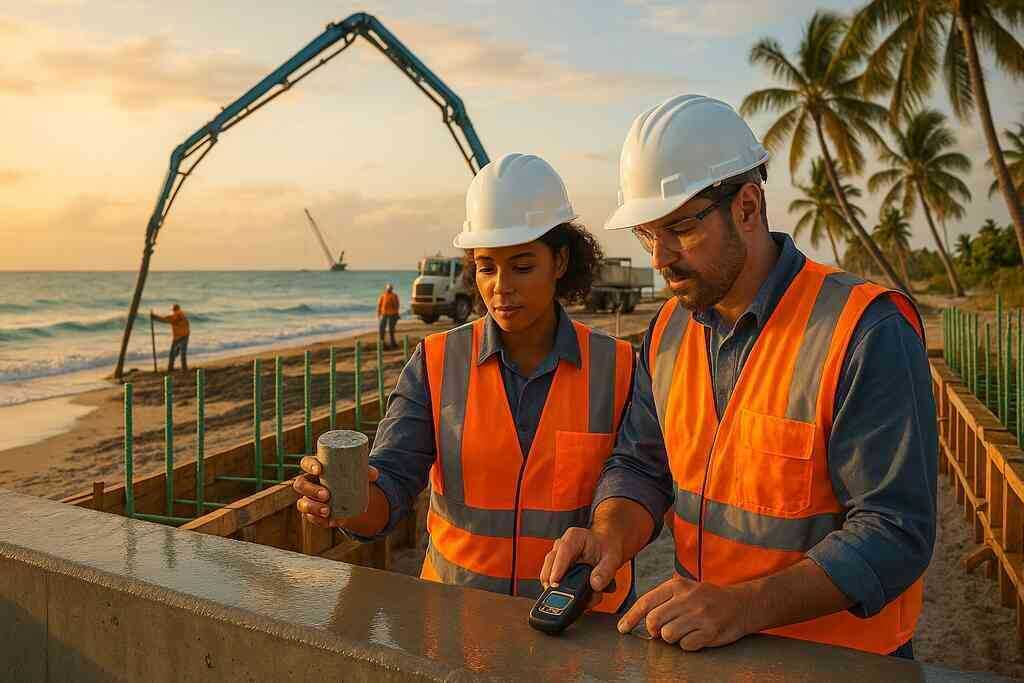
With BIM coordination, pour sequences align with tidal charts, minimizing delays caused by unexpected groundwater intrusion. Crane paths, rebar staging zones, and pump truck positions are all simulated to avoid last-minute improvisation. This foresight also reduces OSHA compliance violations because material handling risks are addressed virtually before anyone sets foot on site. The end product is a safer, more predictable job site where everyone from apprentices to seasoned superintendents operates with confidence.
Storm surge load calculations and beachside foundation reinforcements
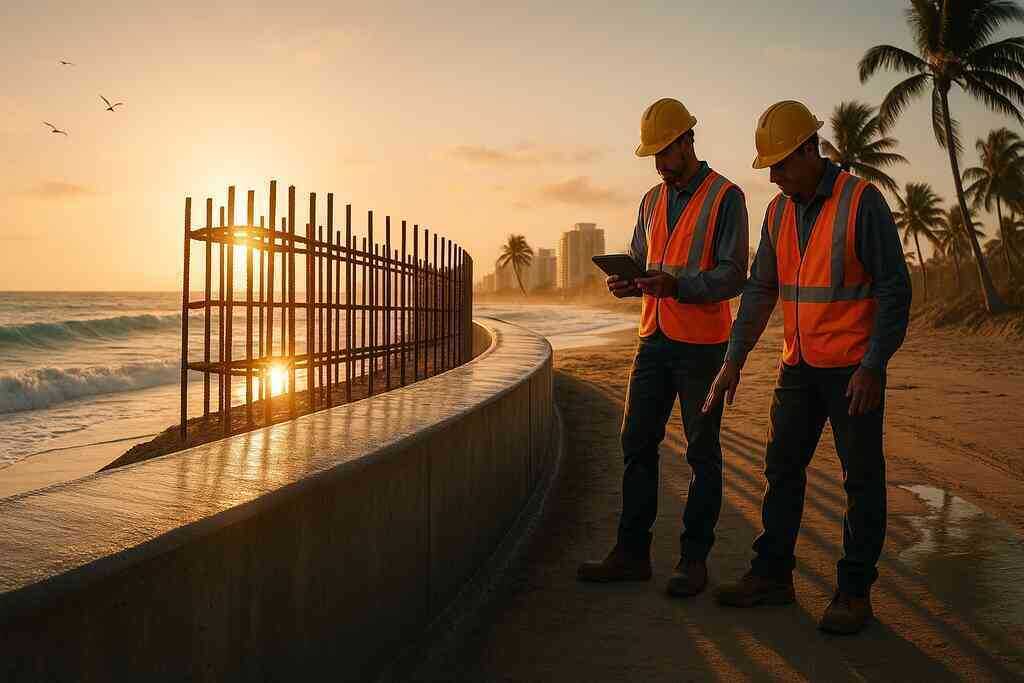
Storm surge load calculations define how deep and wide footings must be to counter buoyant forces when seawater engulfs grade slabs. Engineers employ finite element models that integrate FEMA surge data with local bathymetry to pinpoint scour depths. Foundations often combine battered piles with grade beams tied into steel-reinforced seawalls for holistic defense. Contractors then select concrete admixtures suited to high-humidity exposure to protect pile caps hidden below groundwater lines.
Beachside foundation reinforcements extend into superstructures through stainless-steel hold-downs and hurricane straps. These connections transfer lateral forces from wind and waves into concrete shear walls, ensuring continuous load paths. Insurers increasingly audit these details, so comprehensive photographic documentation accompanies every inspection request. Such transparency reflects the advanced contractor vetting process unique to this region.
Concrete curing methods in tropical climates and waterproofing membranes for coastal slabs
Curing in the tropics demands constant vigilance because high temperatures accelerate evaporation and jeopardize design strength. Contractors schedule pours at dawn, deploy misting fans, and wrap slabs in reflective blankets to retain moisture. Membrane-forming curing compounds receive UV-resistant additives so protection persists under relentless sunshine. Continuous temperature and humidity sensors embedded in test slabs feed office dashboards, enabling data-driven adjustments in real time.
Once curing ends, waterproofing membranes shield the slab from tidal moisture and hydrostatic pressure. Sheet membranes with heat-welded seams deliver robust bonds, while spray-applied elastomers bridge minor substrate cracks. The choice depends on lifecycle cost analysis and accessibility for future repairs. Proper sequencing-cure first, waterproof second-prevents trapped moisture that would otherwise blister membranes and compromise performance. This disciplined approach illustrates how South Florida contractors translate laboratory science into beachfront reality.
OSHA compliance and contractor safety checkpoints
Safety weaves through every procedural thread, from initial soil testing to final punch lists. Daily toolbox talks highlight heat-stress mitigation, fall-protection anchorage, and silica dust control during slab saw-cutting. OSHA compliance officers often visit unannounced, so foremen maintain up-to-date documentation: harness inspections, scaffold certifications, and concrete pump logs. These records reside in cloud platforms accessible to all stakeholders, bolstering accountability at every level.
Contractor safety checkpoints intersect directly with quality controls. Proper rebar-tying posture, for example, reduces musculoskeletal injuries while ensuring tight bar spacing that limits unwanted concrete cracking. Extending these best practices builds a culture where craftsmanship and worker wellbeing reinforce each other. Projects complete faster because fewer incidents halt production, and owners benefit from lower insurance loading factors.
Surfside Legacies: Delivering Resilient Builds Beyond the Shoreline
Value engineering coastal builds for clients from Delray Beach to Parkland
Value engineering along Florida’s Gold Coast balances upfront expense against decades of hurricane exposure. Contractors model alternative scenarios-such as thicker concrete covers or stainless rebar upgrades-and calculate net present value over thirty years. Clients in Delray Beach appreciate transparent spreadsheets that quantify savings from reduced maintenance, while Parkland homeowners focus on resale premiums tied to resilient construction. This process brings stakeholders in early, aligning aesthetic goals with storm-hardening pragmatism.
Contractors further leverage regional supplier networks to secure bulk pricing on marine-grade materials, then pass those savings to owners-a hallmark of South Florida general contractor best practices. Consistent communication ensures homeowners understand why a slightly higher bid often translates to fewer post-storm repairs. The resulting trust generates repeat business and strong referrals across online platforms.
From seawall specifications to driveway concrete standards aligning with South Florida building codes
Seawalls serve as first-line defenses, so specifications demand 5,000 psi concrete with water-to-cement ratios below 0.40 and corrosion-resistant reinforcements. Contractors choose aggregates washed to remove salt contamination and deploy form liners that shape wave-deflecting curves. Expansion joints include hydrophilic waterstops that swell upon contact with seawater, maintaining watertight integrity. Above the high-tide line, driveway concrete standards mirror many seawall principles, emphasizing sulfate attack mitigation strategies and controlled shrinkage joint spacing.
Homeowners working with driveway concrete and paving experts in South Florida notice consistent detailing: proper subbase compaction, vapor barriers, and high-early-strength mixes that open to traffic sooner. These shared quality thresholds simplify inspections and speed certificates of occupancy. Harmonized standards produce coherent curb appeal that withstands both salt spray and vehicular loads over the long term.
Quality assurance loops that keep South Florida contractors at the forefront of construction services
Quality assurance loops begin with pre-pour checklists, extend through real-time data collection, and conclude with post-occupancy evaluations. Compression tests, slump flow measurements, and surface hardness scans feed databases that benchmark every project against historical norms. Deviations trigger root-cause analyses and corrective actions, which are then documented to refine future specifications. This continuous improvement process solidifies South Florida contractors’ reputation for delivering concrete that performs on corrosive coastlines.
Clients witness this commitment through periodic reports that translate technical data into clear narratives. These updates, paired with drone imagery and BIM model overlays, illustrate exactly how design intent became tangible structure. The fusion of technology and craft ensures South Florida construction services remain synonymous with resilience, elegance, and enduring value.
Frequently Asked Questions
Question: How does South Florida Contractors use chloride penetration testing and the ASTM C1202 rapid chloride test to ensure saltwater corrosion resistance in coastal builds?
Answer: Every contractor listed in the South Florida Contractors Directory must submit concrete mix designs that achieve fewer than 1,500 coulombs on the ASTM C1202 rapid chloride test before a single yard is poured. Third-party concrete lab inspections verify these results during production pours, and the data is uploaded to shared dashboards for engineers, owners, and code officials. By enforcing strict concrete permeability standards at each job site, South Florida Contractors protect beachside foundation reinforcements and guarantee long-term saltwater corrosion resistance that meets or exceeds coastal building codes compliance.
Question: What steps are included in the contractor vetting process when clients search near me for a South Florida general contractor who specializes in hurricane-ready concrete mixes?
Answer: The vetting process starts inside the South Florida Contractors Directory, where homeowners filter by zip code to find a contractor with proven marine environment structural assessments. Each general contractor profile lists previous projects, chloride penetration testing records, and storm surge load calculations. Once contacted, the contractor provides a concrete mix design submittal review, schedules pre-construction mock-up evaluations, and secures third-party lab inspections. This layered approach assures clients that lifecycle cost analysis, OSHA compliance, and coastal site soil analysis have all been addressed before construction services begin.
Question: In the blog How South Florida Contractors Vet Coastal Concrete Designs, value engineering is mentioned-how do your teams balance eco-friendly coastal concrete options with budget goals?
Answer: South Florida Contractors model multiple scenarios, comparing traditional mixes with eco-friendly coastal concrete options such as portland-limestone cement or geopolymer blends. By running lifecycle cost analysis for coastal structures, we quantify reduced maintenance, lower insurance premiums, and longer service life achieved through sulfate attack mitigation strategies and marine-grade rebar selection. The result is a clear, numbers-driven recommendation that often shows a modest upfront premium but significant savings over 30 years, giving Boca Raton remodelers and Delray Beach custom home clients confidence in both sustainability and fiscal responsibility.
Question: How do you coordinate storm surge load calculations with BIM to keep Boynton Beach renovations and West Palm Beach projects on schedule?
Answer: Our engineers feed FEMA surge data and local bathymetry into finite element models that determine foundation depth, concrete cracking control joints, and waterproofing membranes for coastal slabs. These calculations are imported into BIM coordination software, allowing teams to visualize pour sequences, rebar staging, and crane paths. By aligning tidal charts with concrete curing methods in tropical climates, contractors avoid groundwater intrusion, maintain OSHA compliance, and deliver construction services on time to clients searching for renovation experts near them.
Question: What quality assurance loops keep South Florida contractor safety checkpoints and concrete admixtures for high humidity performing at a high level?
Answer: Quality assurance begins with pre-pour checklists covering high-range water reducers, shrinkage-reducing admixtures, and thermal expansion considerations. During placement, sensors track humidity, temperature, and slump flow. Cylinders are cast for seven, fourteen, and twenty-eight-day breaks, while supervisors document every step for OSHA compliance and contractor safety checkpoints. Post-occupancy, our teams conduct surface hardness scans and visual inspections for spalling, feeding the data back into future concrete mix design submittal reviews. This continuous improvement system reinforces South Florida Contractors’ reputation for coastal concrete durability testing excellence.