
Guide To Coastal Codes For South Florida Contractors
February 7, 2026
Opening the Blueprint: Decoding Coastal Codes Before the First Shovel
The stakes for a South Florida general contractor near me
The moment a proposal hits the drafting table for a waterfront duplex, the clock starts ticking against hurricane season pressures. Every South Florida general contractor shoulders unique responsibilities that inland peers rarely consider. Wind load requirements for contractors, flood elevations, and salt-air corrosion allowances all converge on the first schematic. Missing any detail can jeopardize insurance coverage, financing, and, most critically, occupant safety. That high-stakes backdrop transforms code compliance from paperwork into a life-safety mission.
Liability multiplies when a single mis-sized hurricane strap tears loose and compromises an entire roof diaphragm. Courts have held builders personally accountable for ignoring updated Florida Building Code hurricane provisions. Beyond legal exposure, reputational damage spreads quickly through neighborhoods that trade referrals over backyard conversations. General contractors in South Florida therefore treat code mastery as a market differentiator rather than a bureaucratic hurdle. Prospective clients now demand documented familiarity with South Florida coastal building codes before they even request pricing.
Why coastal regulations outpace inland standards
Geography, not bureaucracy, drives the tighter rules along the peninsula’s southeastern rim. Barrier islands funnel storm surge, while the Atlantic’s fetch delivers high-velocity projectiles during hurricanes. The Florida Building Code responds by elevating minimum design pressures, tightening material testing protocols, and mandating redundant load paths. Many inland counties base requirements on outdated wind maps, but coastal municipalities adopt revisions as soon as they are published. Contractors ignoring these differentials face automatic permit rejections and costly redesigns.
Community insurers and federal agencies amplify the gap by offering incentives only to projects that exceed baseline statutes. FEMA coastal A zone design tips, Miami-Dade impact window compliance, and local freeboard add-ons collectively raise the bar. As a result, hurricane-rated construction standards along the Gold Coast resemble commercial specifications in other states. Builders in Boca and Broward now detail stainless fasteners and sealed sheathing as standard, not upgrades. The trend shows no sign of reversing because property portfolios increasingly demand resilient assets.
Leveraging the South Florida Contractors directory for compliant teams
Even seasoned project managers realize they cannot shoulder every specialty themselves, especially when code revisions roll out quietly between permitting cycles. Savvy leaders assemble a vetted coalition through the directory of coastal contractors in South Florida. Search filters reveal roofers versed in uplift worksheets, electricians certified for seaside wiring, and engineers stamping HVHZ plans. Because each listing discloses licensing and insurance status, you shorten due diligence time while boosting compliance confidence. The directory therefore functions as both a talent pipeline and an early risk-mitigation tool.
After building a core team, executives can find a general contractor near the South Florida coastline collaborating with those specialists. That relational capital accelerates permit submittals because code reviewers prefer unified drawings over stitched-together revisions. Integrated teams also share cost databases that reflect the real premiums on marine-grade fasteners and impact-rated fenestration. Transparent numbers make it easier for owners to accept budget allocations toward hurricane straps, flood vents, and corrosion-proof hardware. Collaboration built on shared coastal expertise consistently translates into faster close-outs and fewer punch-list surprises.
Wind as Architect Engineering Structures for Hurricane Rated Reality
West Palm Beach high velocity wind zone mapping
West Palm Beach sits inside Florida’s officially designated High Velocity Hurricane Zone, often abbreviated HVHZ. Updated wind maps dictate that structures withstand design gusts exceeding 180 miles per hour. Smart owners therefore hire wind zone general contractors in West Palm Beach who already track municipal amendments. These specialists overlay parcel coordinates onto GIS layers that illustrate directional pressure changes across barrier islands. Early mapping saves costly redesigns because wind load requirements for contractors grow stricter nearer the shoreline.
Contract reviewers expect submittals to reference ASCE-7 pressure tables alongside Florida Building Code hurricane provisions. General contractors in South Florida compliance teams now generate 3-D models that confirm wall zone and roof zone classifications. They also quantify torsional forces created by irregular footprints, which coastal homes often display. When planners share those models with engineers, they eliminate costly field modifications. Consequently, job sites progress smoothly and maintain schedule confidence even as storm season approaches.
Roof uplift resistance guidelines and hurricane straps
Roof sheathing becomes the primary defense once lateral loads move upward through trusses. Guidelines demand continuous load paths, beginning with stainless steel hurricane straps that wrap around top plates. Many owners assume straps are optional, yet every home builder in Florida must document strap spacing on permit drawings. Reputable roofing contractors meeting uplift code in South Florida submit uplift worksheets that prove nails, screws, and adhesives match calculated pressures. Inspectors will pull random fasteners to verify compliance before approving the roof dry-in.
Contractors should also detail secondary water barriers because pressure changes can suck underlayment against decking. Self-adhered membranes add redundancy, while sealed ridge vents prevent wind driven rain intrusion. Manufacturers now publish Florida Product Approvals showing exact uplift data, simplifying selection during pre-construction. Nevertheless, crews must install products exactly as tested, including nail lengths and fastening patterns. Deviations void both code compliance and manufacturer warranties.
Miami-Dade impact window standards and door assemblies
Miami-Dade County pioneered stringent impact testing to protect openings from debris propelled by hurricane force winds. Current protocols fire eight-foot two-by-four missiles at glass and frame corners to simulate windborne objects. Frames that splinter fail, while compliant assemblies resist both impact and cyclic pressure shifts. Homeowners engaging a Boca Raton renovation contractor following impact standards often discover that certified windows lower insurance premiums. Additionally, Miami-Dade sections of the Florida Building Code influence surrounding counties, so specifying compliant fenestration keeps procurement simple across multiple jurisdictions.
Doors require equal attention because a compromised entry can destabilize interior pressures. Fiberglass and steel units now arrive with factory installed multi-point locks that spread loads over the stile. Thresholds integrate caulkable pans to deter driven rain, satisfying exterior stucco moisture barrier code. Remember that shutters alone no longer satisfy many underwriters unless paired with impact-rated glass. Documentation, including Notice of Acceptance numbers, must remain onsite during inspections to confirm approval lineage.
HVAC anchoring and electrical grid hardening at the shoreline
Storm winds treat condensers, air handlers, and disconnect boxes as loose projectiles unless anchored properly. The Florida Mechanical Code therefore mandates stainless bolt kits that attach base rails to reinforced pads. Specifying equipment through HVAC anchoring services in high-wind regions ensures that technicians provide signed calculations alongside torque logs. Engineers also call for vibration isolators that preserve seismic clearances while preventing uplift, meeting both mechanical and structural demands. Coordination between trades avoids field conflicts that could weaken anchor edge distances.
Grid hardening follows similar logic because the electrical code for seaside installations now classifies exterior panels as critical equipment. Approved enclosures carry NEMA ratings, corrosion resistant coatings, and gasketing that survives salt fog exposure. Surge protective devices divert overvoltages caused by lightning strikes common to tropical systems. Electricians bind equipment grounding conductors directly to driven rods rather than relying solely on rebar. Together, these measures maintain life safety systems, even if utility power flutters during a storm.
 Water as Adversary Building Above Flood Lines and Below Surge
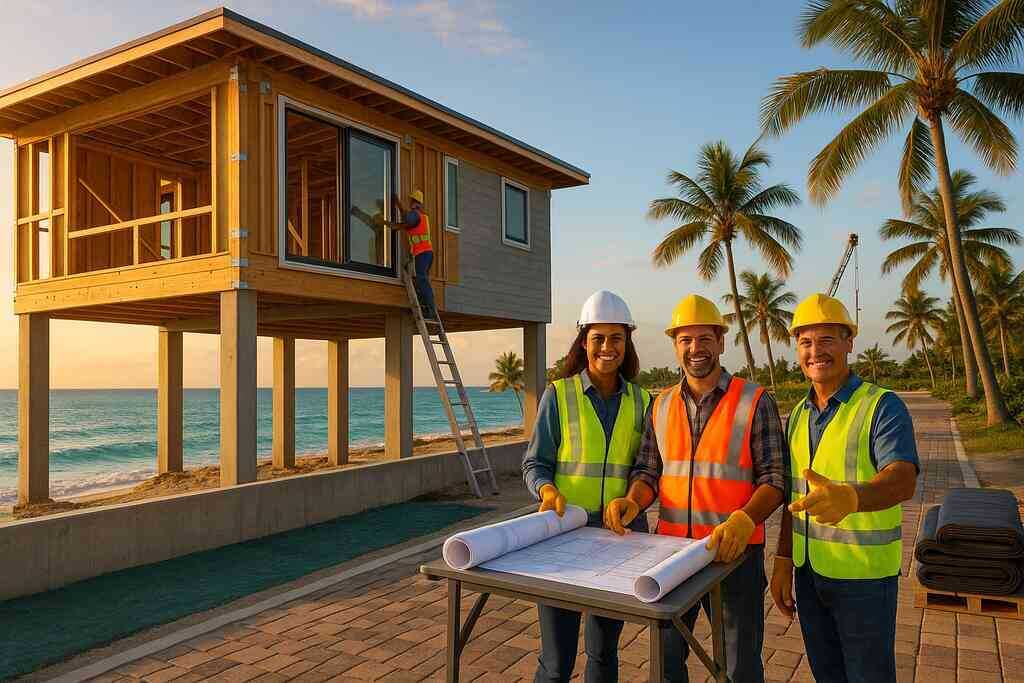 Water as Adversary Building Above Flood Lines and Below Surge
Flood zone permitting guidance and Boynton Beach floodplain management
Successful coastal projects always begin with accurate flood zone identification. Surveyors overlay FEMA maps onto municipal layers, verifying coastal A, AE, or VE designations before drawings start. Permit reviewers in Boynton Beach demand this evidence because floodplain misclassification triggers costly redesigns. Savvy project managers therefore schedule early pre-application meetings, clarifying mitigation expectations with municipal engineers. Those conversations often shorten review cycles and protect critical milestones.
Local statutes add nuanced requirements that outpace federal minimums. Freeboard mandates, cumulative substantial-improvement limits, and dry-floodproofing allowances all vary street by street. Because interpreting these nuances can overwhelm even seasoned builders, many owners engage contractor services in Boynton Beach for flood zones to steward documentation. These specialists translate municipal checklists into action items, align them with Florida Building Code hurricane provisions, and shepherd submittals through each department. Their guidance keeps projects moving even when storm season looms.
Elevation certificate best practices for homeowners and builders
An elevation certificate is not a simple form; it is a legal instrument that determines insurance premiums and resale value. Survey teams must shoot finished-floor elevations after final grading, yet before substantial vertical construction. Contractors then cross-reference those numbers against design flood elevations shown on civil sheets, confirming adequate freeboard. When discrepancies surface, rapid communication among the surveyor, architect, and structural engineer prevents downstream delays. Correct data ensures lenders approve draws without hesitation.
Storage of the certificate deserves equal care. Builders upload signed PDFs to cloud portals accessible to the entire project team, including future buyers. Inspectors request the document at framing and final stages, verifying compliance with flood zone permitting guidance. Because certificates also influence stormwater runoff calculations, accurate northing and easting coordinates matter. A misplaced benchmark could raise insurance costs for decades, underscoring the need for rigorous field validation.
Storm surge resilient foundations and seawall integration
Storm surge behaves like a mobile battering ram, applying lateral and uplift forces simultaneously. Designing foundations to resist that assault requires deep pilings, breakaway walls, and reinforced grade beams. Engineers calculate scour depths using historical surge data, then extend pile tip elevations well below predicted erosion lines. That depth protects structural capacity even when the surrounding soils wash away. Continuous load paths transfer wave energy into competent strata, safeguarding the superstructure.
Seawalls complement foundation resilience by absorbing and reflecting hydrodynamic forces before they reach the building. Strategic tie-backs anchor walls to dead-man systems buried inland, preventing overturning during extreme events. Forward-thinking owners partner with builders in Boca Raton on storm surge standards to align wall heights with municipal coastal setback line rules. The result is a unified defense that satisfies both environmental agencies and structural inspectors. When shoreline protections and foundations work as one, properties remain habitable even after record tides.
Driveway permeable paving and pool decking slip resistance in flood zones
Traditional concrete slabs shed water quickly, but they also exacerbate downstream flooding. Municipal codes now favor permeable systems that let rainfall percolate through aggregate layers, reducing surface runoff. Contractors specify open-joint pavers, porous asphalt, or resin-bound gravel depending on load requirements. Proper installation includes under-drains and geotextiles that prevent soil migration, ensuring durability during repeated inundations. The approach earns stormwater credits while protecting adjacent wetlands.
Pool decks require a complementary strategy because wet surfaces can become hazardous when algae blooms follow standing water. Slip-resistant coatings, grooved textures, and silica-enhanced sealers improve traction without trapping moisture. Experienced hardscape crews source materials labeled with Florida Product Approval numbers to streamline inspections. Homeowners interested in permeable surfaces often consult specialists in permeable driveway paving in coastal flood areas to balance aesthetics, code compliance, and longevity. This integrated mindset turns outdoor spaces into functional storm-management assets.
Plumbing venting above design flood elevation
Mechanical and plumbing systems represent hidden vulnerabilities when floodwaters rise. Current code insists all vent terminations, cleanouts, and backflow devices sit above the design flood elevation. Contractors route stacks through interior shafts, keeping penetrations away from surge-exposed walls. Where exterior vents remain unavoidable, durable ABS or PVC Schedule 40 materials resist saltwater corrosion better than cast iron. Rubber couplings receive stainless clamps to prevent galvanic reactions.
Builders also install automatic backwater valves to stop sewage reversal under hydrostatic pressure. These devices hinge open during normal flow yet seal instantly when flood levels climb. Regular maintenance plans include annual valve testing and gasket replacement, ensuring reliable performance during emergencies. By marrying thoughtful routing with corrosion-resistant components, plumbing systems stay operational when neighbors face outages. Forward-looking design therefore converts potential liabilities into resilient infrastructure.
Salt Air Corrosion and the Hidden Battle for Material Longevity
Salt air corrosion resistant materials and marine grade fasteners
Salt-laden breezes batter every exposed connection, so South Florida coastal building codes insist on true corrosion immunity. Experienced general contractors in South Florida compliance teams specify 316 stainless, silicon bronze, and hot-dip galvanized alloys from the first bid meeting. Even washers and joist hangers must meet a documented marine grade fastener specification or inspectors will flag them. For deeper context, review our detailed coastal building code guide for South Florida contractors, which outlines approved alloys and required coatings. By choosing these materials early, project managers avoid costly tear-outs that occur when hidden rust appears during punch-out.
Beyond base metal selection, smart builders demand factory-applied polymer coatings that seal micro-pores and block chloride intrusion. Home builders in Florida hurricane straps schedules now reference salt-spray test durations, ensuring connectors survive decades of tropical storms. Crews also record torque values because overtightening can crack zinc layers and welcome corrosion. Further, wind load requirements for contractors push designers toward heavier gauges, so every fastener must resist both uplift and chemical attack. This proactive mindset turns hardware into a long-term asset rather than a silent liability.
Exterior stucco moisture barrier code requirements
Exterior stucco offers beauty, yet its porous nature can trap salty moisture against framing. Florida Building Code hurricane provisions now demand a continuous water-resistive barrier, plus two separate flashing layers at every opening. Inspectors check staple spacing, lap widths, and drainage planes to confirm manufacturers’ instructions were followed precisely. Contractors navigating complex assemblies near dense urban shorelines often rely on navigating complex coastal codes near Miami and Broward for clarification. These resources streamline submittals and prevent expensive field corrections.
After lath installation, crews perform a cure-and-fill test that floods the surface, verifying proper weep functionality. Any leak triggers immediate remediation before finish coats lock problems inside the walls. Additionally, integrally colored cement mixes receive corrosion-inhibiting admixtures that protect embedded metal corner beads. The combined strategy satisfies exterior stucco moisture barrier code mandates while extending façade lifespan. Because salt air never rests, continuous quality checks remain essential from scratch coat to final texture.
Patio coverings decks and roofing contractors wind mitigation forms
Patio coverings and rooftop decks sit on the frontline of salt exposure, so every ledger, clip, and truss anchor must resist both uplift and oxidation. Insurance carriers request roofing contractors’ wind mitigation forms that document connector models, spacing, and test approvals. Property owners gain premium discounts when forms confirm storm-ready assemblies. To assemble seasoned carpenters, many designers simply find Decks Contractors through the directory, ensuring they already understand hardware certification. This pre-screening saves valuable days during tight build schedules.
Though paperwork matters, field execution ultimately determines performance. Crews seat silicone-sealed flashings beneath decking boards to channel water away from structural members. Stainless post bases elevate columns above slab puddles, removing another corrosion pathway. Moreover, treated lumber now features micronized copper formulas that pair well with compatible fasteners. Together, these decisions create patio systems that withstand wind, water, and relentless ultraviolet rays.
Energy code for coastal climates and envelope performance
Salt air corrodes metals, yet it also signals persistent humidity that challenges envelope efficiency. The energy code for coastal climates therefore targets vapor control, thermal breaks, and airtight seals with equal vigor. Designers begin by mapping prevailing winds, guided by the geography and climate of the South Florida region, to site buildings for passive cooling. High-performance wraps integrate corrosion-resistant reinforcement threads, preventing tear-outs during gusty storms. Low-emissivity coatings on impact glass further reduce solar gain while maintaining hurricane compliance.
Crucially, mechanical ventilation systems must balance pressure so salty moisture never condenses inside walls. Commissioning agents measure blower-door metrics and adjust fresh air intakes until they meet target ACH levels. Closed-cell spray foams applied to rafters add both structural rigidity and vapor resistance, supporting envelope performance goals. Meanwhile, reflective roof membranes deflect heat, reducing equipment runtime and energy costs. When thermal design aligns with corrosion control, coastal homes stay durable, comfortable, and efficient.
From Paper to Punch List: A Coastal Code Compliance Roadmap
 From Paper to Punch List: A Coastal Code Compliance Roadmap
South Florida contractor code checklist for field inspections
Every coastal job site succeeds or fails on the strength of its checklist. A well-built South Florida contractor code checklist moves through excavation, framing, and final punch without missing a single hurricane strap. Inspectors want proof that the crew met wind load requirements for contractors, elevation certificate best practices, and Miami-Dade impact window compliance. By organizing those checkpoints in chronological order, general contractors in South Florida avoid frantic, last-minute corrections that stall cash flow. The list doubles as training material, so new hires absorb coastal building DNA before they even load the truck.
Digital tracking now elevates the humble checklist into a real-time compliance dashboard. Supervisors upload photos that show storm surge resilient foundations, coastal setback line rules, and Fort Lauderdale seawall regulations being met. Color-coded alerts flag any lapse, letting the South Florida general contractor resolve it before the inspector arrives. Owners receive transparent snapshots that verify their investment aligns with South Florida coastal building codes. That transparency fosters trust, shortens punch lists, and protects everybody’s bottom line.
Delray Beach new construction permits and Boca Raton renovation updates
The permitting counter in Delray moves quickly when drawings arrive stamped by code experts in Delray Beach for hurricane design. These professionals translate nuanced hurricane-rated construction standards into crisp details that reviewers approve without red ink. They pre-load applications with flood zone permitting guidance, ensuring freeboard and drainage notes satisfy staff engineers. As a result, Delray Beach Construction Company teams can break ground sooner, positioning Delray Beach Custom Home projects ahead of storm season. Time saved in permitting often equates to money saved on contingency.
Ten miles south, Boca Raton Remodelers juggle renovation scopes that must dovetail with the evolving energy code for coastal climates. Local staff release bulletins updating nailing patterns and corrosion-proof hardware lists for Boca Raton Renovation Contractor submittals. Savvy builders track those notices within the same project management software that houses their field checklist. When code shifts appear, updated documentation flows directly to site tablets, keeping craftsmen aligned with the newest Florida Building Code hurricane provisions. Continuous feedback loops turn static permits into living documents that safeguard both schedule and structure.
Leveraging coastal setback line rules and Fort Lauderdale seawall regulations
A waterfront parcel may seem ideal until the coastal construction control line slices through the backyard. Understanding that invisible boundary early allows construction companies to optimize square footage without triggering lengthy variances. Coastal setback line rules dictate pile depth, grade beam placement, and landscape grading to preserve natural dune migration. Experienced home builders in Florida weigh those factors alongside storm surge data, crafting a footprint that remains compliant for decades. Proper planning prevents ugly surprises-and expensive redesigns-after surveyors hit the sand.
Fort Lauderdale adds another layer with stringent seawall regulations designed to tame king tide overflow. The city mandates specific wall heights, cap thicknesses, and tie-back spacings that integrate with adjacent properties. Ignore them and the permit desk issues immediate denials, derailing even the most elegant architectural vision. By coordinating seawall engineering with structural and geotechnical consultants, builders create seamless defenses that satisfy municipal reviewers and waterfront insurers alike. The result is a resilient complex that stays dry while neighboring lots mop saltwater from living rooms.
Connecting with general contractors in South Florida through the directory
Even the best roadmap stalls without the right drivers. Project owners, architects, and investors routinely open the South Florida Contractors directory when they type “contractor near me” into a search bar. Powerful filters reveal construction services ranging from Boynton Beach Remodelers to West Palm Beach Renovations specialists, each fully licensed and insured. Because every listing shows prior projects and specialties, stakeholders can quickly assemble a synergy of skills-structural, mechanical, and finish-tailored to coastal risk. The directory therefore shortens the hiring cycle and raises the collective bar for quality.
Once the team is formed, communication remains streamlined through the platform’s built-in messaging and document exchange. A South Florida contractor can upload revised wind uplift calculations while an electrician shares electrical code for seaside installations in the same thread. Owners watch progress unfold without chasing email chains, and inspectors can verify compliance documentation instantly. By unifying outreach, selection, and collaboration in one hub, the directory transforms due diligence into decisive action, turning paper plans into finished, compliant masterpieces ready for the next hurricane season.
Frequently Asked Questions
Question: How can South Florida Contractors help me navigate the strict wind load requirements for contractors and roof uplift resistance guidelines on a new coastal project?
Answer: Our directory lists pre-vetted general contractors in South Florida who work daily inside the West Palm Beach high velocity wind zone and other HVHZ districts. These experts use ASCE-7 tables and Florida Building Code hurricane provisions to calculate design pressures, select hurricane straps, and provide roofing contractors with wind mitigation forms that earn you insurance credits. By hiring through South Florida Contractors, you secure a team that already owns the 3-D modeling software, uplift worksheets, and stainless marine grade fasteners specification needed to pass every plan review and field inspection the first time.
Question: What steps do South Florida Contractors recommend for securing flood zone permitting guidance and accurate elevation certificates under Boynton Beach floodplain management rules?
Answer: Start by searching “contractor near me coastal code expert” on our site and filter for Boynton Beach Renovations or Boynton Beach Remodelers. These professionals schedule a pre-application meeting with municipal engineers, overlay FEMA coastal A zone design tips on your survey, and coordinate with licensed surveyors for elevation certificate best practices. They upload signed PDFs to the same cloud portal inspectors use, ensuring fast approvals, correct freeboard, and lower flood-insurance premiums. The result is a streamlined path from concept to concrete without costly redesigns.
Question: In your Guide To Coastal Codes For South Florida Contractors, you stress Miami-Dade impact window compliance. How does the directory connect me with certified installers near me?
Answer: Simply enter your ZIP code and select impact-window service under Find Whole Home Remodeling Contractors. The directory returns Boca Raton Renovation Contractor listings, West Palm Beach Renovations specialists, and other construction services that carry Notice of Acceptance numbers for every window and door line they install. You can click Make a Call Now to confirm stock, schedule a site visit, and verify they include Miami-Dade missile-test data in the permit packet. This end-to-end transparency guarantees your hurricane-rated construction standards are met and documented.
Question: Do you provide a South Florida contractor code checklist that covers Fort Lauderdale seawall regulations, marine grade fasteners, and energy code for coastal climates?
Answer: Yes. Every general contractor in the South Florida compliance team registered on our platform can download a customizable checklist that tracks more than 150 coastal building code line items. It flags Fort Lauderdale seawall regulations, coastal setback line rules, salt-air corrosion resistant materials, HVAC anchoring in high-wind areas, and the latest energy code for coastal climates. Field supervisors upload time-stamped photos to the checklist, giving owners, lenders, and inspectors real-time proof that storm surge resilient foundations, exterior stucco moisture barrier code, and plumbing venting above design flood elevation all meet or exceed standards.