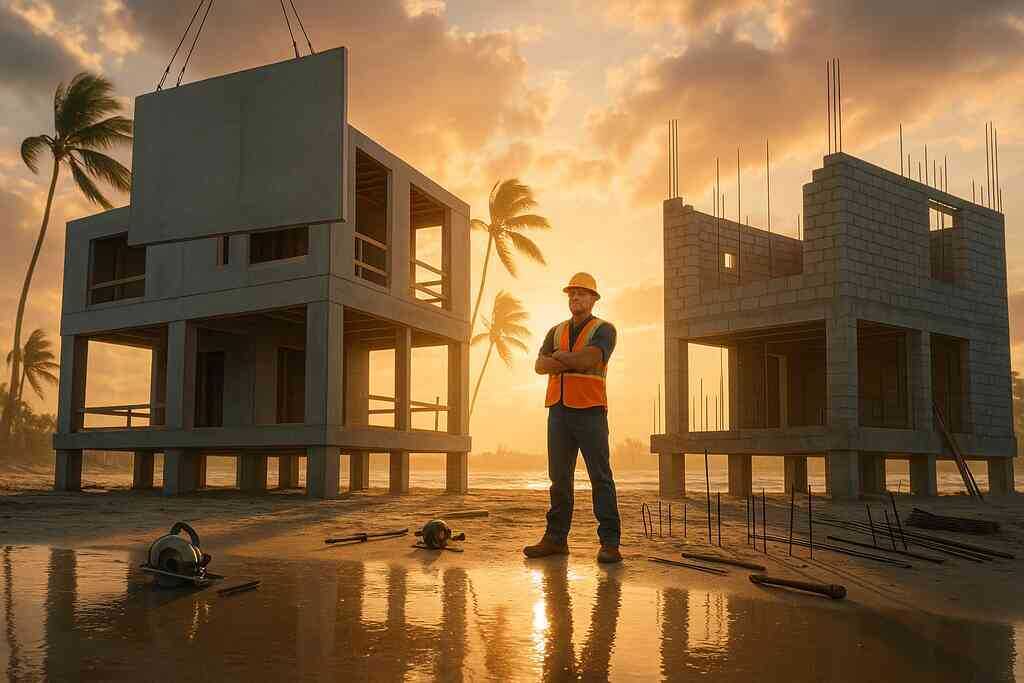
Prefab Versus Masonry Tests By South Florida Contractors
January 28, 2026
Atlantic Gusts and Concrete Dust Setting the Scene
Why hurricane resilience shapes every blueprint
South Florida homeowners never forget the roar of Atlantic gusts, so every new wall begins with wind in mind. Regional codes demand rigorous prefab construction testing and masonry durability trials before the first footing is poured. A seasoned South Florida contractor studies uplift charts like a quarterback studies defenses, always hunting weaknesses. Panels, blocks, and fastening schedules are modeled against Category-five simulations, ensuring hurricane resilience comparison data drives design. For readers gathering estimates, the South Florida contractor directory and resources offer vetted pros who already speak the language of wind pressure.
Prefab panels attract attention because factory presses create consistent density and embedded steel channels. That controlled environment eliminates voids that sometimes haunt rushed on-site pours, helping panels meet Miami-Dade wind load thresholds sooner. However, concrete masonry units, or CMU, deliver incomparable thermal mass benefits of masonry that steady interior temperatures when the grid flickers. Engineers test both assemblies inside blast chambers, tracking crack propagation at joint lines. These numbers inform insurance underwriters who reward clients choosing assemblies that keep envelopes unbreached.
From Boca Raton Remodelers to West Palm Beach Renovations: Voices from the field
Ask Boca Raton remodelers about block versus panel, and you will hear stories of patios still perfect after three storms. They credit thick CMU cores and continuous tie beams wrapped in epoxy-coated rebar. Meanwhile, West Palm Beach renovation crews praise modular panels craned into tight lots, allowing faster dry-in before afternoon squalls arrive. Each crew keeps moisture resistance in coastal builds at the forefront, sealing every penetration with redundant flashings. Although methods differ, both agree that quality labor remains the true storm shield.
Homeowners comparing general contractors in South Florida sometimes overlook acoustics, yet field recordings reveal telling differences. Masonry walls muffle wave roar and neighbor noise, enhancing serenity during recovery days. Prefab assemblies answer with advanced acoustic membranes laminated inside factory lines, creating lighter walls that still hush traffic. Contractors document decibel readings during post-completion walk-throughs, adding another metric for informed selections. Such transparent performance data strengthens trust and streamlines permitting conversations with code officials.
How Miami Dade wind load compliance drives innovation
The Miami-Dade Notice of Acceptance remains the golden ticket for any wall system marketed along the coast. Manufacturers submit specimens to cyclic pressure tests that mimic debris-laden gusts hammering soffits. Prefab suppliers often achieve certification first because integrated fasteners simplify anchor schedules, reducing variables that fail lab audits. Masonry producers respond with high-strength grout mixes and carbon fiber reinforced lintels, pushing CMU block wall strength to new records. This friendly rivalry accelerates innovation that benefits every home builder in Florida.
Compliance extends beyond structural panels into roofing, windows, and even driveway concrete interfaces. Architects coordinate engineering notes across disciplines, ensuring the entire envelope performs as a single resilient shell. South Florida general contractor teams track each approval number in cloud databases, ready for spot inspections at any stage. Clients then enjoy smoother closings and potentially lower premiums because documented performance satisfies underwriters. Ultimately, relentless wind load scrutiny elevates construction services and keeps communities safer season after season.
Lab Versus Slab Inside the Structural Test Arena
Factory quality control metrics and onsite grout testing
Prefabricated wall plants resemble aviation assembly lines, where lasers verify every stud location before concrete reaches the mold. Sensors log density and temperature in real time, creating a digital paper-trail that South Florida contractor insights rely on during permitting. Because these readings accompany every shipment, municipal inspectors gain confidence long before panels are craned into place. Homeowners comparing modular home assemblies appreciate this transparency, and many begin their search with the locate builders near South Florida for prefab or masonry directory to vet teams already fluent in such data. Meticulous factory records shorten close-out punch lists, translating directly into fewer schedule delays.
Concrete masonry, by contrast, proves its mettle under open-sky conditions, where humidity swings can skew slump ratios. Foremen combat variability through onsite grout testing, extracting cylinders that cure beside the wall for apples-to-apples strength readings. These samples face compression machines that mirror Florida Building Code structural tests, confirming CMU block wall strength against published charts. General contractors in South Florida document every result in cloud portals, giving code officials and insurers equal access. When readings surpass target PSI, crews confidently proceed to tie-beam placement, knowing the skeleton will resist uplift once hurricane season returns.
Thermal mass benefits against high R-value prefab panels
South Florida’s afternoon heat spikes challenge even the best HVAC designs, so builders weigh the thermal mass benefits of masonry against the high R-value prefab panels boast. Thick CMU cores absorb radiant heat, releasing it slowly after sunset and flattening indoor temperature swings. Engineers model this lag effect and often pair block walls with reflective roof coatings for maximum efficiency. Home builders in Florida chasing net-zero targets sometimes still favor factory panels, yet energy simulations reveal masonry can reduce peak cooling loads by double-digit percentages. Choosing between the two becomes a nuanced dance of budget, performance, and architectural style.
High-density prefab panels counter with embedded foam layers and metallic vapor barriers that push whole-wall R values noticeably higher. During prefab construction testing, labs cycle temperatures rapidly to mimic coastal microbursts, proving that internal cores resist condensation even when dew points soar. Contractors track kilowatt-hour savings over entire subdivisions, demonstrating that tailored panel stacks can match, and occasionally surpass, masonry performance. Such data empower value engineering for custom homes, where every utility dollar saved boosts resale appeal. Ultimately, climate-responsive envelopes hinge on collaboration between architects and construction companies committed to evidence-based design.
Acoustic and moisture resistance benchmarks in coastal builds
Beachfront lots amplify sound; waves, jetskis, and traffic reverberate between structures like concert halls. Acoustic performance evaluation therefore measures not only decibel reduction but also tonal clarity inside occupied rooms. Masonry walls, dense and discontinuous, naturally dampen low-frequency rumble that keeps newborns awake. Prefab suppliers answer with laminated membranes bonded during production, ensuring layers remain airtight even after transport vibration. Field tests place calibrated speakers outside while sensors monitor interior readings, giving Boynton Beach remodelers experienced in CMU walls objective numbers to share with clients.
Coastal storms add a second threat: wind-driven rain that infiltrates capillary cracks. Moisture resistance in coastal builds demands flashings, breathable wraps, and salt-air corrosion mitigation at every joint. CMU assemblies lean on water-repellent admixtures and integral stucco additives, while prefab panels integrate gasketed seams locked tight with torque-specific fasteners. The guide to navigating complex coastal codes in Florida outlines inspection checkpoints that verify these defenses before drywall begins. Passing scores not only protect finishes but also influence insurance premium impact on construction choice, a decisive factor for many waterfront buyers.
Carbon footprint snapshots of each assembly method
Sustainable building options in South Florida now extend beyond recycled countertops into the very skeleton of a home. Lifecycle assessors calculate emissions from cement kilns, steel mills, transportation, and onsite energy use, producing a carbon footprint comparison of building methods. Prefab plants operate in controlled environments, recycling wash water and capturing dust, which lowers embodied carbon per square foot. They also minimize waste by cutting panels to exact dimensions, leaving little for landfills. Such statistics resonate with municipal leaders setting aggressive climate goals.
Masonry advocates counter with emerging geopolymer blends that swap traditional Portland cement for fly ash and slag, slashing CO₂ output dramatically. Ongoing research, highlighted in the Exploring green concrete advances for resilient builds report, shows these mixes can reach hurricane-grade strength while sequestering industrial by-products. Contractors executing flood zone foundation strategies mix low-carbon grout onsite, then document volumes for green-building certifications. Whether selecting block or panel, owners now weigh emissions alongside cost and timeline, proving environmental stewardship sits firmly on the critical-path schedule.
 Dollars Days and Debris Lifecycle Costing and Speed Analysis
 Dollars Days and Debris Lifecycle Costing and Speed Analysis
Rapid onsite assembly and labor savings in flood zones
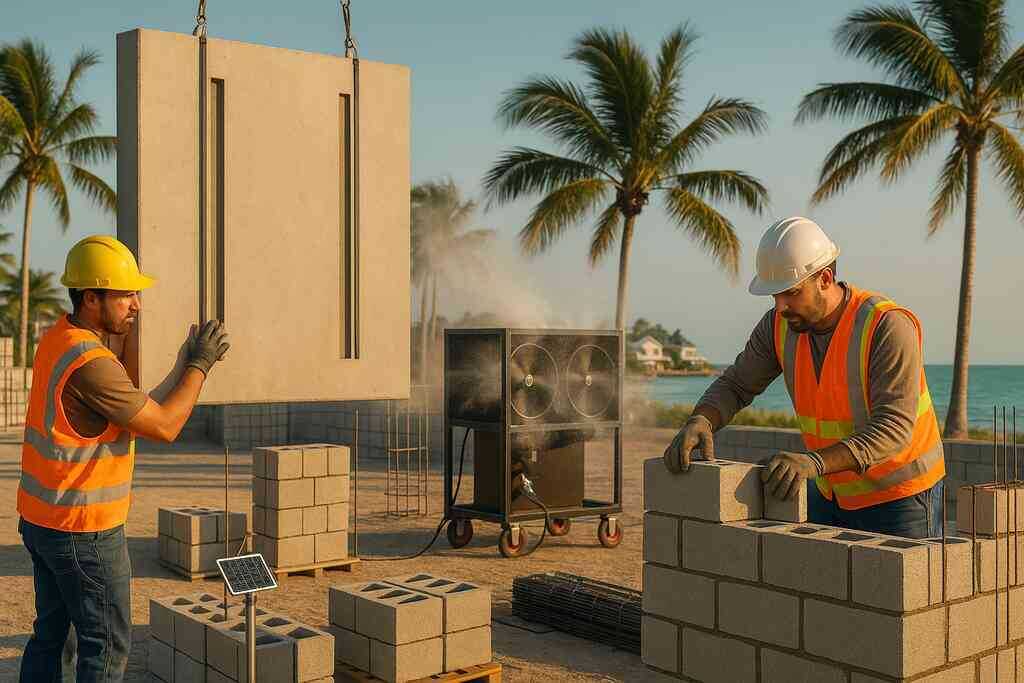
Prefabricated modules arrive sealed, labeled, and ready for craning, so staging yards stay clean even when tidewaters creep inland. South Florida contractor insights show that rapid onsite assembly can cut weather-exposure days in half, a priceless buffer when afternoon squalls strike. Modular home assemblies also minimize temporary bracing, freeing crews to jump straight into mechanical rough-ins while neighbors still wrangle formwork. Labor cost analysis for prefab highlights fewer overtime hours, because panels click together under predictable torque settings instead of hand-stacked blocks. When flood zone foundation strategies demand swift elevation, that speed shrinks the window during which storm debris might batter an unfinished frame.
General contractors in South Florida lean on just-in-time delivery schedules that synchronize trucks with crane availability, ensuring no panel sits vulnerable on saturated soil. West Palm Beach renovation specialists now clock record setting dry-in times, sometimes locking roofs before the next tidal cycle finishes. Those milestones matter because every protected square foot reduces insurance punch-list scrutiny later. By contrast, masonry durability trials still require sequential pours and curing pauses, adding days that can compound into weeks when humidity spikes. The result is a clear labor savings curve favoring prefab in flood-prone corridors, one that homeowners can verify through budget trackers shared by West Palm Beach renovation specialists for modular panels.
Material sourcing for masonry and salt air corrosion mitigation
CMU block wall strength begins long before the first unit is laid; it starts inside regional quarries selecting aggregate resistant to chloride intrusion. Experienced Boynton Beach remodelers purchase cement blended with supplementary fly ash, lowering permeability and fortifying joints against salt-laden breezes. Material sourcing for masonry therefore intertwines with salt-air corrosion mitigation, because rebar in coastal builds must survive decades of spray. Contractors test epoxy-coated steel samples in salt-fog chambers alongside masonry durability trials, documenting rust patterns for clients comparing bids. Those reports prove why a penny saved on an inferior bar today can balloon into a costly structural retrofit tomorrow.
Local supply chains further shield schedules from port delays that occasionally stall imported panel hardware. Delray Beach construction company buyers often ride at dawn to inspect kilns and verify batch tickets, guaranteeing consistency that prefab construction testing sometimes takes for granted. Their vigilance pays off when surge events wash sediment across roads; nearby stockpiles allow immediate replacement of damaged skids. Additionally, builders weave galvanic break tapes between metals and mortar, a small step that prevents hidden electrochemical reactions. Such holistic sourcing keeps masonry competitive even as prefab touts speed.
Insurance premiums shift when choosing prefab or masonry
Insurance carriers update actuarial tables every storm season, rewarding assemblies that maintain envelope integrity under Miami-Dade wind load compliance testing. Prefab suppliers bring binders packed with cyclic-pressure graphs, allowing underwriters to assign favorable windstorm deductibles once installations pass inspection. Masonry champions counter with decades of claims data showing block homes that survived past landfalls with minimal payouts. Actuaries now parse both sets of evidence, so premium shifts hinge on documented performance rather than marketing hype. Homeowners leveraging a South Florida general contractor near you can request side-by-side hurricane resilience comparison sheets before finalizing coverage.
Roof systems remain the biggest wildcard, because uplift failures quickly negate wall strength savings. Working with find roofing experts for Miami-Dade wind compliance brings vetted crews who sync fastening schedules with either panel anchors or masonry tie-beams. Coordinated details often shave additional percentage points off policies, especially when third-party inspectors log every torque check. Investors holding multiple rentals notice these reductions immediately, because lower premiums compound across portfolios. The takeaway is clear: structural choice and insurance strategy must evolve together, not in isolation.
Permitting pathways for prefab modules within the Florida Building Code
Navigating municipal desks can feel like paddling through mangroves, yet prefab modules now enjoy streamlined lanes within the Florida Building Code. Engineers submit sealed shop drawings that already incorporate Florida Building Code structural tests, sparing reviewers from recalculating every shear panel. Digital submittals also include tracking numbers from Miami-Dade Notice of Acceptance databases, accelerating approval stamps that once took months. Field inspectors then audit factory quality control logs on tablets, ensuring each serial number matches what was modeled. That transparency reduces reinspection fees and shortens lender draw schedules.
Still, local amendments vary block by block, so contractors monitor hearings that tweak egress or energy thresholds each season. Staying ahead means studying the updated hurricane codes for 2025 resource, which distills new language into actionable checklists. Masonry permits follow familiar paths but may require additional grout break tests, adding coordination meetings that prefab avoids. Both methods must document flood-vent calculations when projects sit below base elevation, yet modular assemblies often integrate vents at the factory, satisfying code in one sweep. Ultimately, choosing the right pathway depends on timeline, tolerance for paperwork, and partnership with a seasoned South Florida contractor who speaks fluent bureaucracy.
Resale Value and Maintenance Case Files from Delray to Boynton
Lifespan maintenance costs for custom coastal homes
Custom homes lining the Atlantic in Delray sparkle at closing, yet wise buyers budget for decades, not weekends. Salt crystals infiltrate fascias, demanding repainting every seven years despite premium coatings. Routine stucco inspections catch hairline cracks before they channel rainwater into wall cavities. A seasoned South Florida contractor schedules these audits alongside annual HVAC tune-ups, keeping envelopes tight. Over thirty years, disciplined maintenance reduces structural repairs, preserving resale premiums even when adjacent properties fade.
Material choice predictably shapes expense schedules. Prefab panels resist termites, so owners skip costly fumigation rounds common with legacy framing. CMU block wall strength delivers another dividend, because cracks seldom exceed cosmetic thresholds. However, grout joints need periodic sealant renewal to maintain moisture resistance in coastal buildings. Added together, total maintenance projections rarely surpass two percent of original construction costs annually.
Value engineering wins in Boynton Beach Remodelers projects
Value engineering begins on the whiteboard long before demolition dust rises on Ocean Avenue. Boynton Beach Remodelers scrutinize every beam, hunting redundant materials that add weight without strength. Switching from solid sawn headers to engineered lumber saved one client thousands while keeping Miami-Dade wind load compliance intact. They documented results in the Boynton Beach custom home oasis project case study shared with prospective owners. That transparency turns abstract savings into tangible trust during bid selection.
Labor optimization follows material trimming. Crews pre-cut roof truss blocking off-site, reducing scaffold hours exposed to unpredictable squalls. That simple shift lowered accident insurance premiums, further tightening budgets. South Florida contractor insights show these incremental gains can free funds for impact-rated glass upgrades. Consequently, renovated homes exit the market faster, eclipsing neighborhood comparables by double-digit percentages.
Retrofit potential for driveway concrete roofing and decking interfaces
Older coastal estates often conceal vulnerabilities where disparate materials meet, especially at driveways intersecting foundation footings. Freeze cycles are rare here, yet tidal moisture undermines concrete-to-steel bonds over time. Retrofit crews inject low-shrink epoxy grout, restoring bearing capacity without full slab replacement. Parallel roofing interfaces gain new life through self-healing membranes that seal nail penetrations automatically. Homeowners appreciate minimal disruption, as cars and patios return to service within days.
Choosing the right specialist streamlines every retrofit phase. Property managers start by using the directory to find Driveway Concrete and paving Contractors alongside Find Roofing Contractors in one search. Coordinated teams stagger tasks, preventing heavy equipment from damaging freshly surfaced decks. General contractors in South Florida oversee this choreography, ensuring warranty scopes remain clear. Ultimately, targeted upgrades boost curb appeal and extend lifecycle, strengthening negotiation power when it is time to list.
Final Verdict: Building Futures One Block or Panel at a Time
 Final Verdict: Building Futures One Block or Panel at a Time
Decision matrix for home builders in Florida
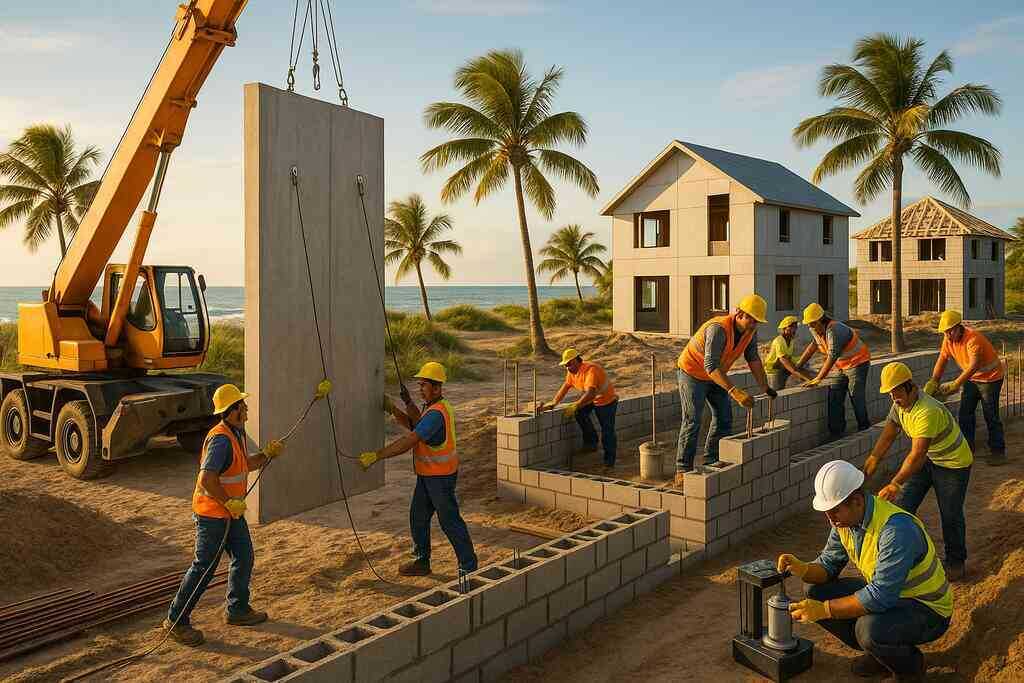
Every South Florida contractor begins with a scorecard that balances wind, water, budget, and beauty. Homeowners compare prefab construction testing data against masonry durability trials, translating lab numbers into peace of mind. Columns list hurricane resilience comparison values beside thermal mass benefits of masonry, giving clarity at a glance. To explore these metrics further, review the comparing prefab wall systems article on South Florida Contractors before drafting budgets. The exercise reveals how small shifts in panel thickness or block spacing can unlock valuable insurance discounts.
Decision tables continue by weighing project timelines against risk tolerance. Prefab assemblies promise rapid onsite assembly savings, ideal when flood season looms. CMU walls extend schedules but reward patience with unmatched acoustic performance evaluation results. Miami-Dade wind load compliance scores remain non-negotiable, so engineers overlay those requirements on every option. Finally, smart owners update their matrix whenever material pricing or code language changes, ensuring choices stay current.
Sustainable building options with local supplier networks
Eco-minded clients now ask about the carbon footprint comparison of building methods during initial consultations. Suppliers answer by showcasing low-carbon cement, reclaimed steel, and factory recycling programs. Reliable sourcing hinges on proximity, because short delivery routes slash emissions and reduce storm delay risks. A quick scan of the regional overview of South Florida climate demands reminds teams why humidity control and salt resistance guide every green decision. Local quarries and panel plants therefore become strategic allies, not just vendors.
Collaboration also fuels innovation. Contractors share moisture resistance in coastal builds data with manufacturers, inspiring next-generation sealants that breathe while blocking chloride ions. Meanwhile, architects integrate rooftop solar anchors directly into panel molds, trimming future retrofit costs. Masonry producers experiment with geopolymer mixes that sequester industrial by-products and still meet Category-five strength. These synergies prove that sustainability and strength can coexist without sacrificing style or speed.
Partnering with a South Florida general contractor near you
Choosing materials is only half the battle; execution separates theory from reality. Homeowners browsing Boca Raton contractor services for hurricane-ready homes discover teams already fluent in uplift charts and factory log audits. These professionals coordinate engineers, suppliers, and inspectors, turning complex matrices into streamlined schedules. Transparent communication tools let clients track torque checks, grout breaks, and energy simulations from any device. Trust grows quickly when progress photographs align with daily field reports.
A seasoned South Florida general contractor also manages evolving code requirements with ease. Familiarity with the role of a general contractor in project delivery ensures seamless permit navigation and lender draw coordination. The contractor’s network secures priority slots at panel plants or block yards, preventing costly idle days. Post-completion, maintenance calendars and warranty documents arrive organized, empowering owners to protect their investment long after the ribbon cutting. Partner wisely, and the right builder transforms your decision matrix into a resilient coastal sanctuary.
Frequently Asked Questions
Question: How do prefab construction testing and masonry durability trials differ when it comes to Miami-Dade wind load compliance?
Answer: Prefab construction testing happens inside climate-controlled plants where factory sensors record every pour, cure cycle, and fastener torque. These digital logs are packaged with each shipment, so Miami-Dade inspectors can verify wind load calculations before the panel ever reaches your lot. Masonry durability trials, on the other hand, rely on onsite grout cylinder pulls and cyclic pressure chambers that simulate hurricane uplift on CMU block walls. South Florida Contractors vets local labs for both methods, ensuring that whether you pick modular home assemblies or traditional block, your project passes Florida Building Code structural tests on the first try.
Question: What advantages does South Florida Contractors offer when comparing CMU block wall strength with the energy efficiency in prefab panels?
Answer: The directory connects you to general contractors in South Florida who specialize in both systems, so you receive side-by-side bids that include thermal mass benefits of masonry and the high R-value foam cores in prefab panels. Our listed pros provide detailed energy simulations, show real-world acoustic performance evaluation data, and outline carbon footprint comparisons of building methods. By seeing the numbers for peak cooling loads, insurance premium impact on construction choice, and long-term maintenance costs, homeowners can make a truly informed decision-without juggling multiple phone calls.
Question: In your recent blog Prefab Versus Masonry Tests By South Florida Contractors, you mentioned rapid onsite assembly savings. How does that translate into lower labor costs and insurance premiums?
Answer: Rapid onsite assembly means prefab panels lock together in days, not weeks. Fewer weather delays reduce overtime, staging rentals, and exposure to flood zone foundation risks. Because the envelope reaches dry-in faster, underwriters often assign lower windstorm deductibles, recognizing a reduced chance of rain or debris damage during construction. Our South Florida contractor insights show labor cost analysis for prefab can trim total build budgets by up to 15 percent while shaving insurance premiums by double digits.
Question: How can I use the South Florida Contractors directory to find experts in moisture resistance in coastal builds and salt-air corrosion mitigation near me?
Answer: Simply enter your ZIP code on SouthFloridaContractors.com, filter by specialties such as Find Roofing Contractors, Find Driveway Concrete and Paving Contractors, or Boca Raton Remodelers, and review each profile’s coastal project portfolio. Look for contractors who highlight water-repellent admixtures, epoxy-coated rebar, and gasketed panel seams. The directory displays distance, licensing, and customer reviews, so you can quickly shortlist a South Florida general contractor near you who already understands salt-air challenges.