What Does Passive Cooling Mean to South Florida Contractors
February 23, 2026
Awakening to Passive Cooling in the Sunshine Construction Belt
Why South Florida General Contractors Must Rethink the AC-First Mindset
South Florida contractors once relied almost exclusively on oversized air-conditioning to chase comfort, yet soaring energy bills and stricter codes now demand a different approach. Passive cooling strategies-natural ventilation techniques, shading solutions, and thermal mass construction-can trim mechanical loads by half while keeping interiors pleasantly cool. When a South Florida general contractor embraces these methods, they instantly differentiate their construction services in a competitive, heat-intense market. Clients notice the quieter interiors, lighter utility bills, and lower maintenance costs, which moves passive cooling from a fringe concept to a mainstream expectation. That shift forces every contractor in South Florida to take design conversations beyond SEER ratings and toward sun paths, breezes, and building envelopes.
Contractors who master passive cooling also future-proof their businesses against grid instability and tightening codes. Homeowners increasingly ask about sustainable home retrofits rather than bigger condensers. Neighborhood associations prefer eco-friendly remodels that preserve community aesthetics while reducing peak electrical demand. Even lenders reward energy-efficient building envelopes with better terms, so financial incentives align with technical best practice. Smart builders now pitch passive design during early schematic meetings, framing mechanical systems as backup rather than primary comfort drivers. The result is a reputation for innovation that ripples across Boca Raton remodeling leads and Delray Beach custom home request lines alike.
Heat Mitigation as a Profit Center for Construction Companies Near You
Turning heat mitigation into a revenue stream starts with quantifying savings. General contractors in South Florida can demonstrate that reflective roofing materials and cool roof design lower attic temperatures by thirty degrees, extending shingle life and shrinking duct losses. That data justifies premium materials and healthier margins without feeling like an upsell. Interior paint contractors also benefit by specifying lighter, solar-reflective palettes that result in fewer customer callbacks for peeling or fading. Across every trade, documented reductions in cooling load become tangible proof of value that clients share on social media and in neighborhood forums.
Passive cooling projects also create natural cross-sell opportunities for construction companies. A driveway concrete and paving contractor can integrate light-colored aggregates to reduce surface heat islands, then partner with pool decking crews for complementary thermal mass solutions. Electricians installing smart ceiling fans can collaborate with HVAC professionals to program mixed-mode ventilation schedules. By marketing these bundled services, a South Florida general contractor gains economies of scope that raise average project value while showcasing holistic expertise.
How the South Florida Contractors Directory Connects Homeowners with Eco-Friendly Remodel Leaders
Savvy homeowners now start their search at the South Florida contractor network for passive cooling projects, where filters highlight companies experienced in passive house design, green building certification in Florida, and humidity-smart construction. The directory allows users to compare credentials, read project spotlights, and book consultations within minutes, driving qualified leads straight to firms that have invested in sustainable skill sets. Because listings rank by proximity, even small Boynton Beach renovation specialists can compete with regional giants if they showcase verified passive cooling case studies.
For contractors, the platform functions as a digital showroom. They upload cross-breeze layout diagrams, cool roof drone footage, and energy-audit before-and-after charts that validate performance claims. With each completed project, reviews citing lower interior temperatures without constant AC reinforce social proof. Directory analytics then pinpoint zip codes where demand surges, letting construction companies fine-tune their marketing around neighborhoods most receptive to cost-saving cooling solutions.
Reading the Climate: From Atlantic Sun Paths to Everglades Humidity
Solar Orientation Planning That Outsmarts Relentless Coastal Glare
The Atlantic sunrise delivers blistering heat before breakfast, so proper solar orientation is the first line of passive defense. South-facing facades should incorporate deep overhangs, while east and west walls need vertical fins or dense vegetation to block low-angle rays. Even a modest rotation in the floor-plan axis can reduce peak solar gain by ten percent-a metric that architects should model during early feasibility studies. When builders collaborate on these decisions early, framing layouts, window schedules, and mechanical rough-ins align seamlessly, trimming both construction time and waste.
Beyond individual homes, neighborhood planning benefits from solar mapping as well. Aligning streets along the prevailing breeze corridor encourages cross-lot airflow, cooling public spaces and reducing asphalt heat reflection. Municipalities now factor these passive principles into zoning overlays, offering density bonuses to developments that document solar orientation planning. Contractors who can produce such compliance reports quickly gain a competitive edge during bid review.
Humidity Control Construction Practices for West Palm Beach Energy-Efficient Homes
In South Florida, temperature is only half the comfort equation; humidity regularly hovers above eighty percent. Innovative wall assemblies use smart vapor retarders that open when dew points drop, allowing structures to dry out rather than trap moisture. West Palm Beach specialists in humidity-smart construction embed capillary breaks beneath slabs to prevent groundwater from wicking upward into conditioned spaces. These details cost pennies per square foot yet can avert thousands in future mold remediation.
Mechanical strategies are evolving too. Variable-speed ERV units balance humidity without oversizing compressors, while dedicated dehumidifiers run on low amperage overnight when photovoltaic output is minimal. Integrating sensors into the building automation system gives contractors new maintenance service contracts, creating recurring revenue while safeguarding indoor air quality.
Coastal Resilience Tactics That Marry Passive Cooling with Hurricane-Grade Durability
Passive cooling must coexist with high-velocity hurricane zone requirements. Impact-rated Low-E glazing allows cross-ventilation during calm weather but locks tight behind reinforced shutters when storms threaten. Roof assemblies pair reflective membranes with secondary water barriers to shed both heat and wind-driven rain. Contractors who follow these layered approaches earn reputations for building homes that stay comfortable year-round and secure during extreme weather events.
Elevated floor systems, often mandated by flood maps, further aid thermal regulation. Lifting living areas above grade creates shaded undercrofts that cool slab temperatures and permit unobstructed airflow. Properly screened, these spaces become functional outdoor rooms, extending occupant comfort without adding conditioned square footage.
Blueprint Alchemy: Turning Breeze, Shade, and Mass into Everyday Comfort
Cross-Breeze Layout Optimization for Boca Raton Passive Cooling Remodels
Legacy floor plans in Boca Raton rarely accounted for prevailing southeast trade winds, but remodelers now re-angle corridors and widen interior doorways to promote airflow. Positioning intake windows at lower elevations and exhaust vents near clerestories amplifies the stack effect, drawing cooler evening air through living spaces. Boca Raton general contractors specializing in cross-breeze renovations showcase projects where mechanical cooling dropped by forty percent after simple wall relocations and louver upgrades.
Furniture placement matters too. Open-back bookcases and leggy sofas allow breezes to skim surfaces, whereas bulky sectionals block circulation. Educating clients on these subtleties transforms remodelers into trusted advisors, deepening relationships well beyond bricks and mortar.
Landscape Shading with Native Plants: Beyond the Patio Covering Contractor Playbook
Strategic landscaping serves as aesthetic enhancement, ecological restoration, and thermal buffer all at once. Native gumbo-limbo and live oak species cast broad canopies that cool facades and create microclimates for outdoor living. Their deep roots stabilize soil, protecting foundations against erosion from intense rain events. When combined with hardscape pergolas crafted by patio covering experts, the result is layered shading that remains effective from sunrise to dusk.
Choosing native flora also reduces irrigation demands-a critical benefit during seasonal water restrictions. Contractors who partner with local nurseries can bundle planting plans with decking or pool resurfacing quotes, offering clients turnkey solutions that maximize shade while minimizing maintenance.
Thermal Mass Construction Using Driveways, Pool Decking, and Concrete Patios
Concrete, stone, and even water features act as thermal batteries, absorbing heat during the day and releasing it after sunset when ambient temperatures dip. By specifying lighter-colored aggregates and high-albedo sealers, contractors prevent daytime surface scorching while still leveraging nighttime heat release for gentle warming during rare cold snaps.
Pool decking positioned to intercept prevailing breezes cools adjacent interiors through evaporative action. Driveway concrete can integrate recycled glass cullet, enhancing reflectivity while lowering embodied carbon. Collectively, these elements form an outdoor thermal mass network that passively moderates temperature swings across the entire property.
Dynamic Overhangs and Pergolas Designed by Delray Beach Custom Home Builders
Fixed rooflines suit static climates, but South Florida’s sun angle shifts dramatically between solstice extremes. Delray Beach custom home builders now design adjustable louvers and modular pergola panels that homeowners can tilt seasonally, balancing shade and daylighting. Builders specializing in landscape shading retrofits report that customers appreciate the theatrical quality of moving shadows-a visual signal of sustainable living that doesn’t sacrifice style.
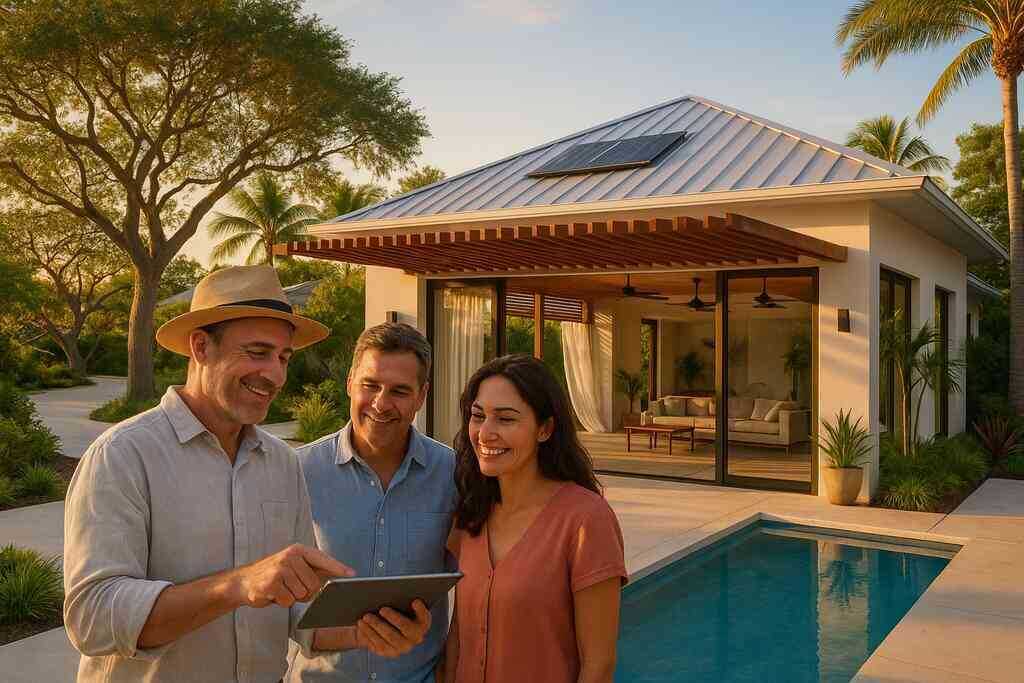
By using corrosion-resistant aluminum frames and sustainably harvested hardwood slats, these systems maintain their aesthetic long after cheaper vinyl options warp. Integrating photovoltaic strips onto pergola ribs further blurs the line between passive and active energy capture, advancing the march toward net-zero ready homes.
Material Mastery: Cool Roofs, Tight Skins, and Low-Energy Backups
Reflective Roofing Materials Plus Radiant Barrier Installation for Boynton Beach Renovations
Boynton Beach renovators quickly discovered that the attic is ground zero for heat accumulation. White elastomeric membranes, ceramic-coated shingles, and metal roofs with high Solar Reflectance Index ratings bounce infrared radiation away before it penetrates the envelope. Beneath the deck, double-sided foil barriers create an additional shield. Specialists in radiant-barrier attics routinely document attic temperature drops of forty degrees, enabling smaller and less expensive mechanical systems.
Contractors should also select fastening systems tested for hurricane uplift to ensure reflectivity does not compromise resilience. These assemblies integrate with stucco or siding transitions, delivering a unified exterior that sheds both solar load and tropical storms.
High-Performance Window Selection That Pairs with Exterior Paint and Stucco Contractors
Low-E, argon-filled glazing blocks ultraviolet gain while preserving coastal views, but frames must match wall assemblies to avoid thermal bridging. Partnering with exterior paint and stucco teams for high-performance envelopes ensures proper flashing integration and color selection that complements spectral reflectivity.
Dynamic glazing adds further adaptability, tinting automatically under intense glare and then clearing for evening cross-ventilation. Though upfront costs are higher, lifecycle analyses confirm rapid payback when paired with passive cooling design.
Attic Ventilation Upgrades and Insulated Envelopes That Let HVAC Systems Rest
Ridge vents, solar-powered exhaust fans, and generous soffit intakes create a convective loop that purges superheated air before it infiltrates living zones. Dense-pack cellulose or open-cell spray foam insulates rooflines while still permitting managed vapor diffusion, ensuring envelopes stay tight without suffocating. These strategies collectively reduce latent loads, allowing low-energy HVAC integration to serve as a safety net rather than the primary comfort system.
Contractors who share blower-door test results give homeowners empirical proof of envelope performance-a compelling point that builds trust. Regular re-testing during warranty visits generates service income and sustains brand loyalty over time.
Integrating Low-Energy HVAC as a Safety Net in Florida Climate-Adaptive Architecture
Even the best passive house design can still face sauna-like summer spikes, so efficient mechanical support remains essential. Heat-pump systems with variable refrigerant flow modulate capacity, consuming power only when internal gains outpace passive dissipation. Coordination with advanced HVAC strategies that support passive cooling guarantees seamless commissioning.
Through mixed-mode controls, thermostats prioritize natural ventilation first, then quietly activate compressors if indoor dew-point thresholds are reached. This hierarchy slashes runtime while preserving occupant comfort, proving that technology and traditional building wisdom can work in concert rather than at cross-purposes.
Building the Legacy: Marketing and Monetizing Passive Cooling Expertise
Green Building Certification in Florida as a Differentiator for Contractor Bids
Earning certifications such as Florida Green Building Coalition or LEED adds a verifiable mark of competence to bid packets. Review committees increasingly factor energy modeling, solar orientation planning, and humidity control practices into scoring rubrics. Contractors armed with passive cooling portfolios routinely outrank equally priced competitors who lack documented performance records. The certification process also sharpens internal protocols, raising quality control standards across future projects.
Once accredited, firms can host continuing education seminars for realtors and appraisers, building awareness that raises overall market demand for energy-efficient homes. That ecosystem effect multiplies inquiries, filling sales pipelines with clients already aligned with passive design values.
Cost-Saving Cooling Solutions That Satisfy Homeowners and Protect Margins
Lowering a home’s cooling load reduces the tonnage of HVAC equipment required, cutting installation costs while maintaining markup percentages. Reflective roofing or radiant barrier line items may carry higher material costs, but reduced mechanical sizing offsets the difference, keeping total budgets intact and contractor profit healthy. Maintenance savings also translate into glowing testimonials, which fuel marketing campaigns at minimal expense.
Additionally, passive features rarely fail, which shrinks warranty risk compared with compressors or condensate pumps. Contractors therefore field fewer emergency callouts, stabilizing cash flow and protecting hard-earned reputations.
Using the South Florida Contractors Directory to Showcase Passive Cooling Projects
Uploading project case studies, energy-audit infographics, and client video testimonials to the directory places proof of expertise directly in front of motivated prospects. Geotagged content surfaces in “passive cooling experts near me” searches, eliminating the ad spend typically required to reach the same audience. Contractors also gain competitive intelligence by observing which keywords peers use successfully, then refining their own listings accordingly.
Collaborative articles and webinars hosted through the platform allow multiple trades-roofers, electricians, and home builders in Florida-to co-market integrated solutions. This cross-pollination fosters referral loops that compound lead generation over time, sustaining growth without proportional marketing costs.
Toward Net-Zero Ready Homes and a Cooler Future for Every Community
Passive cooling represents more than a design tactic; it marks a cultural shift toward stewardship of South Florida’s precious coastal ecosystem. By reducing reliance on fossil-fuel-generated electricity, contractors directly contribute to a lower regional carbon footprint and improved grid resilience during heat waves. Neighborhoods once burdened by brownouts will find stability as homes demand less power during peak periods.
For builders, adopting passive strategies today seeds long-term relevance. As codes evolve toward net-zero mandates, those already fluent in thermal mass, cross-breeze optimization, and cool roof design will navigate transitions with ease. Homeowners will remember the forward-thinking professionals who kept them comfortable, secure, and solvent-cementing loyalty for decades to come.
Frequently Asked Questions
Question: How can South Florida Contractors help me find a South Florida general contractor who specializes in passive cooling strategies for a Boca Raton passive cooling remodel?
Answer: Our directory lets you search by zip code and filter for key services such as natural ventilation techniques, cool roof design tips, and cross-breeze layout optimization. Within seconds you’ll see Boca Raton renovation contractor profiles ranked by proximity, license status, and verified passive cooling case studies. Each listing includes photo galleries, blower-door test results, and client reviews so you can compare construction services side by side. Once you click View Details, you can schedule a call or request a bid, making it straightforward to hire a design-build general contractor who already understands energy-efficient building envelopes and Florida climate-adaptive architecture.
Question: The blog title What Does Passive Cooling Mean to South Florida Contractors talks about lowering AC loads-what specific shading solutions and reflective roofing materials do your listed contractors use to achieve this?
Answer: Contractors in our network combine dynamic overhangs, pergolas, and landscape shading with native plants to block up to 70 percent of direct solar gain. Many Delray Beach custom home builders specify adjustable aluminum louvers that track the sun, while Boynton Beach remodelers install white elastomeric membranes or metal panels with high Solar Reflectance Index ratings. When paired with radiant barrier installation and attic ventilation upgrades, these reflective roofing materials can drop attic temperatures by forty degrees, shrinking HVAC tonnage and utility bills without sacrificing hurricane-grade durability.
Question: I’m worried about humidity control construction practices and building code compliance for passive design in West Palm Beach energy-efficient homes-how do contractors found through South Florida Contractors tackle this?
Answer: West Palm Beach renovation teams listed on our site use smart vapor retarders, capillary breaks, and insulated envelopes that breathe. They often integrate variable-speed ERV units and low-energy HVAC systems configured for mixed-mode operation-windows open first, compressors second. All work is cross-checked against the latest Florida Building Code requirements for air infiltration and high-velocity hurricane zones. Documentation such as green building certification forms and blower-door reports is provided to streamline inspections and qualify homeowners for energy-efficiency rebates.
Question: Do contractors in your directory offer eco-friendly remodel options like thermal mass construction and landscape shading, and how do these translate into real cost-saving cooling solutions?
Answer: Yes. Concrete pool decking, light-colored driveway paving, and stone patios function as thermal batteries that even out day-to-night temperature swings. Native live oaks or gumbo-limbos planted by patio covering contractors create microclimates that lower surrounding air temperatures by up to 10°F. Because these passive cooling strategies require no electricity or moving parts, maintenance costs drop sharply while property values rise. Homeowners routinely report 30-50 percent reductions in summer cooling bills after a single season, delivering rapid ROI and long-term comfort.
Question: How does hiring a South Florida passive cooling expert who carries green building certification add value to my Delray Beach sustainable construction project?
Answer: Certified Delray Beach home builders have passed rigorous exams covering solar orientation planning, high-performance window selection, and coastal resilience building techniques. Their projects often qualify for lender incentives, insurance discounts, and local density bonuses. During construction they provide third-party energy modeling that demonstrates your new home or remodel meets future net-zero requirements, protecting resale value. Certification also gives you confidence that every product-from Low-E glazing to reflective roofing materials-has been vetted for both durability and environmental impact, ensuring your investment pays dividends for decades.