What Is Green Concrete Per South Florida Contractors
January 12, 2026
Beyond the Gray: The Rise of Green Concrete in South Florida
Defining green concrete through the lens of South Florida contractors
Green concrete solutions in South Florida stand for mixes engineered to cut embodied carbon, conserve water, and boost durability. Local pros describe it as concrete that swaps a portion of Portland cement for fly-ash, slag, or biochar, shrinking emissions without sacrificing strength. Because every South Florida contractor battles salty air, intense sun, and sudden storms, they treat eco performance as more than a buzzword; it is mission-critical resilience. Green mixes further mandate sourcing aggregate within a short haul radius, lowering trucking pollution while supporting regional quarries. To learn how builders put theory into practice, explore this directory’s eco-friendly concrete expertise in South Florida and see proven job-site results.
Contractor in South Florida teams also measure green concrete by cradle-to-grave metrics. They track cement replacement percentages, curing energy, and eventual recyclability, then compare them to traditional slab data. Low-carbon footprint concrete mixes frequently score higher on compressive strength after twenty-eight days, giving general contractors in South Florida confidence to specify them for critical elements. Furthermore, greener blends exhibit lower heat of hydration, mitigating cracking in summer pours and preventing thermal shock on pool decks. This performance angle explains why Delray Beach Custom Home projects now list eco concrete as a standard, not an upgrade.
Climate and coastal challenges fueling sustainable cement alternatives near you
South Florida’s coastal belt faces corrosive salt spray, high humidity, and flooding, all of which accelerate ordinary concrete decay. Sustainable cement alternatives for contractors embrace supplementary cementitious materials that bind chlorides, extending reinforcing steel life in seawalls and balconies. Moreover, permeable designs let stormwater seep through slabs, easing pressure on municipal drains during hurricane season and meeting homeowner demand for environmentally friendly concrete driveways. Builders near Miami notice insurance carriers rewarding such features with lower premiums because reduced runoff cuts flood risk. Consequently, adoption accelerates across West Palm Beach Renovations and Boca Raton Remodelers alike.
The regional climate context fosters rapid innovation. Warm nights permit energy-efficient curing methods relying on ambient heat instead of fuel-hungry heaters, slashing job-site emissions. Contractors leverage pozzolanic reactions within slag-based concrete durability insights to lock in moisture while resisting sulfate attack from brackish soils. These strategies align with statewide initiatives for low-carbon concrete in Florida, ensuring projects clear permitting hurdles smoothly. As municipal codes tighten around sea-level resilience, sustainable mixes transition from elective to essential spec lines in bid documents.
Why homeowners and construction companies gain from high-performance eco mixes
Homeowners experience immediate benefits because high-performance green concrete for coastal homes tolerates thermal cycling better, lowering maintenance bills on patios and pool decks. Recycled aggregate concrete best practices also create textured finishes that grip wet bare feet, a safety perk prized by families around Delray Beach Remodeling jobs. The material’s dense microstructure seals out mold spores, delivering healthier indoor air when used for thermal-mass benefits of green concrete walls. Such advantages translate directly into appraisal boosts and improved resale value in eco-savvy neighborhoods.
For construction companies, eco blends shrink disposal fees by recycling demolished concrete into new slabs, an operational saving that compounds across large portfolios. Because green mixes cure with less heat, crews can strip formwork sooner and tighten project schedules, raising overall capacity. South Florida general contractor leaders tout fewer warranty callbacks thanks to moisture-resistant eco concrete patios that outlast budget alternatives. Finally, many municipalities offer tax rebates or expedited inspections when jobs specify certified low-carbon formulas, further sharpening competitive bids. All told, the business case merges seamlessly with the environmental imperative, making green concrete the smart default choice for future projects.
 From Aggregate to Afterlife Lifecycle Deep Dive on Sustainable Concrete Practices
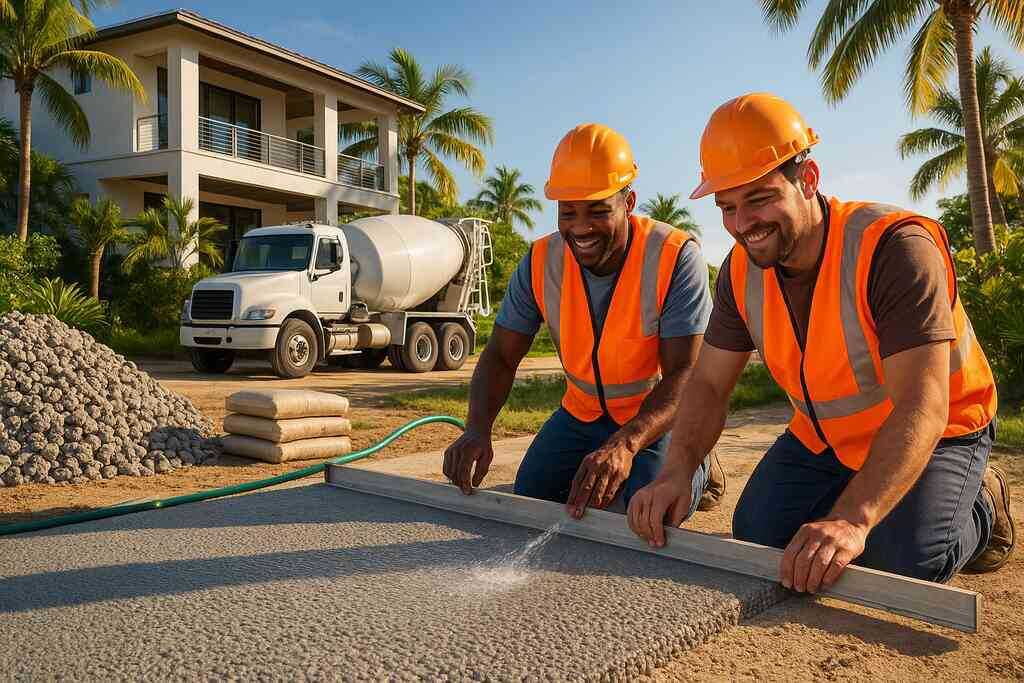 From Aggregate to Afterlife Lifecycle Deep Dive on Sustainable Concrete Practices
Low-carbon footprint mixtures harnessing fly-ash and slag synergy
South Florida contractor crews lower embodied carbon by exchanging up to fifty percent Portland cement with fly-ash and ground granulated slag. These replacements trigger pozzolanic reactions that densify the paste, making low-carbon footprint concrete mixes stronger after extended curing. Contractors in Boca Raton and Miami favor fly-ash blended cement South Florida projects because it resists sulfate attack from brackish soils. Reduced heat of hydration helps slabs stay crack-free during tropical afternoons, preserving finish quality on polished floors. Ultimately, less clinker means fewer emissions, aligning construction services with statewide initiatives for low-carbon concrete in Florida.
Design teams also monitor color and setting profiles when specifying slag-based concrete durability insights. Slag lightens the mix, reflecting sunshine and keeping exterior plazas cooler, an unspoken energy benefit. Because slag particles are angular, they improve workability at lower water content, supporting water conservation goals. South Florida general contractor specialists routinely test trial batches to fine-tune admixture dosages that offset variable ash chemistry. The result is predictable strength curves that meet tight schedules without sacrificing green credentials.
Recycled aggregate concrete best practices for driveways patios and pool decks
Demolished sidewalks no longer head straight to landfills; instead, crushed concrete aggregate feeds next-generation mixes. Recycled aggregate concrete best practices demand precise grading to replace virgin stone while protecting pump lines from clogging. Boynton Beach Remodelers specifies 40% recycled coarse aggregate for homeowner driveways, reducing hauling costs and landfill tipping fees. The angular texture interlocks well, boosting surface friction on sloped approaches and wet pool decks. Homeowners appreciate that the sustainability feature doubles as a slip-resistance upgrade.
Quality control remains paramount. Crews wash reclaimed aggregate to remove chlorides, ensuring reinforcing steel remains corrosion-free through decades of salty breezes. Moisture content is also tracked because recycled stone absorbs more water, affecting the slump. South Florida Contractors recommend pre-wetting the aggregate to achieve consistent workability, sidestepping last-minute job-site surprises. When finished, these eco drives and patios showcase sustainability without flashing neon labels, reinforcing the quiet power of responsible material choices.
Permeable concrete delivering hurricane-ready drainage from Miami to West Palm Beach
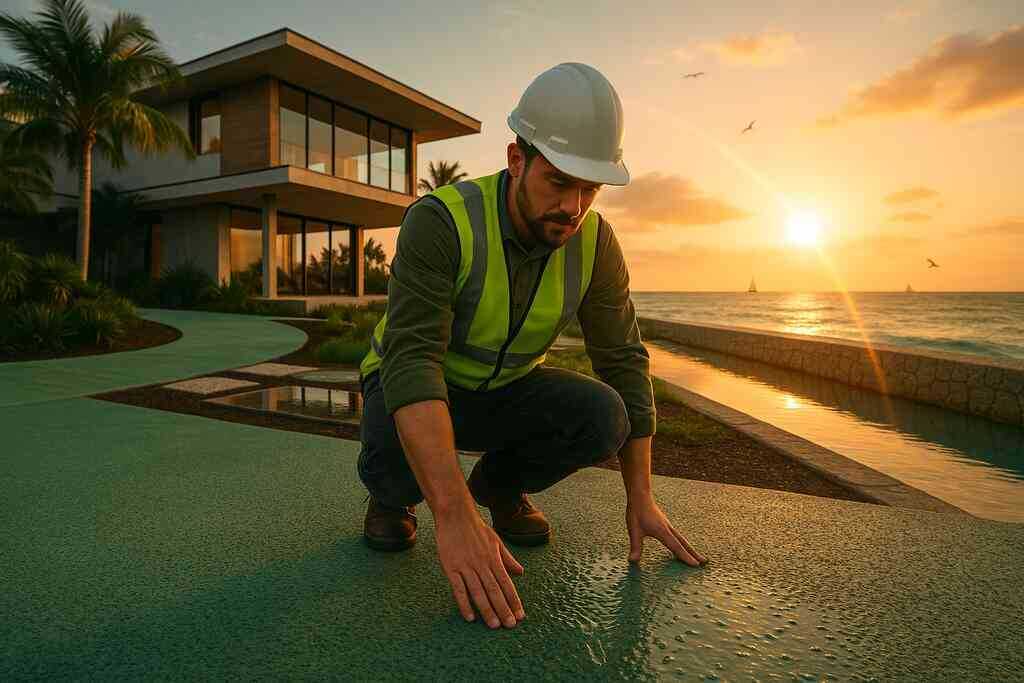
Permeable concrete features interconnected voids that let rainwater travel straight through the slab, easing flash-flood concerns. Civil engineers pair sub-base reservoirs with perforated pipes, directing runoff away from structures during intense cloudbursts. Miami homeowners praise the technology because cars stay above water even when streets resemble rivers. Municipal planners view permeable concrete for hurricane drainage as an essential component of resilient infrastructure moving forward. Reduced hydrostatic pressure around foundations further protects property values in flood-zone neighborhoods.
Local craftsmen continue refining mix design, balancing porosity with compressive strength to survive everyday traffic. They often blend small amounts of fibers that bind the matrix without clogging voids. Collaborative testing with Delray Beach builders adopting permeable cement solutions Delray Beach builders adopting permeable cement solutions proves crucial, sharing field data that guides spec updates. West Palm Beach Renovations teams now achieve a twenty-year design life while meeting the 2025 hurricane code with permeable concrete attributes. The shared knowledge network accelerates adoption across county lines.
Marine-friendly coral-safe formulations for seawalls and coastal homes
Protecting fragile reef ecosystems means more than reducing macro-pollution; chemical leaching also matters. Marine-friendly concrete installations substitute low-alkali cement and incorporate limestone fines that mimic native seabed chemistry. West Palm Beach pros specializing in marine-safe concrete document reduced pH spikes during curing, safeguarding coral larvae near construction zones. Contractors often add corrosion inhibitors that lock chlorides away from rebar, extending seawall lifespans amid relentless salt spray. These measures cut lifecycle costs while preserving marine tourism assets.
Formulations undergo aquarium testing before coastal deployment. Samples are cured underwater beside live coral fragments, and biologists observe tissue response over weeks. Only blends passing strict bio-compatibility metrics reach job sites, reflecting industry dedication to stewardship. South Florida contractor crews then adopt non-vibratory placement methods, reducing turbidity that could smother nearby reefs. Such holistic protocols set a benchmark that other coastal regions now study attentively.
Biochar-infused and carbon-capture cement technologies are appearing on local job sites
Innovators infuse finely ground biochar into fresh concrete, sequestering carbon while enhancing internal curing. The porous charcoal particles hold water, releasing moisture slowly as hydration progresses, mitigating shrinkage cracks. Contractors report improved insulation values, adding thermal-mass benefits of green concrete walls to energy-efficient designs. Parallel advances involve carbon-capture cement technologies where mineralized CO₂ replaces traditional limestone feedstock. Plants producing these binders operate within trucking distance of major tri-county markets, ensuring prompt supply.
Field trials across Delray Beach Custom Home builds demonstrate compressive gains at twenty-eight days comparable to control mixes. Because biochar darkens the mix, designers achieve modern charcoal hues without synthetic pigments. Building officials accept these products after witnessing third-party test data and certifying ASTM compliance. Early adopters gain marketing distinction, but broader uptake is predicted as economies of scale drive price parity with conventional cement.
Energy-efficient curing methods tailored to warm-climate sustainability
High humidity and warm evenings offer natural advantages that South Florida crews harness for energy-efficient concrete curing methods. Instead of fuel-powered heaters, contractors wrap slabs with reflective blankets that trap ambient warmth, accelerating early strength. Fogging systems maintain surface moisture, preventing plastic shrinkage without over-watering the mix. These warm-climate concrete sustainability strategies slash job-site emissions and reduce generator noise in residential neighborhoods. Labor productivity climbs because workers remove formwork sooner and advance schedules.
Supplementary approaches include solar-powered curing chambers for precast elements, leveraging abundant sunshine. Sensors embedded in test cylinders transmit real-time maturity data to project managers’ tablets, enabling evidence-based decisions. By aligning curing protocols with the region’s climatic gifts, general contractors in South Florida showcase ingenuity while cutting operational costs. Clients appreciate the quiet, odor-free process that respects community well-being.
Lifecycle assessment metrics and LEED compliance checkpoints for South Florida builds
Owners increasingly request a cradle-to-grave accounting of emissions, water use, and maintenance demands. Lifecycle assessment of South Florida concrete starts with raw material extraction and continues through eventual demolition recycling. Software tools convert field data into global warming potential scores, informing material selection during preconstruction. Achieving LEED-compliant concrete in South Florida builds requires documenting recycled content, regional sourcing, and low-VOC form release agents. These checkpoints support credits across Materials and Resources as well as Sustainable Sites categories.
Contractors aggregate results into concise dashboards for architects and lenders. When green concrete cost versus traditional mixes appears favorable, financing approval accelerates. Boca Raton Renovation Contractor promoting LEED concrete frequently cites longer replacement intervals as hidden savings. Transparent reporting enhances trust, fulfilling the E-E-A-T pillars of modern construction communication. Through disciplined tracking, teams verify that ambitious sustainability promises translate into measurable outcomes.
Regulatory guidelines and permitting nuances across Palm Beach County codes
Palm Beach County inspectors maintain stringent specifications for concrete strength, permeability, and environmental impact near waterways. Regulatory guidelines for sustainable concrete evolve regularly, reflecting updated hurricane risk models and sea-level projections. Permit applications must include mix design sheets, third-party test certificates, and chloride permeability results. Failing to address these nuances can stall projects, especially large multifamily developments on coastal parcels. South Florida Contractors therefore stay proactive, meeting reviewers before formal submittals to anticipate concerns.
Recent code amendments encourage supplementary cementitious materials but cap total alkalinity to protect coral. Builders must also provide runoff mitigation plans when permeable pavements interface with storm sewers. Guidance on navigating coastal building codes for eco mixes becomes invaluable to smaller firms lacking in-house compliance teams. Many turn to regional associations for continuing education hours that spotlight emerging sustainability clauses. Staying ahead of the curve minimizes redesign costs and cements reputations for reliability.
Pro contractor tips for placement finishing and moisture-resistant eco concrete
Green mixes can behave differently under the trowel, so fieldcraft matters. Experienced finishers keep the slump slightly lower to offset fly-ash-induced bleed water delays. They use magnesium floats rather than steel early on, preventing surface sealing that traps moisture. For moisture-resistant eco concrete patios, crews apply integrally mixed crystalline waterproofers, eliminating the need for topical sealers later. Edges receive additional vibration to ensure dense consolidation, vital for pool deck durability.
Timing also changes. Low-carbon mixes are set slower, meaning bull-floating may stretch beyond traditional thirty-minute windows. Supervisors monitor ambient conditions closely and adjust labor allocation to avoid cold joints. Saw-cutting contraction joints wait until the surface supports foot traffic without traveling, often several hours later in shaded courtyards. Finally, installers protect fresh slabs from sudden afternoon downpours with breathable membranes, safeguarding aesthetics and structural integrity alike.
Building Tomorrow Action Plan for South Florida Contractors and Homeowners
Cost comparison and incentives driving eco concrete adoption
Budget remains the primary hurdle whenever sustainable cement alternatives for contractors appear during bidding. Comparative studies show fly-ash blended cement South Florida projects often cost two percent less over a ten-year lifecycle. Lower maintenance, smaller disposal fees, and insurance rebates offset slightly higher upfront material prices. Municipalities sweeten deals with expedited inspections and impact-fee reductions for LEED-compliant concrete South Florida builds. Builders should document these savings early, allowing homeowners to see tangible returns rather than abstract environmental benefits.
Federal and state programs further trim expenses. Florida’s low-carbon procurement guidelines award additional points to bids featuring recycled aggregate concrete best practices. Utility companies sometimes offer energy credits when warm-climate concrete sustainability strategies lower cooling demand through thermal-mass benefits of green concrete walls. Contractors can bundle such incentives with private green financing packages, easing cash-flow pressures on complex remodels. Transparent spreadsheets comparing green concrete cost versus traditional mixes foster trust and accelerate sign-offs.
Sourcing local green cement suppliers near me strategies for just-in-time delivery
South Florida general contractor teams avoid price spikes by cultivating relationships with regional mills. They insist on weekly inventory updates to guarantee just-in-time drop-offs that align with pour schedules. This coordination reduces onsite storage, minimizes waste, and shrinks hauling emissions. Aggregates sourced within a fifty-mile radius also support local jobs, reinforcing community goodwill. For small firms without bulk leverage, cooperative purchasing agreements create volume discounts while preserving delivery flexibility.
Digital platforms streamline procurement. Contractors track truck positions in real time, adjusting crew deployment if traffic threatens the mix temperature thresholds. Those systems pair with material passports that list embodied carbon scores, simplifying lifecycle assessment of South Florida concrete. When clients ask for proof of sustainability, project managers simply forward the verified data sheets. The result is an auditable, low-risk supply chain capable of scaling future-ready projects.
Collaborative research with Florida universities shaping next-gen mixes
Universities across the state maintain laboratories evaluating biochar-infused concrete innovations and carbon-capture cement technologies. Contractors donate field samples, enabling researchers to compare controlled conditions with real-world performance. This synergy accelerates code approval cycles because test results feed directly into standards committees. Students gain hands-on experience, and builders receive early access to breakthrough formulas.
Joint grant proposals further reduce research costs. Collaborative studies often focus on permeable concrete for hurricane drainage, assessing porosity retention after cyclic salt exposure. Findings then translate to training modules hosted by trade associations. Such knowledge exchange keeps general contractors in South Florida at the forefront of global sustainability discourse. Stronger professional networks also simplify hiring when firms need specialized talent for ambitious designs.
Future-proof solutions for rising sea levels and resilient coastal infrastructure
Climate models predict higher storm surges, making durability non-negotiable. Marine-friendly concrete installations incorporating coral-safe concrete formulations anchor seawalls, docks, and bridge pylons. Supplementary cementitious materials bind chlorides, slowing rebar corrosion even under constant splash zones. Engineers pair these mixes with permeable aprons that relieve hydrostatic pressure during extreme rain events. Together, they form holistic systems rather than isolated fixes.
Designers also integrate elevated floor slabs supported by moisture-resistant eco concrete patios. Such elements double as communal plazas, keeping ground-level amenities dry without sacrificing aesthetics. Backup power pads employ high-performance green concrete for coastal homes, shielding generators from floodborne debris. By planning for worst-case scenarios today, builders protect property values and public safety tomorrow. Continuous monitoring through smart sensors closes the loop, signaling maintenance needs long before structural integrity falters.
Next steps for Boca Raton remodelers and regional teams to lead the green concrete movement
Momentum requires local champions who practice what they preach. Boca Raton contractors championing low-carbon concrete already showcase model projects, offering open-house tours that demystify techniques for peers and clients. Similar outreach by Boynton Beach teams integrating recycled aggregate mixes and West Palm Beach pros specializing in marine-safe concrete expands the talent pool. Regional workshops share contractor tips for green concrete placement, preventing beginner missteps that could tarnish reputations.
Marketing must highlight benefits in relatable language. Homeowners respond to promises of cooler patios, lower insurance premiums, and faster inspections more than abstract carbon metrics. Firms should feature case studies on their sites, link to milestones toward green building mastery in South Florida projects, and encourage satisfied clients to post reviews. As demand grows, supply chains mature, driving prices down and quality up. Ultimately, collective action turns today’s niche practice into tomorrow’s construction norm throughout the tri-county area.
Frequently Asked Questions
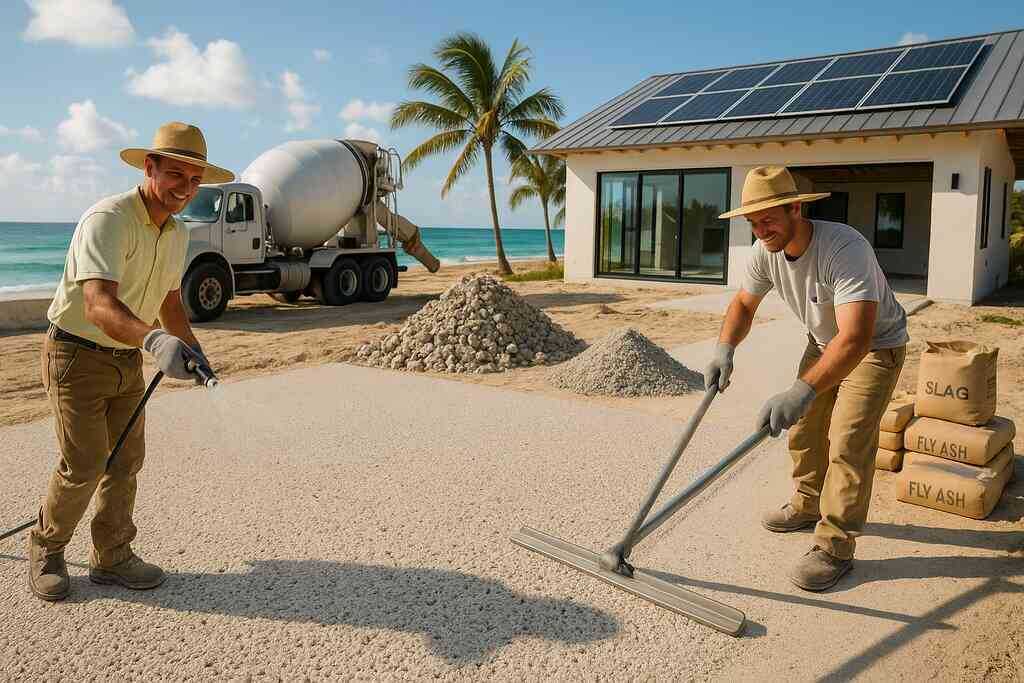 Frequently Asked Questions
Question: What sets green concrete solutions in South Florida apart from standard mixes, and will they still satisfy Miami-Dade and Palm Beach County building codes?
Answer: Green concrete solutions in South Florida replace a sizable portion of energy-intensive Portland cement with fly-ash, slag, biochar, or other supplementary cementitious materials. The swap cuts embodied carbon by up to 50 percent, lowers the heat of hydration so slabs resist summer cracking, and improves chloride resistance-essential for coastal durability. Because South Florida Contractors partners only with suppliers whose mixes are ASTM- and ACI-certified, every eco formulation already meets or exceeds the structural, permeability, and hurricane-impact requirements enforced by local inspectors. Our directory even tags LEED-compliant concrete South Florida builds, so you can filter contractors who know the permitting nuances before you break ground.
Question: How can a contractor in South Florida quickly source proven sustainable cement alternatives-such as fly-ash blended cement South Florida projects rely on-without blowing up the schedule?
Answer: Timing matters, so South Florida Contractors maintains real-time inventory dashboards from vetted regional ready-mix plants. Once you select a South Florida general contractor through our platform, they receive live updates on slag-based concrete durability insights, truck routing, and batch tickets that list each mix’s embodied-carbon score. This just-in-time model minimizes on-site storage, limits waste, and keeps pours on schedule, all while ensuring your job uses low-carbon footprint concrete mixes delivered within a 50-mile radius to slash hauling emissions.
Question: In the blog post What Is Green Concrete Per South Florida Contractors, you mention permeable concrete for hurricane drainage-how does that help my home near me withstand extreme storms?
Answer: Permeable concrete contains interconnected voids that funnel rainwater through the slab into a stone recharge bed, relieving hydrostatic pressure during the torrential downpours common from Miami to West Palm Beach. By pairing this green technology with recycled aggregate concrete best practices, our listed construction companies create driveways and patios that keep cars dry and foundations stable even when streets flood. Insurance carriers often reward these installations with lower premiums because the design demonstrably reduces flood risk.
Question: Will choosing low-carbon footprint concrete mixes and coral-safe concrete formulations add significant cost to my Boca Raton green concrete renovation, or are there financial incentives?
Answer: Up-front material costs can run 2-5 percent higher, but South Florida Contractors maps out incentives that more than offset the premium. Boca Raton Renovation Contractor teams frequently secure expedited inspections, impact-fee discounts, and even utility rebates for warm-climate concrete sustainability strategies that lower cooling loads. Add in lifecycle savings-fewer repairs, longer slab life, and reduced flood damage-and green concrete cost versus traditional mixes often turns positive within three years. Our directory’s cost-comparison tools make the math transparent so you can show lenders or homeowners exactly where the ROI appears.
Question: What placement and curing tips do your general contractors in South Florida follow to ensure recycled aggregate concrete driveways and moisture-resistant eco concrete patios perform for decades?
Answer: Fieldcraft is crucial with sustainable mixes. Crews selected through South Florida Contractors pre-wet recycled aggregate to stabilize the slump, use magnesium floats to avoid sealing in bleed water, and extend bull-floating windows for slower-setting low-carbon blends. Integrally mixed crystalline waterproofers turn high-performance green concrete for coastal homes into moisture-blocking patios without later seal-coat expenses. For curing, energy-efficient concrete curing methods leverage warm evenings: reflective thermal blankets capture ambient heat while fogging systems maintain surface moisture-no noisy fuel burners required. These best practices deliver dense, crack-free slabs that shrug off salt spray and afternoon downpours.