
Why a cheap deposit can turn into a lien waiver nightmare
A low deposit feels comforting until the paperwork starts drifting. Then the scope changes, the schedule slips, and the draw request arrives before the work actually matches the money. If you are reading this because a payment request already feels off, take a breath. That feeling is often your first useful warning. We hear this from clients across South Florida more often than people expect.
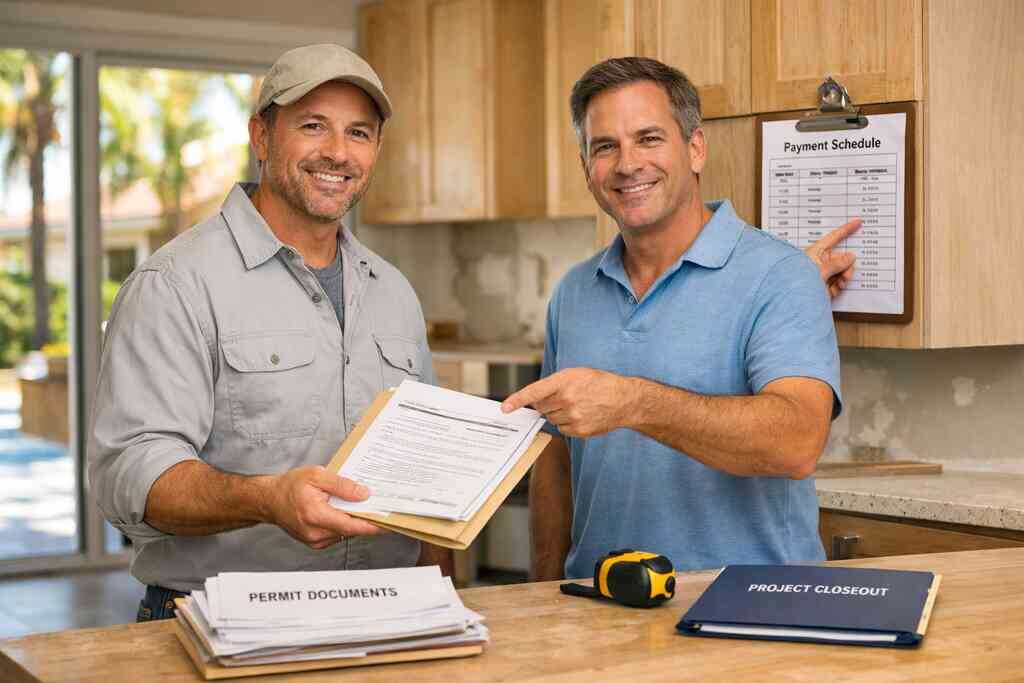
On a remodel, the money and the work need to stay in lockstep. If the contractor says the wall is open, the electrical is exposed, and the framing is “basically done,” you still need proof. That means photos, a clear payment schedule, and a South Florida contractor payment rules mindset before the next check leaves your hand. A cheap deposit can seem harmless, but it can also create pressure to pay early without a proper paper trail.
How progress payments can go sideways when the scope keeps moving
Progress payments are supposed to match progress. Simple idea. Harder in real life. On South Florida contractors projects, scope drift happens fast when a kitchen opens up and suddenly reveals old plumbing, undersized wiring, or hidden water damage. The mistake we see most often is paying for a milestone that was never clearly defined.
Here is a common pattern on a South Florida kitchen remodeler job. The homeowner agrees to a deposit, then demolition uncovers rotten subflooring. The contractor asks for more money to keep crews moving. That may be fair, but only if the added work is documented through a real change order contractor Florida process. Without that, you are funding surprises instead of paying for completed work.
A payment schedule should name milestones, not feelings. Tie each draw to something visible, like cabinet installation, rough-in inspection, or drywall completion. That makes it easier to compare the invoice to the actual site. It also keeps contractor billing best practices from turning into guesswork. In South Florida, where weather and permit delays can stretch a project, clarity matters even more.
What a conditional lien waiver really protects before money leaves your hand
A conditional lien waiver is not just paperwork. It protects you by saying the contractor gets paid only after the payment clears. That is a huge difference from signing away rights too early. Under Florida construction lien law, the wording on a lien waiver Florida form can matter as much as the check itself.
Here is what almost no online guide mentions: many homeowners sign the waiver because they trust the relationship. Trust is good. Verification is better. A conditional lien waiver protects you because it keeps the contractor from later claiming a lien for that specific payment if the funds never actually arrive. That is why how to compare lien waiver forms in Florida before paying should be part of every draw review.
One client in Broward called us after a late-stage bathroom job stalled over a cabinet backorder. The contractor wanted the draw anyway. The homeowner paused, asked for a conditional waiver, and found out the supplier had not been paid yet. That one pause avoided a mess that would have followed the house title. Small step. Big protection.
Why retainage and final payment release matter more than most homeowners think
Retainage is the portion you hold back until the end. It gives you leverage when punch-list items, cleanup, or closeout paperwork are still incomplete. In residential contractor payment process terms, it is one of the simplest ways to keep the final stage honest. In commercial contractor payment process work, it is even more standard because multiple subs and suppliers may still be waiting on payment.
The final payment release should never happen just because the contractor says the job is “basically done.” That phrase is not a milestone. It is a mood. Final payment should wait for the punch list, closeout documents, warranties, and the proper final lien waiver. If you skip that step, you lose leverage right when you need it most.
A smart retainage strategy also helps with contractor dispute resolution. If there is a missing permit sign-off or an unfinished trim detail, you still have room to resolve it. For homeowners comparing find contractors near South Florida options, that difference is worth real money. Pay fairly, yes. Pay blindly, no.
The paper trail that keeps South Florida contractors paid and your property protected
The paper trail is not bureaucracy for its own sake. It is the shield between your home and a payment dispute. On South Florida construction law projects, especially in Palm Beach, Broward, and Miami-Dade, the contractor should be able to show the license, insurance, and lien documentation without hesitation. If they cannot, slow down immediately. A good find a contractor South Florida search is only the starting point.
If you are juggling work, family, and a renovation call on speakerphone, you are not alone. This part feels tedious, and that is completely normal. Yet this is where contractor fraud prevention starts. The paper trail protects both sides. It also keeps supplier lien release issues from showing up after the last tile is installed.
How to verify a contractor license in Palm Beach Broward and Miami-Dade
You should verify every license yourself. Do not rely on a logo, a truck wrap, or a polished estimate. Check the state record, confirm the business name, and make sure the scope matches the work you need. A licensed contractor Palm Beach County search is not the same as confirming a licensed contractor Broward County or licensed contractor Miami-Dade for the exact trade involved.
If you need how to verify a Florida contractor license, do it before signing anything. This matters even more for exterior and structural work, where hurricane-code requirements affect the permit and inspection path. A general contractor near me South Florida search can surface plenty of names, but not all of them are qualified for your specific scope. Ask for the license, then verify it. Simple. Essential.
Here is the part most homeowners miss. A contractor can be legitimate and still not be the right fit for your project type. A South Florida custom home builder may not be the right choice for a condo renovation South Florida job. A South Florida bathroom remodeler may not be the best fit for a second story addition South Florida project. Scope matters as much as the license.
What contractor insurance requirements Florida homeowners should confirm before signing
Insurance is not a polite extra. It is core protection. Before signing, confirm the contractor has current liability coverage and workers’ compensation where required. If the contractor hesitates to provide proof, treat that as a warning. For homeowners, how to check contractor insurance requirements in Florida should be routine.
You do not need to memorize policy language. You do need to confirm the certificate is current and matches the company doing the work. That matters for a roofing contractor South Florida project, a home remodeling contractor South Florida job, or a South Florida concrete contractor scope. If someone falls, or if property gets damaged, the absence of proper coverage can become your problem fast.
South Florida’s climate adds pressure here. Sudden storms, wet surfaces, and fast-moving subs create more exposure than many homeowners expect. On exterior projects, especially hurricane impact window installer South Florida work or hurricane shutter contractor scopes, insurance should never be assumed. It should be confirmed.
When bonding subcontractor payment protection and supplier lien release become nonnegotiable
Bonding and supplier protection matter most when multiple parties are on the job. If the general contractor pays late, an unpaid subcontractor or supplier may still have lien rights. That is how a project can look finished and still carry a hidden risk. Contractor bonding requirements and subcontractor payment protection help reduce that danger.
For larger scopes, ask how the contractor handles supplier lien release at each draw. Ask who gets paid first. Ask whether the subcontractors sign off before the next payment. These questions are not confrontational. They are smart. They show you understand the payment chain, which often prevents future conflict.
On a South Florida home additions project, we saw a supplier delay tile deliveries because the account balance was not cleared. The homeowner had already paid the draw. The general contractor eventually resolved it, but the project lost two weeks. That is why South Florida construction blog on lien waivers style education helps homeowners spot weak spots before they become schedule problems.
Why notice to owner Florida and project closeout documents are part of the same story
Notice to owner Florida paperwork sounds intimidating, but it is really about rights and responsibilities. If a subcontractor or supplier sends a notice, that means they are preserving their lien rights. You should know whether those notices are flowing on your project. If they are, that is not automatically bad. It simply means the payment chain needs close attention.
Project closeout documents belong in the same conversation. Final lien waivers, warranty letters, inspection approvals, permit sign-offs, and contractor invoice approval should all be collected before the final check. That is how mechanics lien prevention actually works in the real world. It is not one form. It is a system.
For owners in South Florida design build, South Florida luxury renovation, or South Florida HOA permit environments, closeout can be more demanding than the build itself. A condo board may want specific sign-offs. An HOA may need compliance evidence. A permit office may want corrections before closure. The paper trail is the bridge across all of that.
When a change order is smart and when it is a warning sign
A good change order protects everyone. A bad one is a budget leak with a signature line. The key is timing, detail, and honesty. If the scope changes, the paperwork should change too. If it does not, you are creating contractor invoice approval problems before the job is even finished. Change orders are normal on South Florida home additions, kitchen remodels, and bathroom updates. Hidden plumbing, old framing, and outdated electrical systems do not care about your original estimate. Still, every added line should be explained. You deserve to know what changed, why it changed, and how much it costs.
How change order contractor Florida rules affect budget creep on remodels and additions

Change order contractor Florida practices should be specific and signed before extra work starts, whenever possible. That is especially true on South Florida kitchen remodeler and South Florida bathroom remodeler projects, where small choices can snowball. A larger backsplash. Better cabinets. More electrical work. Suddenly, the number looks very different.
The smartest contractors keep the document simple. Describe the change. State the cost. State the schedule impact. Then get approval. That process protects the homeowner and the contractor. It also supports construction contract payment terms that are easy to defend later if there is a dispute.
We have seen a lanai builder South Florida project turn messy because the homeowner approved “minor upgrades” by text. Those messages became hard to track, and the final invoice ballooned. The lesson is plain. If it costs money, put it in writing. If it changes the scope, treat it like a real amendment. That keeps budget creep from becoming resentment.
Why payment application review should match the actual work in place
A payment application should reflect work actually completed in the field. Not promised work. Not ordered materials. Actual installed work. That is the only way progress payment compliance stays honest. If cabinets are stacked in a garage but not hung, the draw should not pretend they are installed.
Review the site before approving the application. Walk the rooms. Look at finishes, rough-in stages, and cleanup. If the invoice says 80 percent complete, ask 80 percent of what? The answer should match the real jobsite. This matters on South Florida flooring installer and South Florida tile contractor projects, where material storage can look like progress when it is not.
Item to reviewWhat you should seeRed flagDemo drawDebris removed and area clearedOnly photos, no site visitRough-in drawFraming, electrical, plumbing in placeMaterials delivered but not installedFinish drawFixtures, cabinets, tile, trim completed”Substantially done” without detailsFinal drawPunch list closed and waivers collectedPressure to pay before closeout### How contractor invoice approval helps prevent construction payment disputes
Invoice approval is not just accounting. It is your last chance to catch a mismatch. If the invoice references work you did not authorize, stop and ask questions. If the amount does not align with the approved change order, pause. That is not conflict. That is responsible ownership.
Most construction payment disputes start small. A delayed draw. A misunderstood allowance. A material upgrade that was never fully documented. Then the tone shifts. Invoice approval, when handled carefully, prevents that escalation. It gives you time to compare the numbers to the field work and the signed scope.
For homeowners considering a South Florida construction permit guide approach, this is also where permit-related extra work should be separated from finish work. If an inspector asks for a correction, the invoice should clearly show whether it is a true change or a contractor responsibility. That distinction matters.
What partial lien waiver and unconditional lien waiver language should trigger a second look
Partial lien waivers can be useful when a progress payment is made. Unconditional lien waivers are more serious. Once signed, they may release rights immediately, even if the money has not fully cleared or all related parties have not been paid. That is why the exact wording deserves attention.
If you see unconditional language on a form tied to a draw, read it twice. Then read it again. You want the right document for the right payment stage. A partial lien waiver should match partial payment. A final lien waiver should wait until the end. That is the safest rule for mechanics lien prevention.
If a contractor pressures you to sign before the check is delivered, slow everything down. Good professionals understand the difference between fast and sloppy. On South Florida custom home builder and oceanfront home contractor jobs, that distinction protects everyone involved. Do not let urgency replace accuracy.
The move that keeps your project closing clean instead of ugly
The cleanest closeout starts long before the final walk-through. It starts with the contract language, the permit path, and the way you treat each draw. If those three pieces are weak, the finish will feel messy no matter how beautiful the tile looks. A clean closeout is not luck. It is planning.
This is especially true in South Florida, where permits, HOA rules, and hurricane-code issues can all overlap. Palm Beach County permit, Broward County permit, and Miami-Dade permit processes are not identical. A job that looks simple on paper can still trigger extra inspections, stronger fastening requirements, or board approvals. That is why exterior and structural scopes deserve more caution, not less.
How to structure construction contract payment terms for residential contractor payment process and commercial contractor payment process
Good payment terms spell out deposits, milestones, retainage, and final release conditions. They should also explain what happens if the scope changes. That keeps the residential contractor payment process and commercial contractor payment process from drifting into confusion. Clear terms help both sides stay calm when the job gets complex.
For homeowners, a practical structure often includes:
- A reasonable deposit
- Draws tied to visible progress
- Retainage held until closeout
- Final payment only after waivers and punch list completion
That structure works better than vague “pay as we go” language. It is especially important for how to hire a contractor in South Florida searches, where the cheapest estimate can hide the weakest payment discipline. A strong contract makes the project easier to finish cleanly.
Why South Florida permit process and hurricane code compliance should come before final draws on exterior work
Do not make the final draw on exterior work until the permit path is clear. The South Florida permit process can involve corrections, inspections, and documentation that are not visible in the finished photos. Hurricane code compliance matters here too, especially for exterior and structural scopes. If the work affects the envelope, roof, openings, or structure, code matters deeply.
This is where what is the Florida building code 2026 for coastal homes type research becomes practical. You do not need to become a code expert. You do need to know that coastal requirements shape the work. For hurricane roof tie-downs, impact-rated openings, and structural ties, final payment should wait until the paper trail confirms compliance.
Miami-Dade and Broward are especially serious about wind-related standards in many scopes. That affects roof, window, and door work. If a contractor asks for the last draw before those items are closed out properly, hold it. The risk is too high.
What to confirm on roofing contractor South Florida jobs hurricane impact window installer South Florida projects and other structural scopes
Exterior work demands more proof than interior finish work. On roofing contractor South Florida jobs, you want inspection records, warranty details, and any manufacturer documentation that applies. On hurricane impact window installer South Florida projects, ask about product approvals, installation instructions, and permit sign-off. For a hurricane shutter contractor, the fastening and anchoring details matter just as much as the visible finish.
The same caution applies to South Florida foundation repair, South Florida concrete contractor work, and screen enclosure contractor South Florida scopes. If the structure changes, the paper trail should be complete before final money changes hands. Here is a useful question: if the job were inspected tomorrow, would every critical item pass without a scramble? If not, wait.
We saw a waterfront home builder South Florida project delay final release because the storm-rated openings had been installed, but the closeout packet was incomplete. No one had lost work. No one had acted badly. Still, the owner was right to hold the final payment. The paperwork and the field work must tell the same story.
When to hold the last payment until the paper trail and the punch list both tell the same story
Hold the final payment when anything is unresolved. That includes unfinished trim, missing manuals, open permit items, and unresolved supplier notices. The final lien waiver should come only when the job is actually closed. If the contractor rushes this part, the risk lands on you.
The punch list is your final quality check. It is not a formality. It is the last defense against small defects becoming permanent annoyances. Combine that with the project closeout documents, and you have a strong finish. That is how South Florida contractors and homeowners both protect themselves.
If you are planning a pool deck contractor South Florida project, paver installation South Florida, or outdoor kitchen contractor South Florida build, give this stage the same respect as demo day. Finish strong. Collect the documents. Confirm the permit sign-off. Then release the last check with confidence.
If you want help finding the right local professional, start with South Florida contractors, verify the license, confirm insurance, and compare payment terms before you sign. You do not have to sort it all out alone, and you do not have to do it all today. Start with one call, one waiver review, and one careful look at the paper trail.
Frequently Asked Questions
Question: What should I know before making a progress payment to South Florida contractors on a remodel or addition?
Answer: Before you release any money, make sure the payment matches real work in place, not just a verbal update or delivered materials. On South Florida contractors projects, the safest approach is to tie each draw to a clear milestone, review the site, and confirm the invoice matches the agreed scope. This is especially important for South Florida home additions, South Florida kitchen remodeler jobs, and South Florida bathroom remodeler projects where hidden conditions can trigger change order contractor Florida paperwork. Ask for a conditional lien waiver, verify the contractor license, confirm contractor insurance requirements Florida, and keep retainage in construction until closeout is complete. If you are comparing a general contractor near me South Florida option, always remember that payment rules for contractors should protect both the homeowner and the contractor, not create pressure to pay early without documentation.
Question: How does South Florida Contractors on Lien Waivers and Payment Rules help homeowners avoid contractor payment disputes?
Answer: The blog explains how lien waiver Florida forms, progress payment compliance, and final payment release work together to reduce risk on residential and commercial projects. It shows homeowners how to review a conditional lien waiver before each draw and why an unconditional lien waiver should only be signed when the payment is truly complete and all related work is closed out. That matters across South Florida, including Palm Beach, Broward, and Miami-Dade, where contractor billing best practices and Florida construction lien law can affect your property if the paperwork is rushed. The guidance also supports contractor dispute resolution by encouraging clear payment schedules, change orders in writing, and proper project closeout documents. For anyone hiring a home remodeling contractor South Florida or a South Florida design build firm, this kind of clear payment process is one of the best ways to prevent mechanics lien prevention problems later.
Question: How do I verify a licensed contractor Palm Beach County, licensed contractor Broward County, or licensed contractor Miami-Dade before signing a contract?
Answer: Start by confirming the contractor’s license directly, not just through a website or marketing brochure. A trustworthy contractor should be willing to provide the license number, insurance certificate, and business information so you can complete your own how to verify a contractor license check. This is important whether you are hiring a roofing contractor South Florida, a South Florida concrete contractor, a South Florida flooring installer, or a South Florida cabinet maker. In South Florida, the right contractor must also understand the local South Florida permit process, including Palm Beach County permit, Broward County permit, and Miami-Dade permit requirements where applicable. For exterior and structural work, ask about hurricane code compliance and make sure the contractor can explain how the project will meet South Florida building codes without skipping permits. A legitimate contractor will welcome those questions.
Question: Why are supplier lien release, subcontractor payment protection, and notice to owner Florida forms so important on South Florida projects?
Answer: Because a project can look finished while unpaid parties still have lien rights. Supplier lien release paperwork and subcontractor payment protection help keep the payment chain clean so the homeowner is not surprised later by a claim tied to the job. That is especially important on South Florida custom home builder projects, oceanfront home contractor work, and larger South Florida luxury renovation scopes where multiple subcontractors and suppliers may be involved. If a notice to owner Florida arrives, it means someone is preserving rights and the payment process needs attention. The best practice is to collect partial lien waiver forms during progress draws and reserve the final lien waiver for the end, after all punch-list items, warranties, and project closeout documents are complete. This approach is one of the strongest tools for mechanics lien prevention.
Question: What makes payment terms different for roofing contractor South Florida jobs, hurricane impact window installer South Florida projects, and other exterior work?
Answer: Exterior and structural scopes need stricter payment controls because weather, permits, and code requirements can affect the job at every stage. On roofing contractor South Florida work, hurricane roof tie-downs, inspections, and manufacturer documentation should all be part of the closeout file before final payment release. The same is true for hurricane impact window installer South Florida projects and hurricane shutter contractor work, where hurricane code compliance matters and the South Florida permit process may require specific approvals before the job is truly finished. Payment terms should be written so that final payment waits for inspection approval, proper lien waivers, and complete project closeout documents. That protects homeowners in coastal home builder Florida environments as well as condo renovation South Florida and townhome remodeling South Florida projects, where HOA rules and permit steps can add another layer of review. In short, the safest construction contract payment terms are the ones that match the real-world inspection and closeout path.
Question: Can South Florida Contractors help me understand when a change order contractor Florida document is necessary before paying more money?
Answer: Yes. The blog makes it clear that if the scope changes, the paperwork should change too. That is true on South Florida bathroom remodeler, South Florida kitchen remodeler, sunroom contractor South Florida, lanai builder South Florida, and outdoor kitchen contractor South Florida projects, where hidden conditions or upgrades can quickly affect the budget. A proper change order contractor Florida document should describe the added work, explain why it is needed, state the cost, and note any schedule impact before the work proceeds whenever possible. That protects contractor invoice approval, keeps payment application review accurate, and prevents budget creep from turning into a dispute. If you are working with South Florida contractors on a remodel or addition, the rule is simple: if it changes the scope or cost, get it in writing first. That is one of the clearest ways to protect both your budget and your property.