
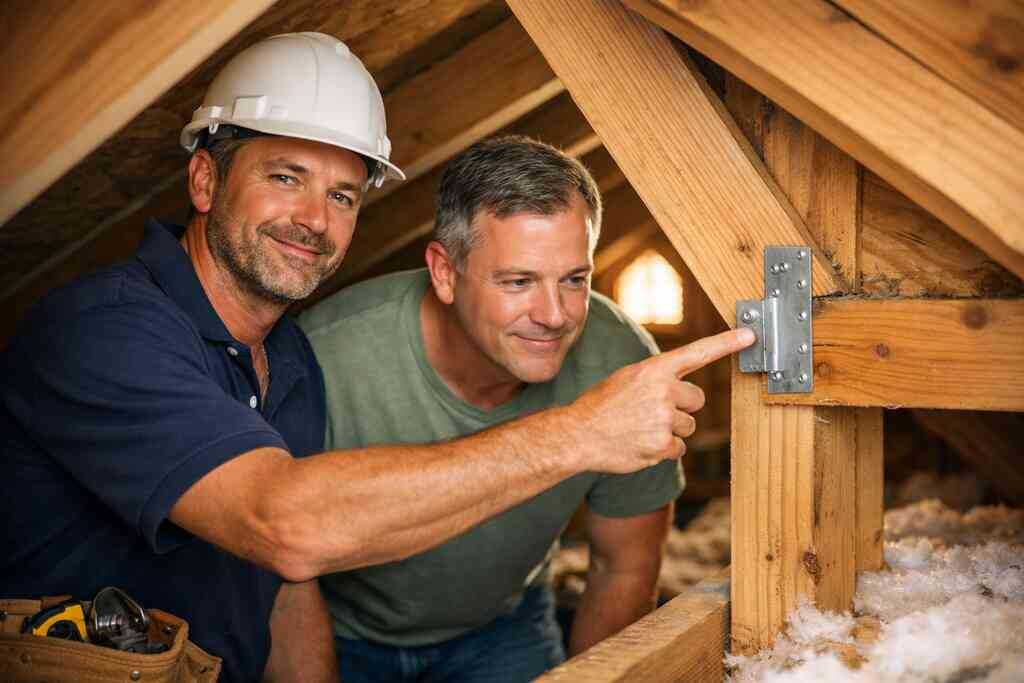
The tie down mistake that turns a strong roof into a liability
A homeowner called us after a hard rain rattled the soffits and left a stain on the bedroom ceiling. The roof looked fine from the street. That is exactly why hurricane roof tie-downs matter before the first named storm. In South Florida, a roof can look solid and still be dangerously underconnected. If you are feeling uneasy about that, you are not overreacting. You are paying attention.
Why hurricane roof tie-downs matter long before the first named storm
Hurricane roof tie-downs are not just storm prep. They are part of the load path that keeps wind from peeling the roof system away from the walls. That load path starts at the roof deck, moves through the framing, and ends at the foundation. If any link is weak, the whole structure suffers. That is why hurricane code compliance starts with connection details, not cosmetic upgrades.
Here is the part most homeowners miss. The roof often fails at the connection points before it fails at the shingles. South Florida contractors see this during inspections, especially after past repairs or roof replacements. The roof may have newer materials, but old connectors can still be hidden in the attic. A best South Florida contractors for hurricane roof tie-downs search should start with that reality in mind.
If you are trying to find a contractor South Florida before storm season heats up, do not ask only about price. Ask how the roof is tied to the walls, and ask what evidence supports the answer. On one Lake Worth project, the attic told a different story than the sales brochure. The decking was newer, but the connectors were inconsistent, and the owner had no permit record for the last roof work. That delay felt frustrating, yet it likely prevented a much larger failure.
What South Florida contractors look for when a roof system is more vulnerable than it looks
A skilled roofing contractor South Florida will look past the surface. They check for weak fasteners, missing clips, corroded straps, and uneven framing conditions. They also look for signs of prior patchwork that never matched the original structural design. That is especially important for a licensed contractor Palm Beach County or licensed contractor Broward County project in older neighborhoods. Many roofs survive on habit, not strength.
The warning signs are often subtle. You may see ceiling cracks, lifted roof lines, uneven ridge boards, or attic moisture around connection points. A home remodeling contractor South Florida who understands structure will treat those as clues, not isolated annoyances. The same goes for a South Florida custom home builder or South Florida luxury renovation team working around a full envelope upgrade. The connection details matter as much as the finish selections.
If a contractor cannot explain the tie-down path clearly, keep looking. A true general contractor near me South Florida result should lead to someone who understands the whole assembly. That includes roof clips, truss straps, and anchorage, not just replacement shingles. It also includes the find a contractor in South Florida for hurricane code compliance step, which should be based on licensing and permit readiness. Confidence is useful. Documentation is better.
Where older homes in Palm Beach, Broward, and Miami-Dade usually get exposed first
Older South Florida homes often show vulnerability first at the roof perimeter. Eaves, gable ends, and transitions around additions tend to expose weak points early. Palm Beach County, Broward County, and Miami-Dade all have neighborhoods where past remodels layered new work over old framing. That is where the problems hide. If the connection is inconsistent, wind finds it.
We see this often in coastal and inland homes alike. A licensed contractor Miami-Dade may uncover a mismatch between the original framing and a later roof replacement. A licensed contractor Broward County may find aging connectors near a prior addition. A licensed contractor Palm Beach County may see corrosion near the attic in homes closer to the coast. These are not rare surprises. They are common South Florida realities.
One client in Coral Gables had a roof that had passed a casual visual check twice. The attic inspection changed everything. A few straps had been patched, but not upgraded, and the repair history was incomplete. The owner was relieved the issue surfaced before a storm, not after. That kind of discovery is why structural due diligence matters before you chase the lowest bid.
When the wind gets serious, what the structure is really depending on
Wind does not care how new your paint looks. It cares about pressure, attachment, and continuity. If the structure cannot transfer force downward, the roof becomes a loose lid. That is the simple truth behind hurricane roof tie-downs. South Florida building codes exist because experience keeps proving that point.
How roof-to-wall connections work in plain English
Think of roof-to-wall connections as the bridge between the top of the house and everything below it. Roof clips, straps, and anchors hold the framing together so uplift forces do not separate the assembly. The roof deck helps, but it is not the only line of defense. The framing, connections, and fasteners all have jobs. If one part fails, others get overloaded.
That is why a coastal home builder Florida project often requires more attention than a quick patch job. The structure must resist uplift, not just shed water. A roofing contractor South Florida should be able to explain where the load starts and where it ends. If they cannot, that is a warning sign. Your house deserves a real answer.
For homeowners, this can feel abstract. It is not abstract when the attic is open and the wind is pressing hard. On a Pompano Beach repair, a contractor found worn connectors that looked fine from the ground. The roof surface had aged well, but the hidden metal told another story. That homeowner learned that a strong roof is really a strong system, not a single material.
Why hurricane code compliance is different for coastal home builder Florida projects and inland homes alike
Coastal exposure changes the conversation, but inland homes are not exempt from serious wind design. Hurricane code compliance applies because South Florida weather can punish any weak connection. Coastal homes face more intense exposure, salt air, and often stricter scrutiny. Inland homes still face high winds, flying debris, and aging construction issues. The demand changes, but the principle stays the same.
A coastal home builder Florida project may need more aggressive detailing, better corrosion resistance, and tighter inspection coordination. That is also true for a waterfront home builder South Florida working near open exposure. Yet inland homeowners sometimes assume distance from the beach means lower risk. That assumption can be expensive. Wind does not stop at the mangroves.
A smart Florida Building Code 2026 conversation should focus on the actual structure, not assumptions. South Florida contractors see the difference every season. A home in a quiet inland subdivision can still need major tie-down attention. The goal is not to overbuild blindly. The goal is to build correctly for the exposure you actually have.
What changes when an oceanfront home contractor or waterfront home builder South Florida is working near harsher exposure zones
Oceanfront and waterfront projects bring harsher conditions. Salt exposure can accelerate corrosion. Wind speeds can be more punishing. Inspection expectations are often higher, and the tolerance for weak detailing is lower. An oceanfront home contractor has to treat every connection as critical, because it is.
That changes how materials are selected and how the work is sequenced. A South Florida custom home builder working on a waterfront property may coordinate framing, roofing, and envelope systems as one package. A South Florida design build team may also integrate impact-rated openings and enclosure details earlier. The roof tie-downs are not isolated from those choices. They belong to the same system.
We finished a waterfront project where the owner planned a cosmetic refresh only. Once the framing opened, the team found connection issues that affected the entire roof assembly. The scope expanded, but the house became far more defensible. That is the uncomfortable truth about older waterfront work. Sometimes the hidden structure forces better decisions.
How South Florida building codes shape the conversation around roof clips, straps, and anchorage
South Florida building codes push contractors to prove that the roof is secured correctly. That means attention to clips, straps, and anchorage from the start. It also means using the right details for the right zone and the right building type. The code conversation is not just about compliance paperwork. It is about storm survival.
If you are planning a major project, the code picture touches everything. A South Florida luxury renovation may involve roof work, window protection, and exterior upgrades in one permit set. A South Florida home additions project may trigger new structural calculations. A second story addition South Florida job can change the entire load path. That is why experienced contractors slow down before they speed up.
Here is a simple test. Ask the contractor where the roof load transfers and what documents support the answer. If they give you a clear explanation, you are in good hands. If they shrug, keep interviewing. You do not need to become a structural engineer. You do need a contractor who respects the structure.
The permit path that keeps a reinforcement job legal and insurable
Permits can feel annoying. They can also save you from insurance trouble, resale problems, and failed inspections. Most homeowners understand the first point before they understand the second. That is normal. The paperwork is tedious, but the risk of skipping it is much worse.
What the South Florida permit process usually asks for before work starts
The South Florida permit process usually wants drawings, scope details, contractor information, and sometimes engineering support. For structural or exterior work, the city or county may want proof that the proposed method matches code. That is especially true for hurricane roof tie-downs. You should expect questions, not shortcuts. A serious contractor welcomes that.
A South Florida permit process for roof replacements and tie-down work can feel dense at first. Still, the structure is simple: define the work, document the method, submit the application, and pass inspections. Some projects move smoothly because the contractor prepared the packet well. Others stall because no one gathered the right documents before work began. If a contractor suggests skipping permits, stop right there.
The permit path also affects insurance and future sales. If work is unpermitted, the next owner may ask hard questions. So may your insurer. That is why South Florida contractors who respect the process protect you twice: once during the build, and once after the storm.
How Palm Beach County permit, Broward County permit, and Miami-Dade permit expectations can differ in practice
The basic rules are similar, but the details can vary. A Palm Beach County permit may ask for one set of supporting documents, while a Broward County permit may involve a different review pattern. Miami-Dade often brings particularly careful attention to coastal exposure and product approvals. The difference is not just bureaucratic flavor. It changes the timing and the paperwork.
That is why local experience matters. A Palm Beach County permit for structural reinforcement may proceed differently than a Broward County submittal for the same general scope. A Miami-Dade permit may involve more scrutiny around product approvals, especially near exposed coastal areas. None of that should surprise a seasoned contractor. It should be part of the plan from day one.
If you are comparing bids, ask each contractor how they have handled the county process before. Do not ask whether permits are “included” and stop there. Ask what drawings, engineering, and inspection steps are expected. A contractor who knows the process can usually explain the differences without drama. That is the kind of confidence worth paying for.
Why South Florida HOA permit approval can slow exterior work even when the city is ready
HOA approval can take longer than city review. That surprises a lot of people. Your city may be ready, but your association may want color samples, product cut sheets, roof material details, or exterior appearance information. That is especially common in condo renovation South Florida settings and in planned communities with strict guidelines. HOA rules are not a substitute for permits, and permits are not a substitute for HOA approval.
A South Florida HOA permit can slow a project even when the structural plan is sound. That matters for hurricane roof tie-downs because timing affects sequencing. If roofing work depends on coordinated exterior changes, the HOA calendar may shape the schedule. A smart contractor plans for that. A careless one blames everyone else.
If you are in a waterfront or gated community, ask for the approval checklist early. That includes what the board wants, what the city wants, and what the contractor needs to file. This is one place where patience pays off. The project may feel delayed, but the delay is better than a rejected submittal.
When hurricane roof tie-downs trigger inspections, engineering, or related paperwork
Not every tie-down job needs the same paperwork, but many do trigger inspections or engineering review. That is especially true when the work touches the roof structure, modifies framing, or accompanies a larger remodel. The more structural the change, the more documents you should expect. That is not a nuisance. It is a safeguard. If you are also planning a home remodeling contractor South Florida project, the scope can expand quickly. A roof reinforcement may connect to attic framing, wall openings, or addition work. That can pull in an engineer or require revised drawings. On larger jobs, a South Florida permit process for home additions and structural changes may become the real roadmap. It is better to know that early. The rule of thumb is simple. If the project changes how forces move through the house, expect paperwork. If the contractor says otherwise, ask why. You are not asking to be difficult. You are asking to keep the work legal, insurable, and defensible. 
The contractor questions that separate confidence from guesswork
The contractor you choose matters as much as the materials. A strong roof can still become a weak project if the paperwork, insurance, and communication are sloppy. That is why selection should start with verification, not charm. South Florida has many capable professionals. It also has some who sound confident and leave chaos behind.
How to verify a contractor license before hiring a roofing contractor South Florida
Start with the license. Always. If someone is acting as a roofing contractor South Florida, verify the license directly before you sign anything. Do not rely on a logo, a truck wrap, or a polished website. Use official verification tools and make sure the trade matches the work.
A How to Verify a Florida Contractor’s License step should be routine. Check the license status, scope, and any disciplinary issues that are visible. Then confirm the company name matches the contract and insurance paperwork. A mismatched business name is a problem. So is a vague explanation. Good contractors respect your caution.
If you are comparing a licensed contractor Palm Beach County with a licensed contractor Broward County or licensed contractor Miami-Dade, the license alone does not tell the whole story. It tells you the contractor is authorized. It does not tell you whether they are good at your exact type of project. That part still takes judgment.
What licensed contractor Palm Beach County, licensed contractor Broward County, and licensed contractor Miami-Dade status should tell you and what it does not
A valid license should tell you the contractor can legally perform the work. It should also tell you they understand Florida’s rules, at least on paper. But license status is not a performance guarantee. It does not prove communication quality, jobsite cleanliness, or structural judgment. You still need references and paperwork.
The better question is whether the contractor has handled similar work in your county. A licensed contractor Palm Beach County may know local permit expectations for roof reinforcement. A licensed contractor Broward County may understand storm-resistant roofing details better than a generalist. A licensed contractor Miami-Dade may be more familiar with higher scrutiny on coastal projects. That local familiarity matters.
You can compare that against your project type. If you need a South Florida concrete contractor for structural coordination, ask about experience with roof load support. If you need South Florida foundation repair, ask how that could affect the roof-to-wall path. Licensing is the entry ticket. Experience is what makes the ticket useful.
Why contractor insurance requirements Florida, contractor bonding requirements, and lien waiver Florida documents matter before any payment
Insurance protects you when something goes wrong. Bonding can provide another layer of accountability, depending on the project and the contractor’s setup. Lien waiver Florida documents protect you from paying twice for the same work if downstream parties are not paid. These are not paper trophies. They are risk controls.
Ask for proof of contractor insurance requirements Florida compliance before exterior work starts. Confirm coverage is current and matches the company doing the work. Then ask how lien waivers will be handled with each payment. A contractor who resists that question is waving a red flag. A good one will explain it plainly.
This is especially important on larger jobs like a South Florida custom home builder project or a South Florida design build renovation. The more trades involved, the more paperwork matters. Even a straightforward tie-down upgrade should not begin without clean documents. If you have ever had to chase a missing receipt, you already know why this matters.
When to ask about change order contractor Florida practices so a small scope change does not become a big argument
Change orders are how scope changes get documented. In plain English, a change order contractor Florida form says what changed, why it changed, and what it costs. You should never rely on a hallway conversation for that. A small attic discovery can become a large budget issue if no one writes it down.
Ask about this before work starts. Ask how unexpected framing damage, product substitutions, or hidden code corrections will be handled. That is especially wise on roof and structural jobs where the attic can reveal surprises. A contractor who already has a process is easier to trust. A contractor who “figures it out later” usually creates conflict later too.
We saw this on a project with a modest exterior refresh that turned into a structural adjustment. The homeowner was stressed because the price changed midstream. But the contractor had a clear written change order process, and that kept the relationship intact. No drama. No guessing. Just a better paper trail.
How to compare a general contractor near me South Florida search result with a true structural specialist
A search result can tell you who is nearby. It cannot tell you who is qualified for structural judgment. That is why a general contractor near me South Florida search should be your starting point, not your finish line. You still need to know whether the contractor has experience with framing, roof anchorage, and permit coordination. That difference matters a lot.
A true structural specialist will talk about load paths, connectors, inspections, and coordination with engineers when needed. A generalist may still be capable, but may not be the right lead for reinforcement work. If your project includes a South Florida concrete contractor, South Florida foundation repair, or a second-story scope, the difference becomes even more important. The job is not only about building. It is about connecting systems correctly.
South Florida homeowners do best when they compare capability, not marketing. That is the mindset behind using South Florida Contractors to help you find a contractor South Florida who actually fits the project. You do not have to sort through every option alone. Start with verified credentials, then ask better questions.
What to do next before the next storm season puts pressure on everything
You do not need to solve every vulnerability today. You do need to start with the right sequence. That means identifying who should inspect, who should design, and who should build. It also means understanding how roof tie-downs fit into the larger resilience plan. Once that becomes clear, the rest feels less overwhelming.
When a home remodeling contractor South Florida should bring in an engineer versus a roofer
A home remodeling contractor South Florida should bring in an engineer when the work affects structure, load paths, or major openings. A roofer can handle many roofing tasks, but not every roof issue is only a roofing issue. If the attic shows compromised framing or questionable anchorage, engineer review may be the right next move. That is especially true on older homes or homes with prior additions.
Engineers are also useful when you plan a South Florida home additions project or a second story addition South Florida scope. Those changes can alter the whole stress pattern of the house. If the contractor treats that as routine, be careful. The structure deserves more than routine treatment.
This is where experienced teams save time and regret. They know when to escalate. They know when to keep the roofer focused on the roof and the engineer focused on the structural calculations. That division of labor is practical, not fancy.
How hurricane impact window installer South Florida, hurricane shutter contractor, and screen enclosure contractor South Florida work fit into the same wind resistant strategy
Roof tie-downs are only one part of storm resilience. Windows, shutters, and enclosures also matter. A hurricane impact window installer South Florida can reduce pressure on the building envelope. A hurricane shutter contractor can protect openings when impact glass is not part of the scope. A screen enclosure contractor South Florida must think carefully about wind loads, attachment points, and code requirements.
These systems work together. If one is weak, the house still has a problem. That is why a coastal home builder Florida or waterfront home builder South Florida often coordinates envelope decisions as a package. It is also why a best hurricane impact window installer South Florida 2026 search should be paired with permit and license verification. Protection only helps when it is legal and installed correctly.
If you are combining multiple upgrades, make sure the contractors coordinate. A roof job, a window job, and a shutter job should not fight each other. They should support one another. The smartest projects treat the house as a system.
Why South Florida concrete contractor and South Florida foundation repair issues can change the roof tie down conversation
Foundation movement changes everything. If the base shifts, the roof-to-wall connection can no longer be assumed straight or stable. That is why a South Florida concrete contractor or South Florida foundation repair issue can directly affect roof tie-down planning. Cracks, settlement, or uneven bearing can change how forces travel through the house.
Here is what almost no online guide mentions. Roof problems sometimes start below the roof. If the walls are out of plumb or the slab is compromised, a reinforcement plan may need more than metal straps. It may need a broader structural strategy. That is why the top signs you need foundation repair in coastal Florida deserve attention before you sign a roofing contract.
If the house has visible settlement, do not let anyone brush it off. Tie-downs are part of the answer, not always the whole answer. The best contractors look down as carefully as they look up.
How South Florida homeowners can plan upgrades for South Florida home additions, second story addition South Florida, sunroom contractor South Florida, lanai builder South Florida, or outdoor kitchen contractor South Florida without creating code problems
Big exterior projects can create code headaches if they are sequenced poorly. A sunroom contractor South Florida should know how the new space connects to the existing structure. A lanai builder South Florida should understand enclosure loads and attachment details. An outdoor kitchen contractor South Florida may need to coordinate utilities, slab conditions, and nearby structural work. If not, the beautiful finish can hide a weak plan.
The same is true for South Florida bathroom remodeler, South Florida kitchen remodeler, South Florida flooring installer, South Florida tile contractor, and South Florida cabinet maker teams when those interior projects are part of a larger remodel. Interior work can still trigger exterior or structural dependencies. A South Florida ADA renovation or aging in place contractor South Florida project may also require openings or layout changes that affect structure. Good sequencing protects the finish work and the permit file.
If you are also considering a pool deck contractor South Florida, paver installation South Florida, or a South Florida custom home builder package, ask how the project phases will be managed. The wrong order can create inspections, rework, and delays. The right order keeps the project clean.
The smartest next move for South Florida contractors and homeowners who want fewer surprises and more code ready peace of mind
The smartest next move is simple. Verify the license. Confirm insurance. Ask how the roof connects to the structure. Then ask what permits and inspections the job will need. That sequence filters out most problems before they become expensive.
If you are ready to act, start by comparing three verified South Florida contractors who have handled hurricane roof tie-downs and structural exterior work. Use a South Florida permit process mindset before anyone starts swinging a hammer. Then ask each contractor to explain the scope in plain English. You do not have to figure this out alone, and you do not have to figure it all out today. Start with one phone call, then another, and make the first choice a careful one.
Frequently Asked Questions
Question: What South Florida Contractors know about What South Florida Contractors Know About Hurricane Tie Downs, and why should I care before hurricane season?
Answer: Hurricane roof tie-downs are a critical part of hurricane code compliance because they help keep the roof connected to the walls and foundation when high winds hit South Florida. South Florida Contractors understands that a roof can look fine from the street while still having weak connectors, hidden corrosion, or outdated fastening details in the attic. That is why homeowners should not wait until a storm is on the radar to look for a roofing contractor South Florida can trust. A careful inspection should focus on the full load path, not just shingles or surface repairs. If you are trying to find a contractor South Florida homeowners can rely on, South Florida Contractors is built around helping you connect with verified professionals who understand South Florida building codes, permit requirements, and structural safety. Always verify licensing and insurance before work begins.
Question: How do I know whether I need a licensed contractor Palm Beach County, licensed contractor Broward County, or licensed contractor Miami-Dade for hurricane roof tie-down work?
Answer: The right contractor depends on where your home is located and how local permitting is handled, but the bigger issue is making sure the contractor is properly licensed, insured, and experienced with structural exterior work. A licensed contractor Palm Beach County may be familiar with Palm Beach County permit expectations, while a licensed contractor Broward County or licensed contractor Miami-Dade may know the local review steps and coastal exposure concerns in those areas. Still, the most important thing is not the county label alone. You should confirm contractor licensing Florida status, ask for proof of contractor insurance requirements Florida, and review how they handle tie-down inspections and documentation. South Florida Contractors helps homeowners compare options across South Florida so they can choose a qualified professional for the right scope, whether it is a roof reinforcement, a home remodeling contractor South Florida project, or a larger South Florida luxury renovation.
Question: What should a roofing contractor South Florida inspect first when a roof seems fine but may still be vulnerable?
Answer: A good roofing contractor South Florida should inspect the connection points first, including roof clips, straps, anchors, framing condition, and signs of corrosion or prior patchwork. In many South Florida homes, the issue is not the visible roof covering but the hidden structural connections that support hurricane code compliance. That is especially important in older homes, homes with additions, and coastal properties where salt air can accelerate wear. A contractor should also explain how the roof load transfers to the walls and foundation in plain English. If the home has related concerns, such as South Florida concrete contractor work or South Florida foundation repair needs, those issues may also affect the roof tie-down conversation. South Florida Contractors encourages homeowners to look beyond the surface and use verified professionals who can inspect the full system, not just the roof materials.
Question: What permits and approvals are usually involved in hurricane roof tie-downs, and why shouldn’t I skip them?
Answer: Hurricane roof tie-downs may require permits, inspections, engineering support, or related documentation depending on the scope and location of the work. The South Florida permit process is not something to bypass, because unpermitted structural work can create problems with insurance, resale, and future inspections. Depending on the project, you may encounter a Palm Beach County permit, Broward County permit, Miami-Dade permit, or even a South Florida HOA permit if your community has architectural review rules. That is especially true for condo renovation South Florida projects, townhome remodeling South Florida, and larger exterior upgrades tied to South Florida building codes. South Florida Contractors advises homeowners to treat permits as part of the protection plan, not a delay to ignore. A reputable contractor should explain the paperwork clearly and never suggest skipping the permit process.
Question: Can hurricane roof tie-downs be part of a larger South Florida design build or home remodeling contractor South Florida project?
Answer: Yes, and in many cases they should be. Roof tie-down work often connects to broader structural or envelope upgrades, especially in South Florida custom home builder, South Florida design build, or South Florida luxury renovation projects. If you are planning South Florida home additions, a second story addition South Florida, a sunroom contractor South Florida project, or even a lanai builder South Florida scope, the roof-to-wall connection may need to be reviewed as part of the larger design. The same is true when combining hurricane impact window installer South Florida work, hurricane shutter contractor services, or screen enclosure contractor South Florida upgrades. These systems all affect how wind loads move through the structure. South Florida Contractors helps homeowners think system-wide so the project is code-ready, properly permitted, and coordinated from the start. As always, verify licensing, insurance, and lien waiver Florida documents before approving work.
Question: Why should I trust South Florida Contractors when comparing a general contractor near me South Florida with a structural specialist?
Answer: South Florida Contractors is designed to help homeowners find a contractor South Florida can count on by making the search more informed and local to South Florida realities. When comparing a general contractor near me South Florida with a contractor who specializes in hurricane roof tie-downs, the difference is often structural knowledge, permit coordination, and familiarity with hurricane code compliance. A strong contractor should understand roof anchorage, contractor bonding requirements, contractor insurance requirements Florida, and how to manage change order contractor Florida documentation if hidden issues appear during the job. They should also be prepared to explain how a roof repair fits with related work like South Florida flooring installer, South Florida tile contractor, South Florida cabinet maker, or South Florida bathroom remodeler projects when part of a larger renovation. South Florida Contractors helps reduce guesswork by guiding homeowners toward verified options, but every homeowner should still confirm licensing, insurance, and experience before signing a contract.