
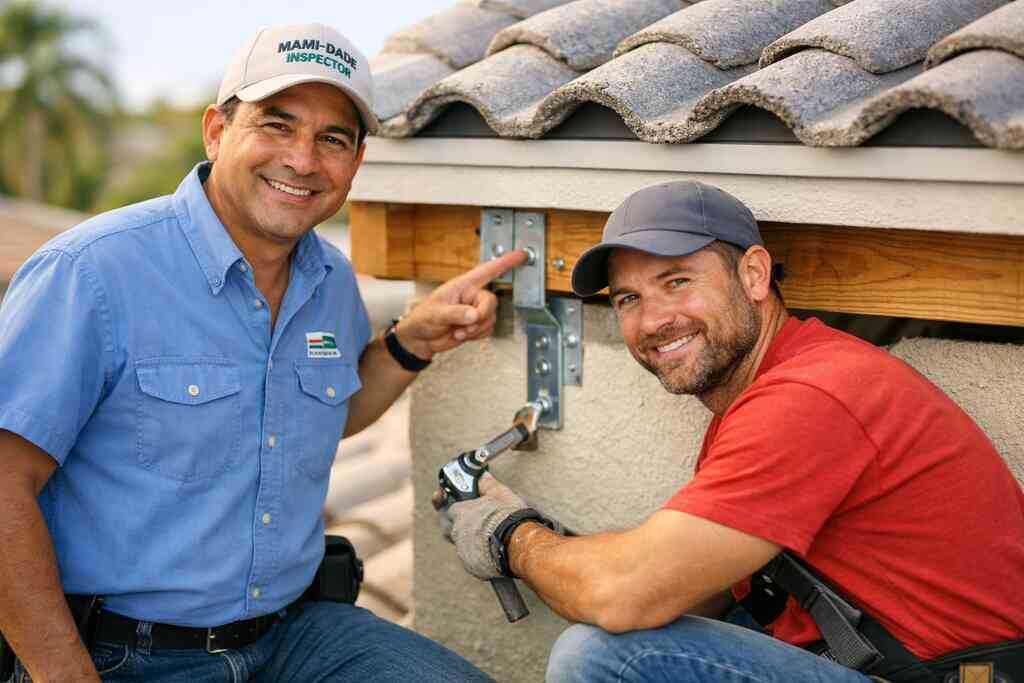
A homeowner in Miami-Dade called after a heavy afternoon storm, convinced the roof had “failed overnight.” It had not. The real problem started years earlier, when the roof-to-wall connection never got the reinforcement it needed. That is the part most people miss. If you are reading this while worried about a quote, a permit, or a leak, take a breath. The concern is real, but the fix starts with understanding how the system is supposed to work.
Why a roof can fail before the storm even arrives
What a hurricane roof tie down actually does in a South Florida wind load system
A hurricane roof tie-down is not a single magic part. It is a connection that helps hold the roof structure to the walls during high winds. In South Florida, that matters because wind does not just push downward. It tries to lift the roof like a lid. That is why hurricane roof tie-downs, roof truss tie-downs, and roof uplift protection belong in the same conversation.
Think of the roof as part of a chain. The fasteners hold the sheathing. The trusses or rafters carry the load. The straps or connectors transfer force into the walls and down to the foundation. If one link is weak, the whole system suffers. That is why what is a hurricane roof tie down in South Florida is really a question about structural continuity, not just hardware.
On the projects we have seen, homeowners often assume the roof is “fine” because the shingles look decent. That can be misleading. A roof can look clean and still be underbuilt for Miami-Dade roof tie-down requirements. Here is the part most homeowners miss: the visible surface usually tells you very little about the hidden connections.
Why Miami-Dade roof tie-down requirements feel stricter than what many homeowners expect
Miami-Dade is known for tighter expectations because the wind exposure is unforgiving. That can feel frustrating if you live in Broward or Palm Beach and hear similar guidance. Still, South Florida building codes push hard on structural resistance for a reason. The region has seen what happens when uplift starts at one corner and spreads quickly.
If you are comparing Miami-Dade roof tie-down requirements on coastal homes with inland projects, the difference is not just geography. It is risk profile. An oceanfront home contractor may treat an inland house with the same seriousness because wind does not politely stop at the Intracoastal. That is especially true in open neighborhoods with few windbreaks.
We hear this from clients almost every week: “My home is not on the water, so do I still need the upgrade?” Usually, yes, if the home sits in a high-wind zone. Miami-Dade roof tie-down requirements feel strict because they are designed for the worst practical case. That mindset protects you when the forecast gets ugly.
How roof uplift protection works when fasteners, trusses, and wall connections have to act as one system
Roof uplift protection depends on one continuous load path. That means each component passes force to the next. Fasteners secure the roof deck. Connectors secure the framing. Wall connections pass the load downward. If any section is weak, the roof can begin to separate during a storm.
A good roofing contractor South Florida should explain this in plain language. If they only talk about shingles, you are not getting the whole story. A licensed contractor Miami-Dade handling structural roof work should talk about sheathing thickness, connector spacing, and wall attachment. Those details matter more than glossy brochures. They also matter more than a low bid.
Here is what almost no online guide mentions: uplift damage often starts as a small connection failure, then becomes a whole-roof emergency. A single weak attachment can create a peel effect. Once that begins, repairs get more expensive fast. That is why South Florida hurricane roof reinforcement is a structural issue first and a material issue second.
What clues on an older home suggest the roof to wall connection may already be underbuilt
Older homes often give themselves away. You may see roof lines with visible sagging. You may notice repairs in one area but not another. You might also find inconsistent framing, patched soffits, or signs of past water intrusion near the top plate. Those are not proof of failure, but they are clues.
A residential roofing inspection South Florida should look beyond surface damage. Inspectors often check whether the roof-to-wall connection appears modern or dated. If the house predates stronger Florida Building Code roof fastening expectations, the hidden connectors may be underbuilt. That is especially important after repeated storm repairs. Patchwork often hides bigger problems.
One client in the Lake Worth area had repeated ceiling stains after every windy season. The roof itself had been patched twice. The real issue was a weak connection at the perimeter that allowed movement and opened seams. Once the structural roof reinforcement was corrected, the leak pattern stopped returning. That saved them from another round of cosmetic repairs.
Why oceanfront home contractor projects and inland homes still get treated as high-risk work in South Florida
People sometimes think only waterfront homes need serious attention. That is too simple. Oceanfront home contractor projects clearly face brutal exposure, but inland homes can still sit in dangerous wind corridors. South Florida storms do not respect county lines. They also do not care whether the home is a luxury estate or a modest ranch.
That is why South Florida contractors often approach roofing as risk management. A home near Hallandale, Kendall, or West Palm Beach can still need a wind-resistant roof system. If the structure is older, the roof tie-down project can become part of a larger hardening plan. That may include impact windows, shutters, or even foundation work if movement has already affected the frame.
If you want a starting point, use a trusted South Florida contractor directory for roofing pros and compare actual licensing, not just star ratings. You do not need to guess. You do need to verify.
The paper trail that separates code compliant reinforcement from expensive guesswork
When a roof replacement permit South Florida becomes unavoidable and why skipping it is a false economy
A roof replacement permit South Florida is not optional when the work crosses into structural replacement, code-driven reroofing, or major repairs. Skipping it can look cheaper on paper. It is not cheaper when an insurer asks questions, a municipality stops the job, or a future buyer finds missing records. That is a painful way to learn the difference between savings and risk.
A permit also helps document code-compliant reinforcement. That matters if you ever need insurance inspection roof credits or wind mitigation verification. If the work is structural, the permit trail is part of the protection. Do not let anyone tell you otherwise. Shortcuts create long delays later.
If you need a reference point, review a roof replacement permit in South Florida before signing a contract. The right paperwork can feel slow. It is still faster than correcting bad work after the fact. Most homeowners find that uncomfortable, and that is completely normal.
How the South Florida permit process changes across Miami-Dade permit, Broward County permit, and Palm Beach County permit reviews
The South Florida permit process is not identical county to county. A Miami-Dade permit may trigger more detailed structural review than you expected. Broward County permit review can differ in document order or inspection sequencing. Palm Beach County permit review can have its own expectations, especially on coastal or HOA-controlled properties. That variation surprises people every week.
This is where local experience matters. A contractor who understands the Miami-Dade permit for roofing and structural work is usually better prepared for tie-down upgrades. Broward may ask different questions about product approvals or inspection timing. Palm Beach can be equally careful, especially on exterior work. The issue is not speed alone. The issue is getting it right the first time.
If you are comparing bids, ask how the contractor handles the Miami-Dade permit for roofing and structural work and whether they have recent experience in your county. That tells you more than a polished sales pitch. It tells you whether they can actually finish the job cleanly.
What to verify before hiring a roofing contractor South Florida or licensed contractor Miami-Dade for structural roof work
For structural roof work, you want more than a general “yes, we do roofs.” You want proof. Ask for a licensed roofing contractor in South Florida who can explain the scope in writing. Then ask who pulls the permit, who supervises the tie-down work, and who signs off on inspections. If the answers feel vague, keep looking.
You should also compare whether the contractor has done this type of work recently. A home remodeling contractor South Florida may be excellent at interiors but not structural roofs. A general contractor near me South Florida search can help you start, but it cannot replace diligence. You need the right license for the right scope. That distinction protects your home and your budget.
A quick checklist helps:
- Confirm active license status.
- Verify matching insurance certificates.
- Ask for recent structural roof references.
- Request the permit strategy in writing.
- Confirm who handles inspection corrections.
How contractor licensing Florida, contractor insurance requirements Florida, and contractor bonding requirements protect the homeowner
Contractor licensing Florida exists for a reason. It is not paperwork theater. It tells you the contractor has met state requirements for the work they claim to do. The same goes for contractor insurance requirements Florida. If a worker is injured or property is damaged, that coverage matters immediately. Contractor bonding requirements add another layer of accountability on certain projects.
Do not assume every company that says “licensed and insured” actually is. Verify it yourself. Use how to verify a contractor license in Florida before you sign. That one step can save you from a very expensive mistake. It also filters out the people who rely on pressure instead of proof.
If the contractor hesitates when you ask for documents, that is a warning sign. Real professionals do not get offended by verification. They expect it. They respect it. They know it protects both sides.
Where lien waiver Florida, change order contractor Florida, and contractor dispute resolution fit into a real project
A lien waiver Florida is a document that shows payment has been made and helps protect you from unpaid subcontractor claims. It is not optional paperwork. It is part of a clean project file. A change order contractor Florida document records scope changes, extra costs, or schedule shifts. That keeps everyone honest. It also prevents the “I thought that was included” fight later. Contractor dispute resolution matters when something goes sideways. The best time to think about that is before tension starts. Ask who handles disputes, who keeps project records, and how changes get approved. Good contractors welcome clarity. Poor ones avoid it. 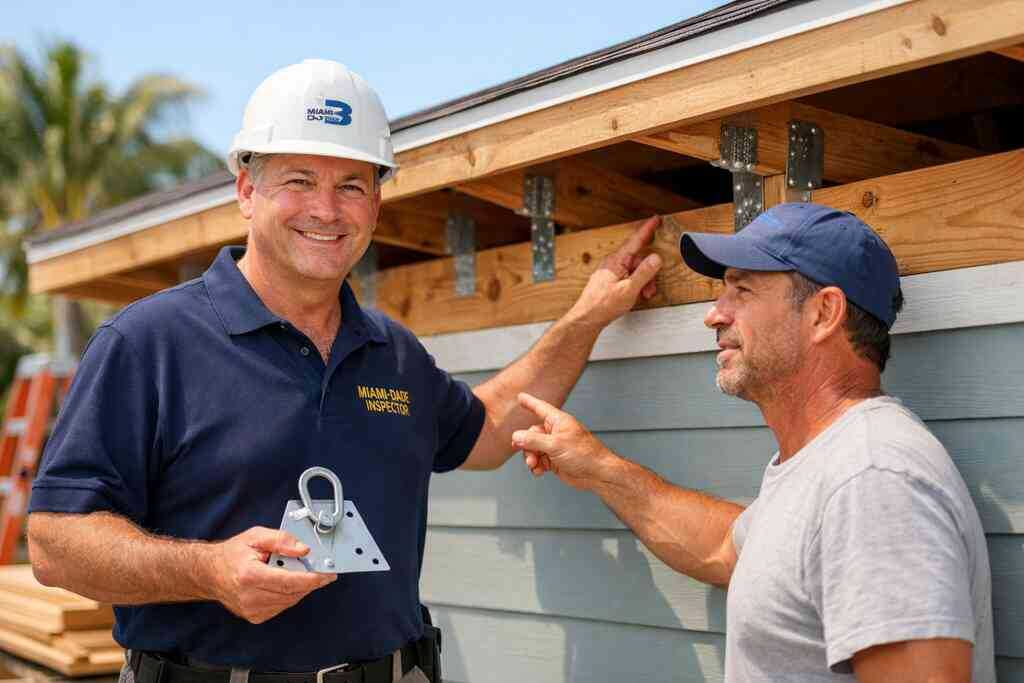
If you are comparing bids, do not just look at totals. Look at the paper trail. A clear quote, signed change orders, and lien waivers create protection you can actually use. That is far better than a cheap price with no accountability.
Why HOA permit rules and condo renovation South Florida approvals can slow exterior work even when the roof itself is straightforward
HOA permit rules can turn a simple roof job into a paperwork maze. Condo renovation South Florida projects add another layer, especially when exterior appearance changes or roof access affects neighboring units. Some associations want product data, contractor insurance, architectural review, and proof of permit before anyone lifts a nail gun. That feels slow. It is still necessary.
If your home sits in a planned community, ask early about South Florida HOA permit requirements. Ask for written approval rules, not verbal guesses. If you live in a condo, confirm board approvals before exterior work begins. The roof may be straightforward, but the approval path may not be. That is common across South Florida.
A good South Florida design build team will anticipate these delays. So will a coastal home builder Florida or waterfront home builder South Florida with real local experience. They know that the longest part of a project is often not the roofing itself. It is the coordination around it.
What smart homeowners ask for before the first nail goes in
How hurricane strap installation, roof anchor hardware, and roof truss tie-downs are evaluated in a real inspection
A real inspection should not stop at a quick glance. It should check hurricane strap installation, roof anchor hardware, and roof truss tie-downs for spacing, condition, and continuity. The inspector should explain what is already there and what still needs reinforcement. If they cannot do that, the inspection is too shallow. You deserve better.
The best contractors discuss the system, not just the parts. They explain how connectors attach to framing members. They explain whether old hardware is corroded or undersized. They explain if the roof truss tie-downs can be upgraded without major demolition. That is the kind of plain language you want.
For a deeper comparison, review hurricane strap installation and roof truss tie-downs with a contractor who actually works in your area. South Florida contractors who know local conditions usually catch details others miss. That difference shows up fast when the wind starts pushing.
Why Florida Building Code roof fastening expectations matter for hurricane code compliance and wind mitigation improvements
Florida Building Code roof fastening rules are not just bureaucratic language. They affect how the roof performs under pressure. They also influence hurricane code compliance and wind mitigation improvements. If you want stronger protection, you need fastening patterns that match the code expectations for your home type and location. Guessing is not a strategy.
A licensed contractor Broward County or licensed contractor Palm Beach County should be able to explain this without jargon. They should say what fastening pattern they will use, what product approvals apply, and how the upgrade helps your roof resist uplift. That is the difference between a real upgrade and a cosmetic patch. It also matters for future insurance conversations.
If you are comparing materials or methods, a good Florida Building Code roof fastening for wind resistance discussion should include the roof deck, not just the finish layer. The fastening schedule is part of the system. You want the whole assembly, not just a prettier surface.
When secondary water barrier details, roof deck nailing pattern, and structural roof reinforcement become part of the same conversation
A secondary water barrier helps keep water out if the outer roof layer gets compromised. That matters in storms. Roof deck nailing pattern affects how well the sheathing stays attached. Structural roof reinforcement helps the frame resist uplift and movement. These are separate terms, but in real work they belong together. If one is ignored, the others lose value.
That is why hurricane code compliance is rarely about one product. It is about the assembly. A weak nailing pattern can undermine upgraded straps. A missing secondary barrier can turn a small breach into serious water damage. The roof deck and the tie-down system need to work together. Otherwise, the upgrade is incomplete.
On recent South Florida jobs, we have seen homeowners focus only on visible roofing products. That misses the structural story. A wind-resistant roof system should include fastening, attachment, and water management. If a quote ignores one of those, ask why.
How a licensed contractor Broward County or licensed contractor Palm Beach County should explain roof uplift protection in plain language
You should not need an engineering degree to understand the proposal. A licensed contractor Broward County or licensed contractor Palm Beach County should tell you where the uplift risk starts and how they plan to stop it. They should explain the roof edge, the connections, and the inspection path. If the explanation sounds rehearsed, keep asking until it makes sense.
Plain language is a trust signal. It means the contractor understands the work deeply enough to teach it. That matters on structural projects. It is also a good sign they will communicate clearly if something changes. Good communication saves time and money.
Ask them to define each term before work starts:
- Roof uplift protection: resistance to wind pulling the roof upward.
- Roof deck nailing pattern: how the sheathing is fastened.
- Secondary water barrier: an added layer against leaks.
- Tie-down: the connector that transfers force into the structure.
Why South Florida contractors often coordinate roofing with hurricane impact window installer South Florida, hurricane shutter contractor, and South Florida concrete contractor teams on larger hardening projects
A roof hardening project often overlaps with other exterior upgrades. South Florida contractors frequently coordinate with a hurricane impact window installer South Florida, a hurricane shutter contractor, and a South Florida concrete contractor when the house needs broader protection. That coordination matters because wind finds the weak link. Fixing only one surface may leave the rest exposed.
If your home is older, the project may expand further. Some homes need a South Florida foundation repair review because movement affects roof alignment. Others are tied to a South Florida home additions plan or even a second story addition South Florida design, which changes load calculations. The bigger the project, the more important coordination becomes. That is not complexity for its own sake. It is responsible planning.
When a roof tie down project starts to overlap with South Florida foundation repair, South Florida home additions, or second story addition South Florida work
If the house has settled, shifted, or been altered, the roof tie-down project may not stand alone. South Florida foundation repair can affect framing alignment. South Florida home additions can change load paths. A second story addition South Florida project definitely changes the structural conversation. You do not want a roof upgrade designed in isolation when the rest of the house is moving.
That is where a South Florida custom home builder, South Florida luxury renovation team, or South Florida design build firm may be useful. They can coordinate structural details across trades. The same applies to a sustainable home builder South Florida or energy efficient remodeler South Florida when the project involves both hardening and performance upgrades. Bigger homes deserve a bigger plan.
If you are at this stage, you do not need to solve everything today. Start with one inspection, one permit review, and one clear scope. Then compare quotes using the same standards. You will see the difference quickly.
Frequently Asked Questions
Question: What is a hurricane roof tie down in Miami-Dade 2026, and how does it help with roof uplift protection?
Answer: A hurricane roof tie-down is part of the structural system that helps connect the roof to the walls so the roof can better resist wind uplift during a storm. In South Florida, that connection matters just as much as the shingles or tiles because wind tries to lift the roof like a lid. The tie-down, roof truss tie-downs, roof anchor hardware, and roof-to-wall connection all work together as one load path. If one link is weak, the whole system is at risk. South Florida Contractors helps homeowners understand this in plain language so they can make smart decisions about hurricane roof tie-downs, South Florida hurricane roof reinforcement, and hurricane code compliance. If you are comparing options, make sure any roofing contractor South Florida you consider is properly licensed and insured, and verify that they understand the local wind exposure in Miami-Dade, Broward County, and Palm Beach County before work begins.
Question: Does my home need a Miami-Dade permit for roofing or a roof replacement permit South Florida if I am upgrading roof truss tie-downs?
Answer: In many cases, yes. If the work involves structural roof reinforcement, significant reroofing, or code-driven upgrades, a roof replacement permit South Florida or a Miami-Dade permit for roofing may be required. The exact permit path can vary by county and scope, which is why the South Florida permit process should be reviewed before any job starts. Skipping permits can create problems later with inspections, insurance, resale, and contractor dispute resolution. South Florida Contractors encourages homeowners to treat permits as protection, not red tape. If you are hiring a licensed contractor Miami-Dade, licensed contractor Broward County, or licensed contractor Palm Beach County, ask how they will handle the permit, inspection sequence, and any required corrections. Always verify licensing, insurance, and, when relevant, contractor bonding requirements before signing anything.
Question: How do I know whether my home needs hurricane strap installation, roof deck nailing pattern upgrades, or a full structural roof reinforcement plan?
Answer: The best starting point is a residential roofing inspection South Florida that looks beyond the surface finish. A roof can appear fine from the street and still have weak fasteners, outdated roof truss tie-downs, or an underbuilt roof-to-wall connection. During an inspection, a good contractor should evaluate hurricane strap installation, roof anchor hardware, roof deck nailing pattern, and whether a secondary water barrier is needed as part of a wind-resistant roof system. South Florida Contractors recommends comparing the inspection findings with your home’s age, location, and exposure, especially if you live near the coast or in an open neighborhood. If the home predates stronger South Florida building codes or Florida Building Code roof fastening expectations, the roof may need more than a cosmetic repair. Before hiring anyone, use how to verify a contractor license in Florida and confirm contractor insurance requirements Florida so you know the person doing the work is qualified to handle structural roof reinforcement safely.
Question: Why should I use South Florida Contractors to find a contractor South Florida for hurricane roof tie-downs and wind mitigation improvements?
Answer: South Florida Contractors is designed to help homeowners find a contractor South Florida who is local, relevant, and easier to compare. That matters because a project involving hurricane roof tie-downs, hurricane code compliance, or roof renovation code compliance should not be assigned to someone based only on a low bid or a flashy website. You want a contractor who understands the South Florida permit process, county-specific review differences, and the realities of coastal wind exposure. Through the South Florida contractor directory, you can compare roofing contractor South Florida options, home remodeling contractor South Florida teams, and even broader professionals such as a coastal home builder Florida, oceanfront home contractor, or South Florida custom home builder when a larger hardening project is involved. South Florida Contractors can help you start the search, but you should still verify licensing, insurance, and experience before hiring any general contractor near me South Florida or specialist contractor.
Question: Can hurricane roof tie-down work be coordinated with impact windows, shutters, or other home hardening projects in South Florida?
Answer: Yes, and in many homes that is the smartest approach. Roof work often connects to broader home hardening for hurricanes, especially if you are also considering a hurricane impact window installer South Florida, a hurricane shutter contractor, or even a South Florida concrete contractor for additional protection. The reason is simple: wind finds the weakest point in the building envelope. Fixing only the roof without considering windows, openings, and structural conditions may leave gaps in protection. On larger projects, South Florida Contractors often sees coordination with a South Florida foundation repair team, South Florida home additions, second story addition South Florida plans, or even a South Florida design build approach when the home needs multiple upgrades at once. If you are planning a broader project, ask each contractor how they will coordinate permits, inspections, and sequencing. And as always, never skip verification of licensing and insurance, especially for exterior or structural work subject to hurricane-code requirements.
Question: What should I ask before hiring for roof uplift protection or a hurricane retrofit for roof in Miami-Dade, Broward County, or Palm Beach County?
Answer: Start with the basics: ask for proof of active license, proof of insurance, recent structural roof references, and a written explanation of the scope. Then ask who is responsible for pulling permits, how they will handle inspection corrections, and whether the project will include tie-downs, fastening upgrades, and any secondary water barrier details. A quality contractor should be able to explain roof uplift protection, roof truss tie-downs, and Florida Building Code roof fastening in plain language without brushing off your questions. You should also ask about lien waiver Florida paperwork, change order contractor Florida procedures, and how disagreements are handled through contractor dispute resolution. For South Florida homeowners, those details are part of getting the job done right. Whether you are in Miami-Dade, Broward, or Palm Beach County, the right contractor should welcome scrutiny, not avoid it. South Florida Contractors recommends using its directory as a first step, then confirming qualifications before you hire anyone for storm damage roof repair, wind mitigation improvements, or any hurricane retrofit for roof.